Wednesday, October 19, 2011

Red bus lemon cupcake rose door white cats


on London bridge


a hand with coffee


in Saffron Walden


Blue (and his brother Zig)

~

A mighty fine trip to the UK.  While carrying the camera everywhere, I was often too busy enjoying myself to use it, and there were few paparazzi moments, but I'll post more over the next few days. 

I have new glasses, including reading glasses, which I've not had before.  I was taken to see War Horse without being told where I was going, met up with Tunbridge Wells' finest, and went to choral evensong at King's College Chapel,(yes I know I said I don't do congregations but this is a bit different) and more besides.  As I say, spoiled rotten.  

Tuesday, October 11, 2011

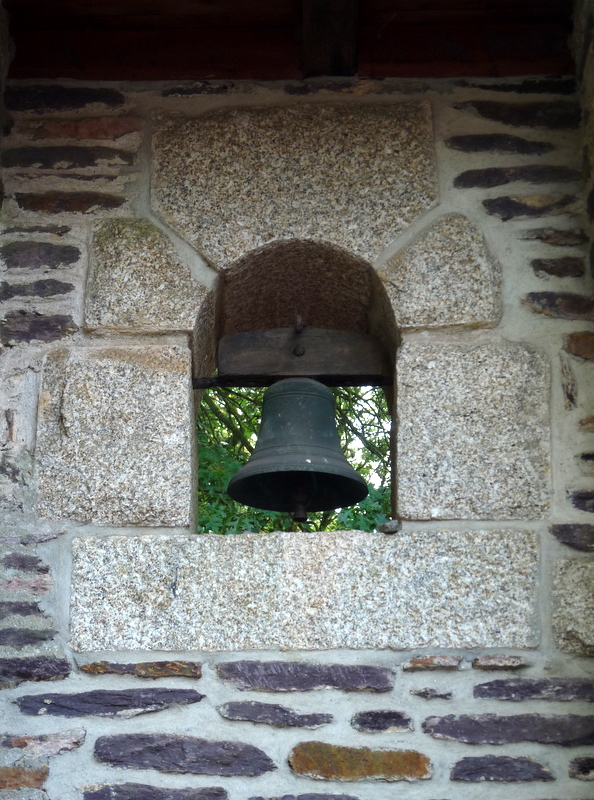
Cloisters and gift shops, and living with ambivalence.

Well, I probably shouldn't have thrown in the glib remark about atheists and believers, it's the kind of thing I regret and want to take back immediately I've said it, the kind of thing that that can lead to a widening gyre of pointless qualification and rebuttal which is everything I want nothing to do with, and as if it matters. It compromises the ambivalent tension and wonderment of my agnosticism, long held carefully in healthy and creative balance, as I see it anyway, which probably sounds intolerably pompous.  

Can you draw out leviathan with a hook? or his tongue with a cord which you let down?

There are so many I care about and respect of so many persuasions, none of whom I wish to see on any kind of defensive.  I have been so blessed and enriched in so many ways, and there are so many ways to be blessed and enriched.  Trouble is, so many people are convinced there's only one way: their own.

Howsoever, I do spend quite a bit of our time exploring religious places.  Not so many churches,  not here anyway.  English churches I still miss quite viscerally, but only when they were empty; the Tory party at prayer (still too true, in many areas) and congregations in general, always repelled more than they ever attracted. This is, of course, one of my many major stumbling blocks with exoteric religions that demand commitment to fellowship, community, gregarious people-personship and general galloping-about-doing-good, I'm well aware.  Yet, though I was unbaptised in infancy, unchurched for all my upbringing and loudly and intolerantly rejecting of the small-town, socially preoccupied, unsearching Anglicanism of my schooling in adolescence,  aesthetically, culturally and psychologically, the English mediaeval, swept out and trimmed, as well as vandalised, by the Reformation, emblazoned and overlaid and generally fannied up by the Victorians, and lovingly turned into heritage in our own time, is still a kind of home to me.

In contrast I find a lot churches here just plain grim, either decaying or overblown or both, their iconography alien and grotesque.  I know there are a couple of dozen posts here tagged with the label churches, and going deep into the folk religion hinterland fascinates me, and then there was Chartres:

But one tower was great, was it not? O Angel, it was -
even beside you.  Chartres was great 

(Rilke, Duino 7) 

But the long history of anti-clericism and separation of church and state, which by and large I support wholeheartedly in principle, has led to an uneasy and resentful unwillingness on both sides to cherish ecclesiastical buildings and art as heritage outside of their religious and political role, and also produced a series of grandiose church buildings from various times in history, from the Counter-Reformation to the 19th century and even later, which sought to reassert the church's power and win back the faithful, filled with overwrought and mawkish imagery to try to whip up their emotions, and which overreached themselves in the attempt, becoming under-used, ill-maintained and tawdry. 

One such we found was the Abbaye de Paimpont  


which is apparently esteemed by some but not by us.  Paimpont might claim to be rather Brittany's Glastonbury, with its odd mix of New Age Arthurian and Catholic revivalist pilgrims, but Glastonbury it ain't.  We stopped for an ice cream and moved on.

Our main focus on this trip, a Saturday afternoon drive into the interior, all the way over the border into Morbihan, was the Abbaye La Joie Notre Dame, a Cistercian convent where they make good chocolate. Religious communities do interest us, always have.  We had our wedding bash at Emmaus House in Bristol, the sisters there were friends of ours at the time, and when we lived in Devon we lived near Buckfast Abbey, I did quite a lot of supply teaching at the Catholic primary school there (no problem for me or the management), and we used to buy honey and other things from the shop, though not the infamous Buckfast Tonic Wine, the bane of the homeless alcoholic community in Glasgow, it seems, which has always puzzled me.  In Gloucestershire we enjoyed the bird gardens and hankered for the china they sold at Prinknash, where Tom's much loved friend and counsellor, a C of E ordained priest, lived in an adjacent bungalow. 

(Can I just say at this point, that for all this and anything else I've said, I fairly much loathe the Catholic church and everything it stands for.  I live, as I say, with ambivalence...)

La Joie was recommended to us by a very sweet lady dressed in a cotton shirt and glass beads of heavenly, belle verriere, blue, who made friends with us outside the Abbey of Timadeuc, some miles to the west, on another such trip.  Timadeuc is a Cistercian monastery, architecturally austere, where they make very excellent cheese and fruit jellies, which was recommended by our dear old friend and stonemason Jean-Paul, who on the cusp of retirement has fallen in love with a large lady who has clearly done him a power of good.  She is a magnetiseuse and guerisseuse, essentially a faith healer.  She has cured him, he said, of all the ills that a life in stonemasonry and self-employment had left him with.  When he said this, Tom posited that that may have been love that did that, and JP assented, that too.  At weekends they too make jaunts into the interior, and she likes to visit Timadeuc to buy essential oils and cds of spiritual music.  

You may see a theme emerging, along with friendship, the happy co-existence of the religious and monastic life with marketing and consumerism.  It was ever thus, I think.  Tom's son, who was for a while a very enthusiastic RC convert, said that Buckfast abbey in particular was known in those circles as Fast Buck Abbey.  There now exists a special, Europe-wide 'Monastic' label for their products, which range from incense and essential oils and toiletries through every kind of comestible, cheese, wine, sweets, grains (hence the muesli), cakes, olive oil.  They are of uniformly high quality, a little expensive, but I gain some satisfaction from the feeling, hopefully not entirely romantic and spurious, that I am buying a little outside of the system, and from people whose philosophy is to be, as far as possible connected with every stage of the means of production.  Also, less worthily, coming from a culture where part of the point of any day out was to enjoy the gift shop and the tea rooms, I tend to find large tracts of France rather lacking in such facilities.  This lack of commercialism is in some ways admirable, but I'm afraid it often leaves me with a sense that something is missing.  The monastic gift shops are rather nice places to visit, even if much of their stock is actually olive wood rosaries and books about Catholic luminaries,and other things I don't want.  Timadeuc's is especially beautiful, with polished wood rafters and lovely light, and the sisters and brothers who staff them seem to enjoy having the dispensation to chat with the customers.  In addition to the muesli and some chocolate and fruit jellies at La Joie, I also found some very pretty hand-knitted items, and bought a Breton-style stripy jumper for our friends' new grandson and a wonderfully soft aubergine-coloured scarf for I know-not-who.  I think they were being made and sold in aid of a new sister foundation in Madagascar, so let's hope they won't be displacing too many lemurs.
  
And by contrast with the decaying Baroque monstrosities of the older churches, there is clean, well-kept simplicity about the place.


The church was built in the 1950s, I think, by the monks of Timadeuc.


The presence everywhere of white symbolises the joy of the name ( I was amused and pleased to find white as the colour of joy confirmed by Rabelais!).


The gardens are very peaceful and lovely, with many fine trees, and pools of deep shade and bright light, including a splendid avenue of tall American oaks at the entrance.


You can't actually get to see very much of the overall site, which is extensive and includes a farm and a lake; it is after all a place of silence, work and withdrawal, and their commercialism and open welcome is within bounds.  But what you can see is worth seeing.


~

I'm hurrying to get this done before my sister arrives bearing curtains, and then I go back with her for a few days to the UK, where all sorts of treats are planned, so garden photos from the sunny days will probably have to wait.  I'll try to get some links into this for some of the places I've mentioned later, but now I must get on and tidy the house a bit!

Friday, October 07, 2011

More applish things for breakfast, and stranger fruit.


Oh, I am so healthy.  I don't really live on toast and marmalade and wine and garlic butter and potato gnocchi and boiled sweets (soft centred ones), I sometimes eat this puffed spelt muesli from the Abbaye La Joie Notre Dame

(I may post more on the role in my life of religious communities as retail experience at another time, except by doing so I would quite possibly lose the respect of both people of established faith and convinced atheists - excuse me is there a difference? Except I often find the former more gentle and tolerant than the latter, only of course I live in Europe... enough, parenthetically, enough.)*

With this rare-varietal, cereal-based food, which also contains coconut and is reassuringly un-crunchy, I mix diverse things, such as chopped prunes, Medjoul dates, apricots or bananas, I'm nothing if not fusion - or perhaps that should be ecumenical - in my tastes.  On this occasion I added more gift apples, this time sweet eaters from B the German Doctor (espoused to the Quiet American), with a little light muscavodo, some soya cream and, a last minute notion, a pinch of cinnamon. And very good it was too, in the blue green hand-thrown bowl which is one of my favourites.

With, of course milky coffee (Fair Trade Guatemalan at the moment, or is it Haitian?), and supplements: lots of B complex, probably so much that most of it passes through me without touching the sides, zinc, and most important of all, magnesium, which I swear by. and which also is to be found in spelt.

TMI, no doubt.  So what did you have for breakfast?  (Thereby confirming this blog's place in the division one banality stakes.)
~


These physalis fruit, I feel, deserve to be portrayed because they are things of quite spiritual beauty too.  Discovered and purchased on a trip to Lamballe market, along with a bunch of earthy but not woody radishes, some gorgeously corrugated big tomatoes, a small aubergine with a long stem still attached, some dried butter beans which here rejoice in the name haricots de Soissons ( though that was the council that condemned poor Peter Abelard and his book, I still think it sounds better than butter beans...) and are quite hard to find, and a net of pink Roscoff onions.  The physalis were grown by a lady selling organic stuff and she grew them herself in a polytunnel, which she said was the only way to ensure a long enough growing season.  Tom was quite surprised one could eat them at all, as he assumed I had bought them purely for their beauty, which I might have done, if they didn't taste so very good too, and if the act of unwrapping them from their papery raiments and popping them in one's mouth wasn't so exquisite.

~

Well, that's a pot boiler of a post for the weekend, since though I have sorted through, shrunk and exported (oh hear me, you Trojans, your Blogger allowance will burn up before your eyes if you do not heed my words and shrink and export your photos... I have seen it!) the pictures I have just downloaded from the astonishing Indian summer we have just experienced, I ran out of steam and time to do any more with them just yet, so this will have to do for the moment.  

And so to bed.  Have a good weekend.

~  

* In fact the abbey is a beautiful, graceful and warm place, which I'd recommend anyone to look in on, except very convinced atheists, I suppose.

Monday, October 03, 2011

Fruits of memory


quelle est la force qui fait qu'elles soient rondes
ces pommes si bien en main     rien ne déborde
mais rarement il advient qu'on les cueille
impeccables dans les airs avent leur chute

( Heather Dohollau, from Le Dit de Couleurs )

'Here are your apples,' said Heather 'don't forget them.  T. picked them specially, they're not windfalls.'

They come from a tree which arches over her delightful walled garden, which isn't far from the centre of the town but where the loudest sounds are often those of seagulls in the distance from near the port or the bell of the sombre neo-classical church up the road or the occasional flutter of the collared doves in the apple tree itself.

T, her son, whisked in shortly after, and, when I thanked him, gave a quick gruff chuckle and his little-boat smile.


I've been eyeing up the apples for a little while, as to me they looked like they might be Bramleys,  Bramley cooking apples are one of the things you just don't see here, but which were a seasonal commonplace of life in Britain.  We had a tree in the garden of the house where I grew up.  It was the apple tree, tucked away at the end of the garden beyond the caravan and the bonfire, on a raised piece of ground supported by chunks of flint and Hertfordshire puddingstone, in between which there were red ants nests - we knew every one. It was next to the raspberry canes and the compost heap and just before the ageing, snaking low brick wall which gave onto East's woodyard beyond.

The tree was in fact three stems, a kind of 'w' shape, just about possible to climb when I was small, and low-hanging so that it was easy to scrape one's scalp on it carelessly, or be swiped at by our ginger cat who became a merciless jaguar when overhead on a branch.  In the spring it was thick with blossom, fragrant and  always surprising.  When my sister Az was in her teens and I was a young child she often used to draw it, and for a long time I had a small Scraperboard picture she made of a blossoming twig, but sadly I have it no longer, lost along the way.

Yet the tree was something of a disappointment to me when I was small.  Raised on story books and readers containing romantic tropes of swings hung from the boughs of apple trees, and longing to be able to pluck a sweet and rosy fruit from our own tree and bite into it, the shape and low stature of the tree were unsatisfactory, and the huge, lumpy, light green Bramleys were all wrong: 'You can't eat them raw, they're cookers!'


And being an unsophisticated, sweet-toothed, spoiled brat, born post-rationing and used to fruit sweets and milk chocolate and orange squash (though I could eat the fresh raspberries till the cows came home), the apple pies and crumbles my mother made them into were not interesting either, and seemed sour; she probably didn't quite dare use the amount of sugar required really to make them palatable to us younger ones, so we doubtless got chocolate cake instead.

As I grew older though, and began to mess about in the kitchen (to call it 'learning to cook' would be to exaggerate my efforts at the time), I did enjoy making  my own crumbles, using brown sugar and sultanas and perhaps some spices, and on warm late summer Sundays one year, I had a craze for making apple snow: whipped egg whites folded into sweetened apple purée, for which, with their even, white, rather dry flesh which softens and fluffs up on cooking, Bramleys are excellent.  It was light and refreshing and genuinely quite a sophisticated dish. I can't have made it for well over thirty years now.

The bold green satin skin of the fruit among the leaves I came to see as beautiful too. I remember hearing or reading about a restored steam locomotive which was repainted in 'its traditional, apple green livery'; and the phrase made my mouth water and pucker at once.

So I grew to appreciate the necessity and goodness of cooking apples.  Here though, there seem to be only eaters for sale or giving away (unless you count commercial Granny Smiths, which are supposed to be dual purpose, though to my mind neither fish nor fowl, so to speak, and not good for much), and out here in the countryside of course there are the various mongrel and wilding cider apples going begging in the hedgerows, small and hard and thick-skinned and full of tannins, though useful to add a bit of bite and pectin to jams and jellies and other preserves.  The tree in Heather's garden seemed to offer the first real cooking apples I'd seen since leaving England.  She is not certain that they aren't really Granny Smiths, and I haven't quite convinced myself that they are truly Bramleys, the colour and texture isn't quite right, but if they are they are Grannies then they are bigger and lumpier and of a far more interesting, tough and astringent flavour and texture than any you find in the shops.  I have just cooked a panful into purée, and they certainly soften and fluff into the very pale green-gold softness that I remember.

Perhaps it is time to rediscover apple snow.


Sunday, September 25, 2011

In which we continue our love affair with things aeronautical

Tom's birthday often coincides with the weekend of the Journées du Patrimoine, (Heritage Days) a state sponsored initiative whereby paying museums and other sites of interest open their doors for free, and other places not normally open to the public make themselves so.  This was quite clever of him, though not as clever as my youngest niece who emigrated to New Zealand in her childhood to find that her birthday coincided with Waitangi Day, so that for ever after she could be assured of a public holiday for it.

But we've had some good days out gratis in September, and if we are at Kerbiriou, as we have been for the last couple of years, Yvette and Paul always have a local paper with a list and articles about what's available on the days to look at over breakfast.  Last year we sampled Morlaix museum and gallery which had a contemporary art expo on at the time, but I'm afraid the most memorable thing about the occasion was that I became rather impatient to leave and tried to do so by an emergency exit which set all the alarms ringing and a man had to come running to stop them and tell me off.  We also went to a mediaeval festival at a château nearby, which was quite good.

This year though, the day dawned chilly and grey, and we didn't really fancy gardens or a reprise of the museum, but looking through the options in Ouest France for the area, I saw the naval air base at Landivisiau was open, with a selection of aircraft from the vintage to the latest jet fighters.

Now despite the fact that if Tom is asked, as he was by Barrett Bonden not long ago, about his time in the Air Force, he is likely to give a terse and unenthusiastic reply to the effect that it was mostly a story of  years of frustration and boredom, it doesn't take much for his eyes and enthusiasm to kindle at the very thought of military aircraft, and for myself, since my adolescent dalliance with Biggles, I have always had a penchant for any kind of flying machine.

So the birthday outing was decided.


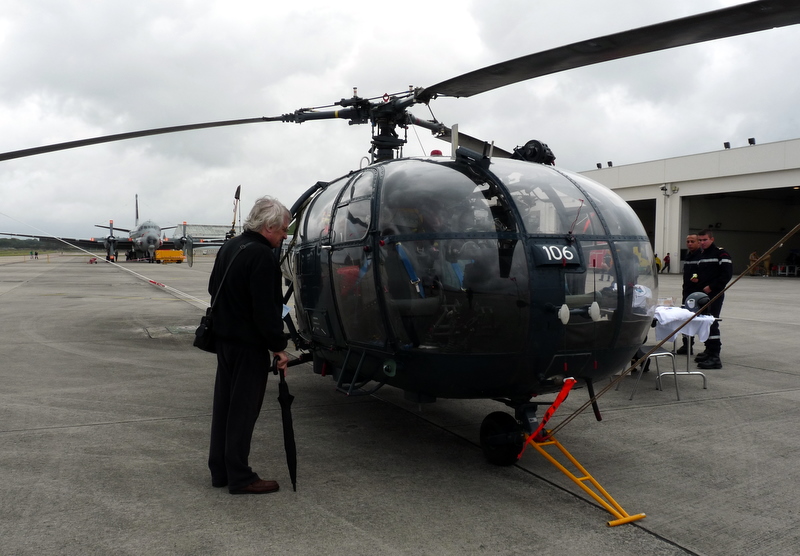
There were plenty of different flying things to look at,


of all shapes and sizes.


There were glossy smooth surfaces,


and  rougher, more weather-beaten ones.

And there was a real live Rafale, the French answer to the Eurofighter, which really floated Tom's boat (or lifted his ailerons, or whatever), with a real live Rafale pilot, who looked like he might have just completed his final adolescent growth spurt, and who was very happy to enumerate, in delightfully careful English ('I have trained in the USA') the reasons his aeroplane whupped the ass of the Eurofighter in every possible way.

Tom was certainly fairly well sold.  The other day I heard strange heavy metal sounds coming from the computer accompanied by gasps and exclamations.  When asked he replied 'I'm watching a video of the Rafale taking off!'


For me, though, that these spiky-looking weapons platforms all bristling with their unfathomable killer technology don't do a great deal for me aesthetically (and I'm not up for arguing any moral points about modern warfare here); the only thing that really caught my eye was this screen in the front of the cockpit, with its dragon-fly iridescence.

So which was your favourite Thunderbird?  Mine was, of course, Thunderbird 2, all lumbering and gentle and capacious,  motherly, you might say. 


 Indeed, rather like this lovely beast, a Breguet Atlantic 2, (except sadly, unlike Thunderbird 2, it wasn't green). 


I liked this plane so much, and took pictures of all sorts of bits of  it from all sorts of angles,


including its innards,


We happily queued for quite a long time to see inside it, it is enormous and full of screens and knobs and buttons and seats and bunks and nooks and crannies (but I couldn't photograph anything inside), it needs a crew of at least 13, and it seems to me a wondrous and complex organism. 


I also liked its charming and dashing flight engineer, who showed us the outside.  Looking up into its workings, I asked him if he or anyone understood all of it, or did everyone who worked on it just know a part, and he looked dreamy and approving and said he felt he was just beginning to, that he had worked with this and only this plane for twenty years and he was still learning.

In fact the whole occasion was notable as much for the conviviality and charm of the people we met, from the pilots and engineers to the rangy and very young aviatrix from the local flying club who showed us the little WW2 era wood and canvas monoplane with a dashboard like a Morris Minor, to the naval officers who were clowning for the groups of kids, wrapped up against the cold and stoically eating their picnics, whom we sat with for our lunch - buns and hot chocolate in one of the hangars.

A remarkably enjoyable day out.  


Wednesday, September 21, 2011

Small numbers of things around the Bay of Morlaix


One drop of water in a field of cabbages.


Two new apples in the garden at Kerbiriou,


and two old boats at le Dourduff.


Three mushrooms (and I don't know how many islands).


Four by four by four.

Tuesday, September 20, 2011

Mollydays


You are not leaving me behind, says Mol, I am posting myself on the luggage, on my own car bed.

In fact most of our luggage pertains to her.  As well as her car bed there is her proper bed, with pillow.  The violet coloured fleecy blanket on top of our (single, small) suitcase is the one which we have to have to spread on our bed so she can come up and join us when we have tea in the morning (don't tell the B&B and gîte owners where we stay, at least we try to save their beds from dog hair).  As well as this there is her food, bottles of water to go in the car, her bowls to eat and drink out of, her brush, her towels in case she gets wet, her ear and eye drops, pain killers in case she twists or sprains anything or gets ear-ache, her healthy treats and the carrots she has bits of when we have our early evening  drink. Have I left anything out? Oh yes, car lead and two extending leads. 


Anyway, she certainly enjoys it when we get there.  You can tell because she does this a lot: what we call Doing a Mad Dog, which involves rolling around on her back waving her legs about and making very fearsome and gruesome noises.  We respond by saying 'Have we got a Mad Dog? Mad Dog, Mad Dog!'


Sometimes she then gets a bit embarrassed and rights herself, especially if she thinks she might be being photographed.

Other times she doesn't and the performance moves on to a new phase.  But I think I've said enough.

She makes us make ourselves ridiculous, we know.

More on the trip anon.

Wednesday, September 14, 2011

Flight 4: littoral

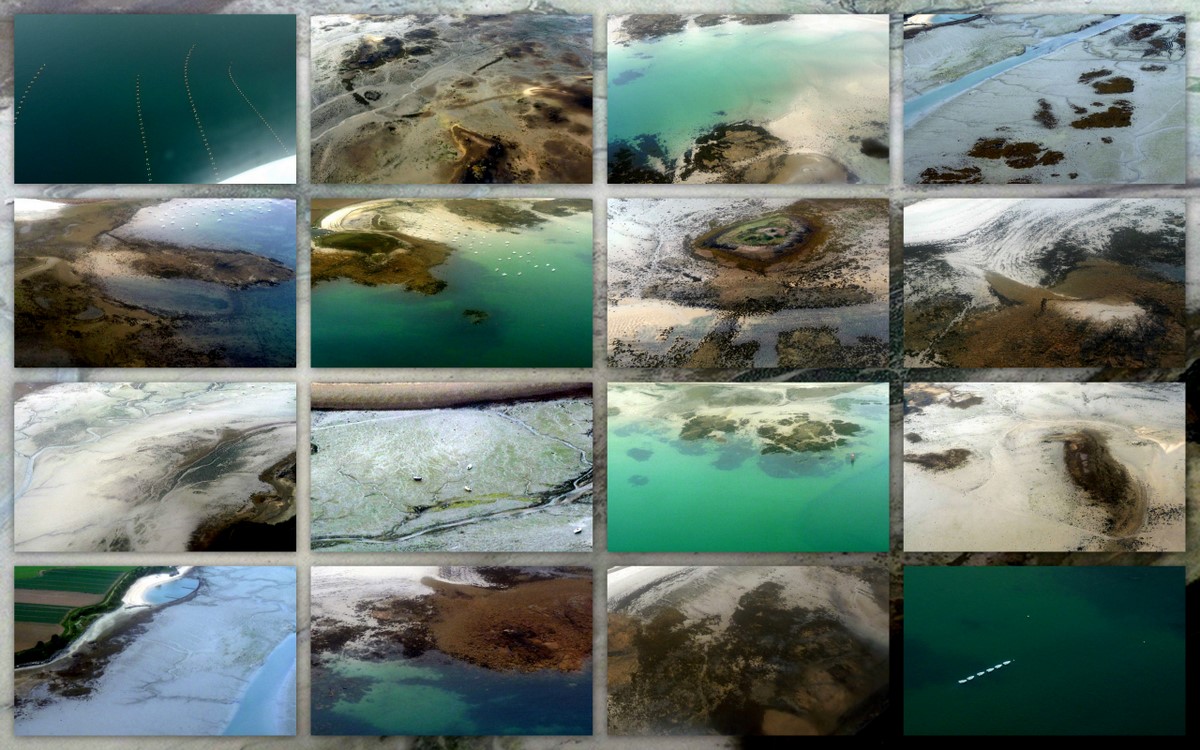
And finally, more shoreline shapes.


~

So that's about it, I hope I've done it justice.  I wanted to get it finished before our September trip to Kerbiriou for Tom's birthday, on which we are off tomorrow.  I'm such a spoiled brat.

The full collection of photos from the plane trip is on Picasa web albums here.  

Thanks again to BB and Mrs BB, and to everyone for such an enthusiastic response.

Back in a few days. 

Flight 3: plotted and pieced

As promised, more pictures patchworked.