Showing posts with label looking back. Show all posts

Thursday, November 24, 2016

Throwback Thursday - Loot and Pip


That's my brother and I,


just to show I wasn't always scowling. This is a studio photograph taken by my Uncle Jack, the family photographer, and I would guess that the 69 in the serial number he has given it refers to 1969, when I would have been in my eighth year, and Pip, my brother Philip, now usually just Phil, would have been about ten. He wasn't called Pip much after a very young age, except by my dad, it embarrassed him. Once Mrs Grange, a large, jolly, generous and cultivated friend of our family, saw Phil on Berkhamsted High Street with a couple of his mates when he was about seventeen and called out 'Hello Pippy!', much to his shame and chagrin, of course. Mrs Grange had wanted to be my godmother when I was born, but my mother in a fit of integrity for which I never quite forgave her, said no, I was not going to be christened, she didn't believe in it any more and wasn't going to go through the motions. Mrs Grange delighted me when I was sixteen by seating me on her chaise longue and offering me a cigarette in front of my parents. It would have been worth being hailed in the street as Looty to have been on the receiving end of Mrs Grange's indulgence and patronage, but it was not to be.

There are a whole series of these photos of us and our parents (one of which is in the post about my mum a couple of years ago), for which we were all obviously scrubbed and brushed and dressed in our best (that dress was finely patterned velveteen in rich blues, greens and purples, still my favourite colours, though I was disinclined towards pretty dresses by then), with a range of expressions from the serious to the hilarious. They are really very nice photos; I often think that Jack was a rather bad photographer of people because his heart wasn't in it, but these are mostly warm and attractive. I don't know what he was saying or doing to amuse us, typically Phil has given way to pure mirth first, but my smile is genuine, if a bit vague. In the next one I am open-mouthed with laughter too.

Mum once said to me when I was in a particularly lugubrious and miserable phase, probably a bit older than I am in this photo: 'You know you can be a depressing person. Philip can drive you mad sometimes but at least he's not depressing'. I know this sounds harsh, I probably was driving her to distraction and I'm really not fishing for sympathy about it! Nevertheless, despite this and the frowning photographs, my abiding memory of childhood, at least where my interactions with Philip were concerned, were largely of this pure merriment that you can see in his face here. Laughter was one of his principal driving forces, along with learning and cleverness; he ruled our television watching like a dictator, (I was scarcely allowed to know of the existence of ITV, only BBC passed muster) but more even than the geeky (the word didn't exist then), improving tenor of Blue Peter and Tomorrow's World, it was the funny stuff that had him yelling up the stairs or down the garden ' Loot! Tom and Jerry/Dad's Army/ Morecambe and Wise...' or whatever. He would get so excited watching something he found particularly uproarious that he would bounce up and down, higher and higher, in his seat, and my dad would say with exasperation 'Pip, can you not do that to the furniture!'

We went through the motions of scrapping, big brother, little sister; physical fights when we were small, in which in fact he was as inhibited as a well brought up puppy, I was rarely hurt and indeed rather relished it if I could claim to be, since as smaller, younger and female I would inevitably get sympathy from everyone else in the family and he would get told off. I never felt unsafe. My sister still laughs and does an imitation of a six-year-old Philip protesting 'Favouwitithm!' when she hauled us apart. (Her other favourite quote from him at this age was when she brought some particularly gifted older design students home from college and they found themselves interviewed by him with intense scrutiny. After they had left he remarked to her 'I didn't know you had such intelligent friends!'). I also remember a time when we were perhaps in our teens, on a caravan holiday, when we decided to have an insult joust; we sat face to face and came up with the most imaginative names we could for each other. I finally called him an amoeba, and he graciously conceded the match to me. And another holiday moment, when we were very little, a warm summer evening when we were out and about, and he said 'Loot, I wish you weren't my sister.' 'Why?' 'Because you're nice.'

Despite my dolorous and tragedy-queen moments, when I was in disgrace with fortune and my classmates' eyes, which led to my mother's comment about our respective characters, I think in many ways I found childhood and school easier than he did. His particular cleverness, his unmoderated excitement which caused him to bounce on the furniture when Jerry got Tom caught in the mousehole and which still distinguishes his speech and manner now, his curly hair, all made him different in a time when I think perhaps it was harder to be different than it is now. But he didn't whinge, he found things to make him laugh, he got cleverer, he went to Cambridge and he married Angela, a mathematician at least as clever as he is. They live, as far as I can tell, happily ever after.

We see each other only now and then, but I think we hold each other in real affection. When I'm around him, I try a bit too hard to be clever and funny.


Thursday, November 17, 2016

Throwback Thursday - Chapman's Dam


When I was four, in 1966, I went with my parents to stay with my Auntie Joan's family in Pennsylvania. We went there again when I was thirteen, the second time my nearest brother came too, but this first time, my being just a foal at foot and not yet at school, it was just me. I had a lovely time; I was considered cute and a honey, made much of by everyone from the pilot of the Aer Lingus plane that took us there who sat me on his knee in the cockpit (that was possible then), to New York hotel maids and men working on the streets to my teenage American cousins and their buddies. 

The picture was taken at a place we called Chapman's Dam. I just googled it and in fact it's actually Chapman Dam, and is still there, of course. I remember it as a sunny place with little beaches and barbecue and picnic tables. I appear to be being fed marshmallows, probably by my cousin Honey, who was really called Marjy after my mum. I don't know who the little girl behind me was, I vaguely remember another child I was friendly with.


Joan was my mother's only sister, she had gone to live in America at the end of the Second World War, because she was a GI bride. Uncle Lloyd, her husband, who for some reason we often knew as Uncle Kit, had been stationed in Northamptonshire where the Cutmores (my mum's family) then lived, he also went to France, maybe for the Normandy landings, I should probably know more about where, when and how as one of my American cousins has been researching it and even made it over here very briefly in the last year or so but I didn't get to see him, but I forget the details. I think Lloyd finished up in Brest so he must have been through Brittany, and thus the cross-hatching of historical coincidence shows itself again there in a small way.

This was the first time the two sisters had seen each other in that time, twenty years almost exactly. It was certainly an exciting thing for them. As always there was, well, history: little bits of grit of bitterness, rivalry, jealousy, diverging accounts of How Things Happened, hurt and soreness around my Gran, their mother, and how she saw and treated each of them. It was wartime and a hard time for all of them, and everyone too sad and reproachful to easily see the other's point of view.  Yet the two sisters supported each other too, made clothes and food and were company for each other and their children, they named their daughters after each other. Joan was altogether a sweeter, easier person than my mum, less sharp (in both senses), more rounded at the corners; once when we talked about her, after the second visit, Mum said she saw her besetting sin as a kind of laziness. She didn't mean idleness, Joan was hardworking, creative, resourceful, handy and outgoing, as Mum would have been the first to acknowledge, but I think she saw in her a kind of complacency, a deeper rooted shiftlessness which didn't try to analyse or criticise or change things much. More kindly it might be seen as acceptance, patience, a sanguine temperament. But Mum not being like that herself, didn't see it like that. 

I loved being in America, both times. My impression of life there was of abundance, though Joan and Lloyd were always quite poor, I think, financially and lived rather hand to mouth. Yet there was a pile of toys for me when I got there, looked out from the attic or donated by friends of the family, which were wonderfully different from anything I'd seen at home, someone bought me some guppies which swam around in a glass vase on the windowsill much to my fascination, there were chickens and dogs, and somewhere else, some friends' farm I think, maybe the family which my eldest cousin finally married into, where there were piles of young puppies and kittens I was allowed to stroke, and an old blind man who asked to be allowed to touch my face to see me with his hands, which I also liked. There was open house at weekends (I think that was more the second time) with huge amounts of food cooked and served, most of it home grown, and when my mum queried whether it was quite reasonable that so many people should descend on the place expecting to be fed, Joan was quite affronted. 

They visited us a couple of times afterwards, including to come for Az's wedding when I was fifteen. Joan died about ten years ago. We had kept in touch on and off; I rang her when my Mum died, perhaps ten years before, and she told me I was a brave girl to make that call. 


Monday, November 14, 2016

A memory meme


In the face of the persistent despair of the world we are labouring with, it's no bad thing to find somewhere else to go; in a post called 'Bolt Holes', Robbie has done just that, and conjured up seven warm, bright, sharply observed and remembered scenes, like seven toning but unique beads on a string, well-lived moments, reasons to be cheerful, grateful, evidence of the dearness of people, books, music, loved long or briefly encountered, and the potential sweetness of life, and most of all, of a wonderful and well appreciated marriage. Treasurable stuff.

It seems to me this ought to be a meme, remember those? That it would be a helpful and heartening thing for others to pick up and think on, and share their own similar recollections.

Yet when I set myself to try to do it, it was difficult. Because, as I've noted before, I am not good at remembering the good. I don't know why this should be, I have, and indeed have had, so much so good in my life; I experience intense, blessed moments every day, even on bad days, which I am always aware of and glad of at the time, yet memories so often end up qualified, coloured, clouded by hindsight and doubt, to be set in a 'yes, but...' context, with an inner, destructive critical voice telling me they weren't really good times at all, I was kidding myself. Arguments about the evils or otherwise of nostalgia seem irrelevant or ironic, I often wish I could connect more positively and rosily with the past. When I want somewhere to bolt, it tends to be into the future, if anywhere, albeit in ways that are either trivial or fantasy, like thinking up knitting projects or dreaming of a small, bright, problem-free home by the river, or into fiction.

Or else the good memories are simply fugitive; I find it hard to connect, to recognise myself as the person years ago who had those experiences. And the continuing moments of joy, satisfaction and gratitude I know I have, which I often dearly wish I could retain in my mind, fly forgotten as a dream. Perhaps that's just the nature of those moments. It's one reason why blogging has been helpful, writing things down solidifies them, helps one remember, or if not, the written record is there for the reading.

All of which is a good reason, along with lighting a candle as darkness presses in from the wider world, to try to find and hold the good moments that have happened, to see them again and cherish them. Life is too precious, too uncertain to dismiss it so wantonly. Here goes:


~ I am sitting cross-legged in the sun on the dark brown, shiny parquet floor in of my glass-walled Hertfordshire Modern primary school, and it occurs to me with surprise and satisfaction, that I am me and everyone else is everyone else. I suppose I am about five.

~ We stop on the way back from Wales, I think, to climb the Malvern hills; I have never known such a thing as the view from their slopes. Perhaps ten years later, when I am nineteen, I climb them regularly, and with surprising ease, on a heavy bike without gears, and the view still thrills me. It doubtless still would now.

~ I have arrived in Paris by coach in the very early morning, late spring, to catch a train to visit my old friend who is doing her student year abroad in Blois. I hitch up with an awkward and shy, plump and bespectacled boy of my own age, who has come on his own for a weekend in Paris. His lodgings aren't open yet, and my train leaves from the other side of town much later, and we walk the breadth of Paris, over Montmartre and across the river, take coffee in a café as the city is coming to life, then go our ways. I know little about the city, have no preconceptions, there is no romance or even potential friendship between the boy and me, just passing companionship, and young legs.

~ I am lying on the warm hearthrug in a bed and breakfast on the island of Iona, dozing after an overnight journey by bus and boat, with eider ducks bobbing on the sea outside the windows. Later I sit for hours in the evening on a low seat in a side chapel of the Abbey, a space bright and warm with textiles and candles, engaged in something - meditation, prayer, talking to my (higher?) self - which is profoundly calm, effortless and real to me. It is a purposely solitary trip I have made here,  but love is waiting behind.

~ We, Tom and I, are driving through the Loire Valley to the Perigord, we are just married. We stop in Montreuil-Bellay. The shower in the hotel (not a very friendly place) is a blue plastic tube, but very pleasant, and later we walk down to the river, where I eat a salad of duck gizzards and we drink Loire rosé for the first time. 'Strawberries!' I exclaim at the first mouthful with unsophisticated delight.

~ Molly, six weeks old, comes wriggling towards us across the tiled floor, piddling as she goes. 'She's heavenly,'  says Tom, with certainty.

~ Emily, his granddaughter, at a pretty fourteen, has an oyster from Tom's plate. 'Keep going' he tells her as she hesitates. She swallows it and grins. 'I like them!' A smart middle-aged French couple at the next table beam at her approvingly. 'Her first?' they ask.

~ The Rijksmuseum tires us rather easily, but at Jessie's and Jantien's flat a couple of blocks away, there is wine and lentil curry and eager conversation, and they walk us back across to the Concertgebouw, where the massed double basses promise, and deliver, a riproaring Schostakovitch symphony.

~


So, it wasn't so hard at all, and there's even one more for good measure. When it came to it, I could think of many more, from many phases of my life, but these are the ones I chose. Try it yourselves.


Thursday, November 10, 2016

Throwback Thursday - Black jeans and Ginger


This photo is unusual in that it has a date written on the back, in my mother's handwriting, 'August Bank holiday, 1967.  It shows my brother and me - I am in the foreground - with three kittens. It was taken on holiday in Hastings, Sussex, on a farm where we were staying in our caravan.


The odd thing about this - apart from that Mum chose to date it, which was almost unheard of with our family photos, so that puzzling out the wheres, whens an sometimes even the whos of them is an endless source of frustration - is that I was fairly certain until now that we got our ginger cat, for he it is who is on my lap, when I was six, but I would still only have been five in the summer of 1967, at the end of my first year at school. Once again, the rather dour and mistrustful frown; Philip, my brother, looks much cheerier.  

I think I'm a year or so older than in the previous photo I posted, I look it and also by that short hair, which I got just after my sister Alison (Az) came back from visiting our older sister Helen in London with her dark hair in an urchin cut. I immediately wanted one too, though I remember Az lamenting the passing of what must have been the last of my infant blond streaks.

Another thing I remember particularly were the black denim jeans I am wearing in the picture, no white knee socks here, though still the Clarks t-bars. We didn't wear trousers that much as little girls, certainly not to school where they were rather frowned on by stuffy head-teachers, I think. But those I loved, and I have always had a penchant for black denim jeans ever since, though you can't always get them. I've had three pairs in my life, including one now, and I've felt good in all of them. I wouldn't mind a black and white striped t-shirt like that either, but I could probably no longer really carry off such broad horizontals these days.

So Ginger came home with us from Hastings. We hadn't had a cat since the black one, who had been brought home from another holiday and another farm, that of my Dad's Aunt Ethel in Somerset, had been run over on the aforesaid lethal A41 some three years before. Mum vowed we wouldn't have any more dogs or cats, but her resolve weakened when these orphans presented themselves. The farm had a number of cats; the mother of these kittens had given birth to them in a haystack and kept them secret from the farm owners, but had then been run over when they were about six weeks old. That might have been the end of them, since no one knew they were there, but our Ginger had found his way out and his sisters had followed him, so the story went. He was, then, a hero, we were told. We took him, I think some other holidaymakers took the other two.

The naming of cats is a difficult matter, it isn't just one of your holiday games... Ginger was endowed with an embarrassment of rather grandiose names, none of which stuck. I think Mum wanted to call him Hastings, for obvious reasons, and she was fond of the place having spent her nursing training years, some of the best of her life, there. I favoured Orlando, after Kathleen Hale's marvellous creation, and Philip, on account of the hero thing, wanted to call him Perseus.  In fact he really had no name at all for about the first six years of his life other than Puss or Pussy, and was only slightly less vaguely dubbed Ginger when we acquired a second cat, Tiggy, to distinguish him from her.

He was a clever, somewhat eccentric cat, inclined to be quite deadly and uninhibited with teeth and claws if you looked at him over the back of the sofa or through the banisters, but a great playmate, loved to dance around the rim of the tub at bath times, would attentively watch us playing board games then reach out a paw and move the pieces, and accompanied us on all our holidays, taking car journeys in his stride as long as he could curl up as close as possible to my dad's feet while the latter was driving. Once as a kitten he shinned up Az's legs in their skinny trousers which made me squeal with delight and her with pain. He used to knock at the back door to come in (the knocker was at waist height) but never if you were outside watching; try as I might, I only caught him in the act of doing so once. He was kindly and solicitous towards Tiggy when she was a kitten and peaceable and companionable with her when she grew up. In the last year or so of his life he co-existed in rather curmudgeonly tolerance bordering on armed neutrality with my collie, Phin, once he had sent him flying with a clawed swipe on the first day of the puppy's arrival. 

He once climbed up onto the kitchen counter and curled up asleep on a warm Victoria sponge cake on the cooling rack.

He never did meet his end on the A41; one evening a man came to the door having hit him with his car, we brought him in with his eyes all wonky and a bit of blood on his face, put him in the warm dark cupboard under the stairs and he sauntered out the next morning and ate a healthy breakfast, he always liked his food and grew rather fat later in life. He didn't venture much towards the road after that, though I always dreaded any knock on the door in the evening. He moved with us to Brighton when I was sixteen, but didn't have a very long life by cat standards, living to about twelve. His eccentricity turned to dementia, accompanied by incontinence, and one morning my dad slipped away with him to the PDSA to have him put down without telling any of us. 

I was sad, but maybe not as sad as I am now thinking about it. It's a long time between five and seventeen, and the focus of my affections had moved to my first dog, then to my first serious boyfriend, more worthily in the former case than the latter, I must say. I've always had a fondness for ginger cats though.


Thursday, November 03, 2016

Throwback Thursday - Riverside Gardens


Nothing like a well-tried alliterative formula for a prompt, lots of people do this one. Went and looked out the old photo albums my wonderful nieces put together for my mum in her old age, and pulled out a couple of faded instamatic snaps. Scanning them was less straightforward; I use the PC less and less (Chromebook for me, a betwixt and between kind of technology), never really got very au fait with Windows 10 and don't keep up with all the changes, now there doesn't seem to be such a thing as a control panel, I finally found something called fax and scan somewhere I've forgotten where and probably won't be able to do so again. Why do they have to keep changing things? Like bloody google doing away with Picasa web albums, so now I'm obliged to upload photos to google plus and again I can never remember what I've done from one time to the next, and I really don't want to be involved with google plus but they manoeuvre you into it anyway... blah blah blah moan moan moan.


Anyway. This is I, aged about four, just along from where we lived. I can remember that blue checked frock, and the nylon ruffled lace collar, which my mum made, as she did most of my dresses when I was small, but not the cardigan, as she wasn't a knitter. I think my sister-in-law sometimes knitted me things (my brother was married before I was a year old, my sister-in-law still knits). 

The expression of slightly sceptical, ironic truculence is one which comes up again and again in photos of me at all ages, so I suppose it must be my face. 


Behind me lie Riverside Gardens. We lived in Gossoms End, in a 17th century cottage set back from a horrendously busy main road - the notorious, pet-killing A41, but round the back was a close of very recently built beige-brick flats, Riverside Gardens. 

'Can Janet and I go to Riverside Gardens, to ride our bikes/ catch butterflies on the butterfly bush/ build a camp/ look for Smoky the cat/stroke Cindy the Beagle?' 

Riverside Gardens was where the cobbler's son next door and I  - whom I wasn't really supposed to play with at all since he first made me eat baths salts and then instigated the episode of playing with creosote in Mr S's shed* - formed the headquarters of the Animal Lost Club; we never found any lost animals other than snails, who were disappointingly reluctant to stay in the refuge we made them. It was also where G, the Only Black Boy in the School, lived; a silent, clearly somewhat troubled, fostered child, who one day when he perceived me walking behind him, turned around and without a word or any expression, twisted my arm behind my back to the point of real pain, then walked on. I didn't cry or scream, simply asked him why, but he didn't answer.

Opposite where I am standing in the photo was the rec. After my rather sententious grumbling about why people don't use public parks and spaces, I was led to recall the rec. It was really rather a horrible, unsafe space; we went there for the swings and big slide and see saw and all the other lethal and now banned examples of children's outdoor play equipment, and for the conkers, but it was fraught with broken glass and vandalism and bullying older children.

This all sounds as though I grew up in a very rough and nasty place, I didn't, we lived in a lovely and picturesque cottage in a very prosperous small home counties town, albeit in a rather rougher end of it. I do have a habit of remembering the bad bits.

With the wonders of google maps and street view, I checked out the area now, in many ways it's surprisingly unchanged; here is a near as I can get to the same spot last year.


Over the road though, things have changed quite a lot; the rec is no more but is the site of a sports centre, the old 1930s council houses where the very poor families lived, and the strange mock-Tudor pre-fabs with their flowery gardens from a pre-war Ideal Home Exhibition where the elderly couples lived, have all gone, replaced with a very nice low-rise housing development with pedestrianised street and little squares, and most importantly, there is now a bypass and the A41 is a relatively quiet street which has changed the atmosphere of the whole town. 

What have also gone are the in-between feral spaces, the undeveloped plots, the fallen trees and nettle-sown patches by the dirty river where we used to run and play, catch butterflies, befriend animals, get frightened and bullied, take some risks we didn't know about and some we did, and invent and imagine, these are all spoken for and tidied up and made good use of now. 

I'm not nostalgic.


*Mr S was the local child molester, but our parents couldn't quite bring themselves to tell us that was why his shed was so seriously off-limits, we thought it was just the creosote.


Monday, March 28, 2016

Easter Sunday with Elfie


Watching Watership Down in the afternoon.

"Look, I've been a dog with a job, now I'm sitting watching cartoon rabbits..." 

This was after we had retrieved a drowned cat from out of our garden pond (the lairy neighbourhood tom, pushing his luck once too often in pursuit of our goldfish, I think/hope, rather than someone's beloved minou, it was hard to tell), and before we had retrieved a dead greenfinch out of Elfie's mouth (it was dead when she found it under the Mexican orange bush, I think/hope). We are now working on the command 'drop'.

Then I found that the burly free-range chicken I was looking forward to roasting for our Easter Sunday dinner was not in fact prêt à cuire, as they usually are but merely effilé. I have come across them with the giblets in a bag inside, and I have learned to cook a poule, rather than a poulet, which could give Paula Radcliffe a run for her money in the stringiness department, slowly so it turns into delectable shreds in a tasty broth, but effilé I have never had to deal with before. It means it has been drawn, so the intestines have been removed, but the remaining organs are all in place and attached. There is a depiction here. At least it didn't still have its head on.

Even so, I announced that after everything else that day there was no way I could cope with this, and I was going to go and face ridicule and give it to Victor. However, Tom said don't do that, he would deal with it and turn it into curry, but not now. I was surprised at this, but then remembered this is a man who owns a pair of poultry shears and isn't afraid to use them, so I put it in the freezer and we ate the potatoes roasted with the garlic cloves I was planning to stuff inside the chickens nicely empty cavity, with some hastily defrosted chipolatas.

The last episode brought back two memories. The first was of my mum buying a couple of chickens when I was a kid from an Asian stall on High Wycombe market, probably suspiciously cheap. They were completely undrawn, so still contained their intestines. I sat in the kitchen and read the instructions to her from the Readers' Digest Cookery Year, a book I still own. She bodged the first one and burst its gall bladder, the smell of which pervaded the house. The second was OK. I guess we must have eaten them, though I'm not sure either of us fancied them much by then.

The second was of lunch at a day out in the eighties of the El Salvador Solidarity Campaign in Islington. There was chicken stew as well as a vegetarian option, and the chicken tasted distinctly as if it had been badly drawn. Jeremy Corbyn was speaking (I imagine he got lucky and had the vegetarian option). He warned against the dangers of dilettantism, I recall. I probably should have listened to him.


Thursday, March 03, 2016

Cutmores


Needing something to get me back into blogging mode again, I thought I'd try doing a throwback Thursday, one of those alliterative tags people sometimes use as prompts, based on some article from bygone times. So I rummaged in the box of old photos and other sentimentalia and came up with this one, which I've always found quite interesting, and I'll set myself an hour after dinner to write something about it.


These are my maternal grandparents, Ellen and David Cutmore, with Dorren the dog. Unusually the photo has a date on it, 1950, perhaps in my mother's hand. Granny was the only grandparent I knew and can remember. Granddad died when I was a baby, I think, but we never met because my mother and her mother were in a period of estrangement at the time, sometimes known in the family as the Nine Years War. I've a vague idea what it was about, but it's not important. My father and my eldest brother, who were among the Blessed Peacemakers but not pushy about it, kept lines of communication open, so my birth and Granddad's death did not go unreported. Mostly the place of this episode in my awareness is as part of a body of evidence of the Cutmores' aptitude to fall out and have long feuds, silences and estrangements. This fact is a sad one of course, but it also reassures me somewhat, in a carrion comfort sort of way, that my own shortcomings as a daughter were perhaps neither peculiar to me nor entirely one-sided.

Something that strikes me is how old Granny looks here; she would have been only just over sixty, less than ten years older than I am now, much younger than many of my friends and family with whom I feel no difference of style or outlook. She died twenty years later at just over eighty, but here she looks exactly as I remember her at the end of her life.  Her look was always archetypal Old Lady, as you see her here - Lyle stockings, little hard shoes with buttons on, high-neck blouses, felted wool coats and jackets, hats of the kind I used to love to try on in British Home Stores. But I suppose it was a kind of echo of the style of her youth, before and around the First World War. I wonder if, in the eyes of children and young people, I am heading towards, or even trapped in, some similar atrophied recreation of how I dressed and styled myself when I was young? Probably. Yet one still occasionally sees old ladies who dress like Granny did, so they must adopt it as their age advances. 

 Yet Grandad is in a timeless, casual open-neck shirt; it looks quite a warm day, a picnic perhaps. 

They both came originally from East Anglia, from Norwich. Granddad's parents were bakers, they were well regarded small business folk, fair haired, solid. He was a racing cyclist, a very popular figure. Granny said, with a mixture of pride and jealousy, I think, that there were times when the whole stand of spectators around the race track resounded with the chant of 'Davey, Davey, Davey!'; there were cabinets full of silverware and other treasures he had won, some of which we still have. He earned the local fame of being the first cyclist to cycle up Gasworks Hill in Norwich without stopping, still no mean feat. Later he sold bicycles. He was a gregarious man, a man's man, clubbable: cycling clubs, angling clubs, the Freemasons, often a source of worry, bitterness, jealousy for Gran. My mum was, frankly, quite hard in her judgements, yet she rarely spoke harshly about her father, though she didn't idolise him either, and had her reasons to feel bitter and short changed too. On rare occasions when, as an adult, she was able to spend relaxed time alone with him, he was, she said, good company. For a man of his time and class, there was much of the bon vivant about him; outgoing, fond of company, enjoying the finding, catching, preparing and eating of fish and seafood: salmon fishing in Scotland, deep sea fishing off Brighton, prospecting for cockles in bare feet, my eldest sister a toddler on his shoulders, on some sandy stretch off the east coast. In a compliment to my fondness for unusual food and foraging, my mum once said he and I would have got on well. Though when I rather sentimentally expressed a wish to have known him, my sister looked a bit doubtful; he was, she said, rather grumpy and not very friendly towards his grandchildren, accusing them of peeing in inappropriate places when it was really the dog. In the photo he does look somewhat dour, with a set of the mouth that bespeaks perennial impatience, disappointment even, but then you can't always tell from photos.

Granny's background was perhaps rather less happy. She was born out of wedlock, though her parents married shortly after. Mum said she remembered her weeping when the law was changed, some time in the 1920s, to legitimise children whose parents married after their birth. Her father often resented her as being responsible for trapping him into a marriage he didn't wish for. Cruel, that. At these times her called her Rachel as an insult, because she looked quite Jewish. But when he lied about his age and enlisted to fight - and die - in the War, he visited her before he left. My mum was a baby, and he emptied his pocket of change and put it in her hand, which with a baby's reflex, curled round it. 'She'll be all right,' he said.

Ellen was quite a beautiful woman in her youth and liked to dress up; she looked not unlike my sister Alison. Somewhere I may have a photo of her in her heyday, if so I'll post it another time. 

The Jewish strain came from Dutch immigrants to East Anglia some time in the 19th century, no one was quite sure when. It was clear to see in my uncle Jack, the youngest of my mother's generation, who was presumably the one taking the photo.  He was able to procure good meals from Kosher eateries in times of rationing with no questions asked. I was watching Danny Finkelstein on telly today and thinking how much like Jack he is. The Viking traders and Saxon yeomen of my father's and grandfather's genes had altogether subsumed it, however, by the time of my generation. 

Dorren (I assume it was spelled that way, it rhymed with sporren) was a cairn terrier of lively temper but quite good repute. He starred in a photograph taken by uncle Jack which won a prize, called 'A Game of Patience', in which Granddad was playing the card game (solitaire, I think in American English) and Dorren is waiting at the end of the table with his lead in his mouth.

These stories are as I remember hearing them. They may not be the true ones.

Monday, February 08, 2016

Weather,wood and wool


Having risen early to try to record again the first seven minutes of the seventh chapter of the second book of The Well at the World's End, (alas and alack, I fear I am verily fed up unto the back teeth with it, forsooth), I find that, while I have worked out that it is probably the laptop fan which is causing the interfering whine on the soundtrack, even if I position the mic and myself differently to avoid this, the escalating winds of storm Imogen are really making far too much racket round the house for a quiet recording environment, or at least one in which I can concentrate enough to read aloud. So as I'm up already I'll start a post, since, touch wood, we still have internet connection, power etc.

I dislike high winds. Some of my earliest blog posts, I recall, were expressing anxiety about this meteorological fact of life, it must have been another windy winter nearly ten years ago. Especially I worried about what would happen if Victor's trees blew down on our house, in particular his largest chestnut tree. Changing bedrooms, so I heard the wind less and we were not directly under the predicted downward trajectory of said tree, and accepting the futility of trying to communicate this concern in any effective way to Victor have to some extent alleviated the fears, but the source of them has continued to grow, as trees will.

A week or so ago I encountered his remaining sister in the village, old Hélène, who is 96 and almost totally blind, outside the house, and she entered into her usual tirade against her brother and his trees and how inconsiderate and irresponsible he was to let them grow so near our house. This was one reason I had stopped trying to talk to Victor about them, I knew he had his sisters on his back pleading our case, and he didn't listen to them so why would he listen to me? Or maybe staying on friendly terms with him so he might just be concerned with our welfare might be more effective. One of the reasons Hélène, and their other sister, Marcelle who's in the retraite and Marie-Thérèse who used to live next door, gave for the undesirability of the trees was the amount of leaf litter and the way they blocked the light from the house. The leaves are a minor nuisance to clear up it's true, and make the road untidy, but in fact the effect on the light, which really is more from the screening effect of the coppiced shoots than the big tree, is something I love. The dancing, ever-changing filtered glow and dappled shade that plays through our windows and onto our walls as the sun moves round the house through the year, green in spring and gold in winter, making it into a great seasonal sundial, is a joy to me.

So I agreed with old Hélène but tended to shrug and laugh it off anyway, but then a day or so later, just before these spells of stormy winds moved in on us, two burly blokes with a couple of mighty chain saws and a piece of robust wheeled agricultural plant with a massive extending arm thing arrived. They held the tree in place with the arm and made short work of downing it onto Victor's patch and cutting the thickest part of the trunk into a couple of pieces. This was done in the darkling dusk (hence I didn't photograph the operation), with no ear protection or any other safety gear. Victor watched from a few paces off, and we watched from the window, while I formulated in my head the French for 'the monsieur has been crushed by a tree/cut his hand/arm/leg off/himself in two with a chainsaw', figuring I'd probably be able to get to the phone more quickly than Victor.

The latter, all ninety-four years and four foot eleven of him, has been having a whale of a time with his own chainsaw, axes, wedges etc, chopping the old tree up, as well as clambering about on a flimsy ladder trimming the remaining smaller ones. His daughters try to keep tabs on him but they don't live there, and he's a stubborn old git and will do what he wants anyway. When I told him on my way out to be careful up there he chuckled like a wicked gnome and carried on hanging off the ladder with one arm while sawing at a branch with the other. Tom had just given him a bottle of wine as a thank you for dispatching the tree, I don't know if he'd been drinking it. It was Chilean red not cider or calva so maybe he wasn't really interested, but his daughter looked appreciative anyway.

I clambered up the bank and took a photo of the section of the tree, then enlarged it and tweaked the contrast to count the rings. I've a feeling it wasn't the full bole at the base, so may have been only a coppiced shoot of an even older tree, but even so I make it about thirty-eight rings. It first saw the light when I was doing my O levels, was a mere sapling when I left school, at which time Victor was probably contemplating his retirement, and I've marked some other points:


Interesting to note it must have withstood the 1987 hurricane which flattened swathes of woodland here and took the roofs off most of the houses in the village, and laid low many fine old beeches in the park opposite my parents' house in Brighton, which I remember looking out at for long sad hours the February after when my father died. But then it was still quite a young tree then, and must have bowed but not broken, like the reed in the fable.

~

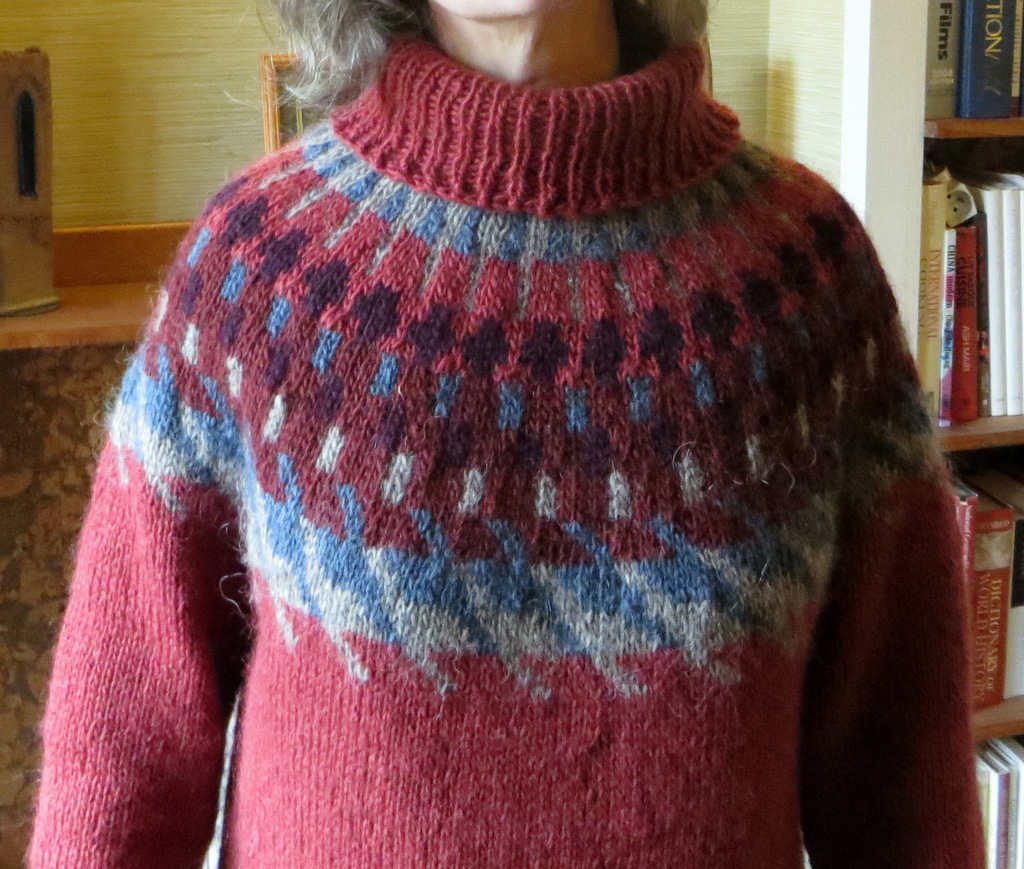
Changing the subject, my first lopapeysa! The design, called Antipodal, came from a recent book and is quite modern and atypical in some ways (including the rolled turtle neck), though the construction is traditional. You knit a big tube for the body up to the underarms, two small tubes for the arms, then join them all together into one yoke which you decrease in size, changing colours and making the patterned bit, up to the neck. So there's very little making up or sewing to do and all the fun stuff, patterning and shaping, comes near the end, so you have it to look forward to and don't lose interest. They're also fairly inexpensive and quick to make, as the wool is quite bulky, though this is made from the thinner Lopi-lite version.


In fact the yoke is really too deep, so the sleeves join too low and if I wear a jacket over it that pushes it up under the arms a fold appears under the neck. I can now see how this might be avoided, and half-considered unravelling some way back and reshaping it, but decided I'd rather just wear it as it is and go on and make another one, which I have already set about doing, though from other wool than Icelandic, which is something of a come-down since lopi wool is extraordinarily gorgeous: tough, seemingly harsh but luminous, unique and surprisingly warm and comfortable once you're inside, just like Iceland in fact. However, I can't really justify sending away for more of it while I've stacks of stashed stuff already, but then there'll be satisfying possibilities of arithmetical adjustments to allow for the different yarn. The study and perfecting of this form of knitting is much appreciated and has a large and enthusiastic following; I can vouch for how compulsive it is.


Reading up on the history of Icelandic knitting, I've learned that while wool and knitted garments have long been an important part of their culture and economy, the patterned yoke pullover is not so very old, dating from the mid-twentieth century, and they were originally called Greenlandic sweaters, not because they came from Greenland but because the patterned yoke resembled the decorative neck elements of some traditional Greenland folk costumes. 

So there you go.

Tuesday, December 01, 2015

End of November, just gone


Well, I did it more or less, only skipped about three times, including yesterday, I don't feel any kind of failure about that, since the old days of having to keep up with the challenge to the letter are past. Truly, while now and then I might have felt disinclined, mostly when I got writing and posting I found myself enjoying it, and in fact it's been great. I've so much appreciated renewing the friendship with blogging and blogging friends. I've got used to posting photos as I take them, and using the storage and editing tools available on the notebook or on-line, and to just sitting down and writing, even when it might seem there was nothing much, or at times this month, too much that was too weighty, to write about. I've use this analogy before, I know, but friends are no less dear and important for the fact that, with time and familiarity, you no longer sit up all night smoking and drinking and discussing the meaning of life in earnest tones, but just stop by from time to time for a cup of tea and an idle chat about nothing in particular. I've treasured all your cheerful responses about such nonsense as Yorkshire pudding, socks and whether you prefer dark or milk, as much as I've been cheered and encouraged and comforted by being able to come here and share worries and woes, whether about the care of a troubled young dog or terrible world events, and by the wonderful wisdom and support I can always find with people here. 

So, my heartfelt and affectionate thanks, and long live the blog. Here's a collage round-up of the month's posts, made with the iPiccy on-line editor, which is rather fun when you get used to it. So much change in thirty days.


Sunday, November 08, 2015

No time is wasted, though all time is lost. Maybe.


Ellena said in a comment a couple of posts ago, that 'nothing is pointless, not even wasting time', which made me think about temps perdu. In French one speaks of losing time, to mean wasting it. This made me think of Proust, and how that element of wordplay in the title is not something I've heard referred to (in my admittedly not very vast reading of the small number of the fifty million and one things ever written about Proust). And that in turn, made me think of Joe, and something he once said, and owing to the wonders of web-based e-mail, by recalling some keywords in the conversation, I was able find it:

'Time Regained is  almost my favourite part of A La Recherche. It explains one aspect of the work which doesn't seem to have been widely noted. That is that it is a book about someone who wants passionately to be a writer and becomes, at different stages, disillusioned with literature and convinced that he is not cut out to produce any. Until, that is, in a moment of epiphany (the uneven paving stones outside the Guermantes house which remind him of similar stones in Venice), he realizes that he carries the past within himself (something much more than memory) and the way in which he will write the work (the one which we have just read and nearly finished) becomes apparent and its realization a compelling need.'

Proust is always going to write, but not doing it, frittering his time in socialising, pursuing hopeless, dysfunctional relationships, or growing cynical and lackadaisical. But by a miracle (though possibly the result of a neurological weirdness most of us wouldn't be able to stimulate) the memories could be triggered in their entirety by sensation, and all the lost/wasted time, all the dialogue and observations of the awful, vapid, cruel people, every microcosmic detail of every seemingly empty moment, every vein on the asparagus, and every shifting mental state as he observed them, could be researched, mined, extracted and transmuted into text. Sometimes mind-bendingly difficult, infuriating, impenetrable text, often exaggerated, but also intensely real, exquisite, vivid, frequently laugh out-load funny.

There was someone on Amazon, whom I've not been able track down again, who wrote brief, funny spoof reviews of well-known books; on A la Recherche she said something along the lines of 'Blimey, he really did remember everything, didn't he? A bit of selective amnesia wouldn't have gone amiss.'  There's also this excellent New York Review of Books article I just found, which considers Proust as an 'accidental Buddhist', but also tells how its writer was 'worried that I might not live long enough to see him through to the end...a wise editor of mine had once written an article on why no one should read Proust before the age of forty'. The paradox is that it is only age and the growing sense that time is short which brings on a sense of timelessness: that it doesn't actually matter whether we complete the grand project which beckons and beguiles us, it's the embarking on it which matters.

So, I got distracted reading through old e-mail conversations with Joe, about Proust and which translation he favoured (Moncrieff), and about meeting Heather, who's also part of time past now, and who could look at a wall 'woolly with light' through a long morning with no sense of wasting time and who would frown at me for needing a translation of Proust at all, and about poems and long gone qarrtsiluni, and food of course. As always when allowing myself to be distracted I feared I was wasting time, but I don't think I was really. Much of it I didn't remember writing, or the events happening; fugitive stuff, life. Electronic media, e-mails and this blog, for example, can be made to recall some of it, but that's only really another way we tell ourselves what we remember; the actual experience still eludes us. Better than nothing, though, and there are things, and people, who represent and offer some continuity.

Ellena also picked up the link I left to the post and video I made just after my sister died, more than five years ago. Reading through that, with its intense protestations and pledging to honour her life by using mine well, I know it was real, sincere, but it begins to seem like somebody else writing already; that imperative has changed, diminished or grown into something else.

For in this world of ours where everything withers, everything perishes, there is a thing that decays, that crumbles into dust even more completely, leaving behind still fewer traces of itself, than beauty: namely, grief.
Proust, Time Regained.

I know not all griefs are so for everyone.


Saturday's, not eternity's, sunrise.


Thursday, November 05, 2015

Bonfire night


Today would be Bonfire Night, or Guy Fawkes Night: light up the sky; remember, remember ... Only not here it isn't, or anywhere other than the UK, I presume. I was reading Dale's counter-blast to Halloween the other day (my purposeful blog revival has indeed meant that I'm keeping up better with other people's too),  in revolt against the idea of seeing death and decay and horror, only too real and serious a matter, as subjects for fun, and the legitimising of playing with disguise and deception and fear.

I instantly found sympathy with the dissent from conformity with what the prevailing culture tells us we should and shouldn't join in with and enjoy, while at the same time I experienced a 'steady on, but where's the harm?' kind of reaction too. But no one should be obliged to go along with anything they have a strong objection or discomfort or revulsion about for fear of being considered a killjoy or lacking a sense of fun - 'where's your sense of humour?' was always the bully's evasion. It is important to question quite why we're observing a custom or festival, and not simply mouth the received ideas as a reflex. I suppose these are, that we need to confront our monsters, to dare death, to permit a degree of controlled misrule, all within a safe context, that those things are represented in a ritualised way that contains and puts them somewhere else, so, in Dale's words, you can go 'back to a world in which it's not true' (though, as he points out, 'there is no world in which it's not true'). Or, that it's simple community fun and creativity, now rendered innocent, harmless and well-supervised. This may be all be so, but it's still worth looking twice.

We didn't really mark Halloween much when I was growing up in the south of England, I don't know if that went for everywhere in Britain, perhaps Scotland and Ireland were different. We knew about it, and once when I was little my sister helped me make a witch costume, and painted horrid wrinkles on my face which was fun because I wasn't normally allowed to draw on myself. But there was no question of going out and about like that, the greengrocers' had yet to stock a pumpkin and we didn't get around to working out how to hollow out a turnip. Our Samhain, onset of winter, festival of lights was Bonfire, Guy Fawkes, Night, of which there were elements that could be conflated with Halloween. We received a certain amount of historical information about this event at school; it was stressed that attempts to blow up the king and parliament, or anyone really, were a Bad Thing and could not end well, but the Catholic/Protestant issue was only lightly touched on, as was the hanging, drawing and quartering, though it was probably where we first heard of it. The shudder and disgust at this could be allayed by the reassurance that was all a long time ago, we could turn back with relief to our world in which it was no longer true. Mostly though, our teachers were concerned with trying to put the fear of god into us about the misuse of fireworks and the horrific results thereof.

Knowing how poor Guido actually met his end, it was slightly puzzling that we made a model of him and burned it - it was witches that were burned wasn't it? Again, a bit of muddling of history. In fact, the burning of Guy Fawkes in effigy rather took over, I gather, from the more frequent burning of the pope, which was the usual way of partying on November the 5th for a couple of hundred years. They still do at the famous Lewes bonfire in East Sussex, though it's made clear it's Paul V, the one reigning at the time of the Gunpowder plot, in commemoration of some earlier Protestant martyrs, not the current one, and he shares the honour with various contemporary figures.

Our guy was made from old clothes, stuffed with straw and newspaper, a nasty yellow or orange papier maché mask from the news agents' shop. Other children carried their guys into the streets and sat them up and begged 'a penny for the guy'; I don't know if this still goes on, perhaps the possibility of allowing children out alone into the dark to importune strangers for money has fallen victim to the fear of other, more recognisable, monsters. But this aspect of extortion, of somewhat menacing, misruled children begging from adult citizens shares something with trick-or-treating. Later, when the latter custom appeared, many people were appalled by the idea of children being allowed to get sweets by the threat of violence or damage.

Anyway, the bonfire of old household and garden waste was lit well in advance just beyond the box elder tree, and my father and brothers, lit up ghastly orange in its light, carried the guy shoulder high and tossed him into the flames. We carefully chose our fireworks, kept indoors and brought out one by one with some ceremony, and lit them with tapers, never matches, the biggest rockets saved for last. I liked the pretty ones, the silver showers and golden rains and Christmas trees. Bangers I hated, though my brother liked them, probably because I hated them, and the rockets and catherine wheels were too unpredictable. Then we went in and ate baked potatoes and sausages in the kitchen.

Vivid memories, for sure, but treasured ones? I certainly enjoyed something of the heightened atmosphere, the element of danger and dark magic, of orange fire and black night, but there was also quite a bit of anxiety, our teachers' dire warnings did impress on me, though we would never have misused a firework, ever, and I was always worried about the animals, our cats and others, or the hedgehogs that might have crept into the bonfire. Also, the burning of the guy did trouble me, not because of any over-imagination of seeing him as a real human, but because the idea of burning our old clothes, and of destroying the work that had gone into making him, was disturbing. It was a kind of sacrifice, however unimportant, and I didn't take it altogether lightly, despite reassurance that it was all in order and permitted.

So, old unhappy far off things, sectarian hatred, historical violence, torture, the burning of effigies, people on the streets of a pretty south east town shouting 'Burn the Pope'! Merry England, happy times. Has it done me any harm, or has it enriched my experience? I don't know. I do still rather like the smell of fireworks, and the taste of baked potatoes. I dare say if there were a cricket club or some such with some fire works in walking distance, and maybe a pub, the King's Arms or whatever, with some good beer, I'd be there.

These days, living in a foreign land, with no children, most festivals and holidays and national commemorations have an opt-out clause for us. The kids here are beginning to get out and about on Halloween a bit, but it's very restrained, often they only really learn about it as part of their English classes; when the neighbours' children came just once a few years ago, they were at great pains to explain they weren't really witches and vampires, but just Sebastian and Sara, whom we knew, pas de souci. There's still a bit of disapproval of it, at the idea of demanding favours, but also I think, as creeping Americanisation, though there was in fact a tradition of it in western Brittany way back, according to Pêr Jakez Helias. The public holiday here is Toussaint, one of many retained religious days-off in this proudly secular and anti-clerical country. Everybody buys mountains of chrysanthemums and covers the cemeteries with them. They truly find a beauty in this, but I'm afraid for me it's rather spoiled the sharp, crisp autumnal odour and bronze starbursts of the chrysanths , since I seem to have fallen into the way of seeing them as inappropriate for anything but graveyards. Perhaps I should go out and buy a pot and reclaim my pleasure in them.

We used to trundle down the road for the 14 July fireworks, though not for the St Jean bonfire, but we don't bother now, largely because it means driving and parking and anyway, it really starts too late, what's the sense in having your bonfire and fireworks night at midsummer, for heavens' sake, when it's scarcely dark till midnight and the kids have to stay up till all hours? And yes, I have already received the retort, delivered quite seriously to my flippant remark, that Desmoulins and co were not thinking of that when they stormed the Bastille. Also, though, it's not our celebration; the first heads on pikes of the great decapitation fest, outside a nearly empty prison where there weren't any arms held after all, doesn't do much to move me to joy really, any more than the fate of Guy Fawkes should have done. And I still worry about the animals, the dog down the road left outside to bark in distress at the bangs and cracks in the distance, while his owners are off at the party.

Today would have been fairly useless for bonfires anyway, as it's rained all day. We aren't really allowed to have them at all any more, but most people in the countryside do from time to time. Thorny things and perennial weed roots have to be disposed of somehow. For other prunings, we have our splendid, still quite new shredder, and that's what I did today, turned a pile of branches and twigs and and leaves  into wholesome mulch, under the shelter of our newly repaired barn roof.


There were some bay tree cuttings among them, so the resulting pot pourri had the sweet scent of a good potato soup.


Sunday, November 01, 2015

First day of November


I'm going to try to post every day in November, how about that! ('try to', I'm told, is to set oneself up to fail).

I began this post with a rather Eeyore-ish, sic-transit, something-rotten-in-the-state-of-Blogland, I've-got-nothing-to-say-any-more, quasi-lament, but I wiped it and wrote (then corrected) the above line instead.

When I first started here, nine years ago now, I used to get up at six in the morning, come and sit in front of the computer and just write. Sometimes I took a bit longer over preparing special posts and editing photos and so on, but essentially it was a matter of regular practice. Things ebb and flow, come and go, of course, but perhaps there's still a value in setting a time and making a commitment; that I'll find something to say and to share by doing so, and if the Blogmuse has grown flabby, menopausal and sluggardly, eschewing flights of poetry and other raptures in favour of a comfy chair, knitting and endless repeats of Midsomer Murders, well it won't do any harm to make her take a bit more regular exercise, and maybe take the camera with her. Also, no excuses about the hassle of downloading and editing photos on the big computer, I shall just stick the SD card into this one and lift the odd picture straight from it, with only the minimal editing (cropping and a bit of instant polish) this machine enables. No 6 am starts though, but maybe 6 pm instead.

So, here we are at Toussaint, and you would think it summer, even now, at half past six in the evening, it feels more like June at midnight. A sudden recollection came to me this morning that I had let another birthday creep up without a card dispatched; I have been very hit-or-miss with them this year, but this is one I usually do manage. My apologetic e-mail brought a swift and cheerful reply, which spoke of moorland walks, brunches of scrambled eggs, Guy Fawkes Night fireworks at the local cricket club and pub meals, all of which induced a certain nostalgie de pays, in a nice way. I cleared my desk and undertook to finish a gift. A deckchair - already put away in the garage for the winter but easily retrieved - and knitting in the sun. What a bummer.


Even the a***hole (that's how we spell it in British English, with and 'ar') chasseurs were remarkably quiet most of the day, with just a few silly pooty noised on their little horns and a few bangs and barking dogs in the distance, presumably they had moslty been dragged off to the cemeteries to deposit chrysanthemums.

I was interrupted only by a late peacock butterfly, which landed and rested in the sun on the back of my hand, cleaned its front legs on its long curled tongue, and opened and closed its frayed wings while the breeze ruffled the soft, surprisingly long, brown fur on the back of its body, for at least five minutes. I decided the underside of its wings was really almost as beautiful as the colourful part, and would probably be my preferred choice for curtains, and offered it a lick of the butterscotch sweet Tom had just brought out to me (uxorious, see).  However, it declined, and only went on its way when I late blowfly alighted further up my arm and I made a reflex swat towards it.

I didn't have the camera then, and probably couldn't have photographed it if I had, but brought it out later and pointed it around a bit. But that will do for today.


Monday, March 30, 2015

White wine by the fire


Pouring the remains of the Montagny from the night before, chilled from the fridge, letting its slight Chardonnay fizz rest on my tongue, I took my glass to sit by the just-lit fire. Spring fire, white wine. Two memories:

A trip to the Loire valley, early spring just before Easter,when I was perhaps twenty-one, to see a friend who is still a friend and was an old friend even then. Driving through the Touraine, stopping at a cave and sitting by a log fire, being brought glasses of chilled pale white wine, the flowery taste of the chenin blanc, cool next to warmth. I didn't grow up with wine, my only idea of wine in France then was that it could be had very cheaply. The girl who had initiated the trip, a friend of my friend, bought four bottles of the white Touraine - perhaps it was Vouvray but I don't think so - to take back to her parents, it was pointed out to me that for very little more than I paid for rough plonk I could have something really good... I couldn't now perhaps drink the plastic sealed stuff in the consigné litre bottles as I did then, but have never developed any real sophistication about wine and can happily drink from boxes and pichets; as an Iris Murdoch character once said, 'why wantonly destroy one's palate for cheap wine'? However, though I didn't rediscover Touraine chenin blanc until many years later, I knew it again, and it remains a great favourite. I've never liked the same variety from the new world or further south in France, though my experience is slight, it always seems dull and crude and characterless.

Before that, I was perhaps seventeen, a summer when I stayed with another friend of the same vintage, whom I still hear of now and then. Rackety summers when our parents dared leave us alone, occasionally involving graceless drunkenness, tinned meatballs and other irresponsibilities. But one evening her grandfather, a kind, unpatronising, urbane old Dutch chap who had been something big in Unilever I think, and who lived in one of those absurdly picturesque, high-priced home counties villages where they film Midsomer Murders and Agatha Christie adaptations, collected us and brought us to his home for dinner. I can't remember what we ate, I think it was good, but I do recall another flowery white wine, I don't know what but again chilled and delicious, in fine glasses engraved with grapes and vine leaves. But it grieved me to note fine incrustations of something like spinach, which had clearly been further baked on rather than removed by his early model dishwasher, and unseen by his elderly eyes. At the end of the meal, I asked to be allowed to wash up to thank him for his hospitality. No need, he said, the dishwasher... Oh but please, I insisted, at least the glasses and cutlery. I can still feel the fragile glassware in my hands, the very hot water, and carefully, discreetly, scrubbing away until all unsightly vegetable matter was removed. I don't think I even mentioned the spinach to my friend.

Many people say happiness is only recognised in retrospect, I've never found that. Happy memories elude me,  though I think perhaps I often considered myself happy at the time, looking back I judge matters more harshly, qualifying them with the shame, regret, or incomprehension with which I seem to regard large swathes of my life, not least those involving the misuse of alcohol.  I know that sounds dismal and self-piteous, I don't mean to be. Other times any memory at all escapes me, lost time remains fruitlessly sought after, estranged from me altogether. Yet these two moments of glad grace, of elegance and delicacy, glimpsed elsewhere and even, exceptionally, in my earlier self, can still be evoked with a physical sharpness by the taste of chilled white wine.

~

Shortly we're off to south east England for a few days, for a big birthday of my sister, and a smaller one of my brother, and for one or two other appointments and rendezvous. It's the first time we've been out of the country together for more than eight years, and feels quite momentous, but probably isn't. Back in a while.


Sunday, January 18, 2015

Books again


One or two posts elsewhere,  Zhoen pondering the matter of writing in books, library or otherwise, comments left on the last post when I featured the books I had at Christmas, and conversations, started me looking back over certain earlier reading experiences, and thinking about the meaning and value we give books as both concrete and abstract things. Stella too, has been writing about culling things, possessions generally, then books in particular. She dwells on the connections reading creates for us, with other people and with our own history. She mentions H is for Hawk, and how it will connect her with me since she came across it here, which is nice. My finding that book was already part of a long series of occurrences of synchronicity, prompted and giving rise to other memories in turn.

I suppose I tend to be on the lookout for things about falconry. Like Helen Macdonald, the book's author, from my teenage years I wanted to be a falconer. The wish faded, there was little opportunity to explore it hands-on at the time, and the extensive reading and research I made showed me that it would probably demand more time, money, grit, heartbreak and a stronger stomach than I would likely ever be able to manage, but I still love the subject, and very much enjoyed our day at Fauconnerie Bretagne a couple of years ago. One of the first books I found on the subject, and one of the first adult books I remember buying for myself, at the age of about thirteen at a school book fair, I think, was TH White's The Goshawk. This has been on my bookshelves ever since, becoming so familiar that, slender and plain-spined as it is, I had largely ceased to notice it, and even wondered if it were still there. But there it was, between Le Grand Meaulnes and the Mary Renaults, and I was happy about that, not only that I still had it but because of the company it was keeping. My ordering of books on shelves is idiosyncratic and fairly fluid and has developed organically, and I don't necessarily remember exactly where things are, but it is important to me, so when lack of space, appropriate height of shelves, additions which expand certain groups that need to be kept together, and my own acts of culling necessitate changes that force certain volumes into places alongside others where I don't really think they belong, it bothers me a bit.

At about the same time as, or just before, I must have read a review of H is for Hawk, the Sunday afternoon radio dramatisation was of TH White's The Once and Future King. It was quite a good one, using bits of White's own Book of Merlin coda as a device to make the narrative retrospective and non-linear, which meant that the darkening heaviness of story's progress could be lightened and enlightened from time to time by some of the episodes from the first volume. I'm sorry for people who haven't read the book, that the label of 'fantasy novel' might put them off. Not that I want to run down fantasy novels anyway, but I just can't think of it as one. I suppose if I had to I'd describe it as a kind of psychological novel, but on an epic, historical, mythic scale, but also the inward broodings of a brilliant, sad, bitter, hurt, rather twisted man. Not sure if I'm selling it to you yet. It's about love as weakness, evil as power, about betrayal and cruelty, good people doing bad things and bad people doing worse ones, about national and personal mythmaking, and most of all for me it's about terrible, painful loss of innocence.

There's a lot of falconry throughout The Once and Future King, but especially in the first volume The Sword in the Stone, along with many other birds and animals and animistic nature and colour and magic and jokes galore, including lots of ironic anachronism generated from the conceit that Merlin was born and lived backwards through time, an idea entirely White's invention, but which took off so well that many people think it is an original part of the Arthurian myth. There is fun and education and wisdom - I still love the Badger's Dissertation as one of the most satisfying of creation stories - a few sad and worrying moments and a few early intimations of later themes, but overall a completely delightful, joyous, appropriate children's book.  I read it one summer when I was about twelve, I think. I had a comfortable and sheltered childhood and was undergoing an old-fashioned though serious education; I was not a precocious reader, and mostly was still cheerfully consuming Monica Edwards and Arthur Ransome, stories of birds and animals and tomboyish adventure and old legends were my meat and drink. At the end of The Sword in the Stone I was thrilled, I knew this was more substantial fare and wanted more, so I announced I would read the rest of the work. My brother, three years my senior and always more of an intellectual heavyweight, looked somewhat doubtful and warned me that I wouldn't find it as pleasant, which of course made me think he was patronising me and I had to rise to the challenge.

The second volume, The Queen of Air and Darkness, is fairly short, and I did get through it. But the blow to the solar plexus which the two episodes of Morgause's evil which open and close the volume delivered remain with me still. I can remember sitting up in bed with the sick knowledge that I couldn't un-read it. In the first, she boils a cat - 'both woman and cat had black hair and blue eyes' - alive, in some detail, on a whim to make an invisibility charm. The charm fails and she loses interest, throwing out the cauldron of water, skin fur and bones out of the window. This shocked and disgusted me, yet I persevered, and somehow her seduction of Arthur at the end - by means, perhaps, of another charm, a ribbon of skin carefully cut from around the outline of the corpse of a dead soldier - had a deeper and more poignant impact. Arthur, though somewhat blooded and battle hardened by this time, is still the open, energetic, kind-hearted, well-intentioned boy of the first volume, an innocent. Merlin, who has the powers of magic and foresight to protect from and avert evil, for a number of reasons - whether a kind of time-travel directive, the requirement that Arthur and others, should work things out for themselves, simple absent-mindedness or the enchantment (not altogether unwelcome) of his own sorceress Nimuë - cannot or does not intervene. Arthur doesn't know who she is or what he's doing, or what the ultimate cascade of consequences will be, but as TH White concludes, innocence is not enough.

Well he certainly helped me offload quite a bit of mine. But it wasn't the first time this had happened. At a similar kind of cognitive point, when I was beginning to choose and read independently at about seven or eight, there were some little softback collections at pocket money prices that I liked very much as objects, they were small and chunky and had bright, slightly folk-art kind of covers, those for the younger readers had red spines and those for rather older ones dark blue. I'd worked through the red ones and reckoned I was ready for the blue. This turned out to be a collection of stories including Bluebeard, a story my evidently sanitised education in fairy tales so far had omitted to incorporate. As I recall it, the details of the contents of the bloody chamber were not spared. Again, I remember where I was, in the back seat of our estate car on a shopping trip, maybe left there with my brother with our books while our parents finished the shopping, as happened quite frequently in those days. I remember closing the book in horror and not picking it up again. Neither then though, or with the TH White, did I tell anyone about what I'd read and how it had affected me, though I may have muttered something to my brother about 'I see what you meant.' I don't quite know why not; a sense of not wanting to share the distress, protecting my elders from something nasty or a kind of fear that I might get into trouble for messing with nasty things myself, pride, that I ought really to be able to cope with difficult stuff for myself, but also perhaps a sense that what happened between me and my books was my private affair, and a knowledge, underneath, that there was in fact nothing that could be said that would make me feel better; 'it's only a story' wouldn't wash with me, then or now - as if that makes it any less real!

And I don't quite know, in these times when children are both exposed to all kinds of horrors, real and fictive, which make these mild trauma seem very small beer, and yet are also overprotected and overseen and fretted about, so that a child psychology book I've read deplores the Saint Nicholas tradition as trying frighten children into good behaviour and damaging them terribly, and that reading AA Milne's 'James James Morrison Morrison' could create serious anxiety in them, or when a mother I knew, still reading (the early volumes of) Harry Potter aloud to her thirteen year old, used to make off the cuff deletions of things she thought would distress or frighten her, quite how things should be.

Anyway. I don't have a copy of the blue-backed Bluebeard book, in fact I have very few books left from childhood, presumably it was either passed on to jumble or left in the attic of my childhood home when my parents moved, along with all kinds of other put-away childish things to be someone else's problem, or conceivably, in the case of some of the objects, rare collector's items. That's one way to deal with your unwanted clutter. Neither to I have The Once and Future King, though I did until recently. I think the first one I had was a library book, as many of the books we read were. We owned a lot of books, but it wasn't considered needful to do so, and many of those I remember most vividly, in terms of their content and what they looked and felt like, were from the library (and no, we certainly never wrote in them!). It took me many years to read it all, in fact, the long anguish, sordid betrayal, compromise, cruelty and conspiracy of the four-cornered adultery of Lancelot and Guinevere and the revenge of the Orkney clan were also difficult to work through in a different way, but for all that it has been my constant and much loved companion for most of my life. I often wondered about its author, and the consciousness and personality which created it, so humane and imaginative and so sad and bitter, so when I heard about H is for Hawk I was doubly interested.

The copy of it I owned, for at least thirty years, was a paperback which I bought for my first serious boyfriend when I was seventeen, it had a not-too-embarrassing dedication inside the cover, with a date, so I know how old I was, in my very neat small, pointy, just post-childish handwriting. Not quite sure why; he had courted me with a gift of The Mabinogion so perhaps I thought Arthurian might interest him, perhaps it did, perhaps there was something subliminal going on!  I ended up keeping it anyway when we went our separate ways. It began to fall apart, worse than most paperbacks, quite early; another brother borrowed it and said he had a very active relationship with it, in terms of becoming quite obsessive about the content, making notes etc, while wrestling to try to keep the pages in any kind of workable order. Finally, not very long ago, I threw it away completely, and though it was odd to put a book in the bin, especially such a familiar one, I did so without regret; it was unreadable and I can always download it to the Kindle if I do want to read it again, though I feel I probably won't need to.

I still have The Goshawk though, with its ring marked cover and scuffed edgesand would be sorry to part with that. I might read it again too, before or after H is for Hawk, or alongside.


The other book in the picture, Bird of Jove, is also falconry related, but part of another story, a shorter and lighter one, which I'll get onto later.