Showing posts with label recipes. Show all posts

Sunday, November 20, 2016

Garlic chicken


While the garlic chicken is cooking.

Here is the recipe for garlic chicken.

Take one oven ready chicken, large or small.

Make a kind of garlic butter paste, with a lot of crushed garlic, maybe a whole bulb,  not too much butter... OK, quite a bit of butter, and some olive oil, and a chicken stock cube. Some fresh herbs if you wish. Smush it all up with a fork; if it's hard to break down the cube, you can add a little hot water.

Keep some of the garlic cloves back and whole.

Chop up an onion, some shallots too if you like, or little onions you can keep whole. Fry the onion in some olive oil and/or bacon drippings. I always use up bacon drippings, we have bacon sandwiches at lunchtime on Sundays. Sue me or send the food police round, I don't care. You can start with some lardons (chopped streaky bacon) if you like. Oh yes, you have to do this in a big stove-top to oven iron pan, Dutch oven, le Creuset casserole thing, call it what you will. If you don't have one you'll have to adapt, but then it's no longer a one pot meal. You could even make it in a crockpot I suppose.

This recipe is very flexible, the main thing is the crushed garlic butter paste, which you then smear inside the cavity of the chicken, under its skin, anywhere really though perhaps not into you hangnails or any mucus membranes if you can help it. I always get it in my hangnails anyway, it's a winter recipe so the chances are I've got hangnails, I soon find out. And that you keep the chicken whole so the stuff oozes out through the flesh and skin.

When you've sautéd or if possible caramelised the onions quite a bit, put the thoroughly garlicated chicken into the pan and brown all sides.

While these things are happening, peel and chop some carrots and potatoes. Add these, and the whole peeled garlic cloves you've kept back, to the pan round the edges of the chicken which has now finished up breast up. Stir them around a bit, if some get inside the chicken - I have usually removed the string so the bird is very décontracté - so much the better.

When everything's nicely coated top it up with liquid, enough to cover the veg and most of the chicken. What liquid is up to you; the original recipe, for there was one, from a French country cookbook I borrowed from the library back in England, was a very basic affair and just called for water (and no stock cube either), but I use whatever comes to hand, chicken stock from the freezer, wine or cider (best to reduce these a bit), this time I poured in the remainder of some very louche looking home-made pommeau Paul at Kerbiriou sent us home with a couple of visits ago. Smells good anyway.*

Put the lid on the pan and let it really get bubbling hot through.

Transfer it to the oven, with the lid on, or if your lid isn't oven proof you could put foil over it. Leave it to cook, in which time you can wash up all the stuff, watch some telly, do a blog post, whatever. You can have the oven quite hot. It's a very forgiving dish and the longer you cook it the better, though if the chicken's falling apart too much it's a bit tricky to get it out to cut it up, or pull it apart rather.

Take the lid off for the last 15 minutes or so to brown it off a bit.

If you only have a stove top, this can be done entirely on that, though it really is better for an hour or so in the oven.

We eat it from great big soup bowls, quite deep ones; I ladle out the broth first, then the veg, and put the pieces of chicken on top. Tom likes breast and I like leg and so between the two of us we do the Jack Spratt thing.

You can use all kind of other veg in it too, root veg of any kind, and celery is very good. Potatoes are essential because they soak up all the flavours and become very voluptuous. I have done summer versions with tomatoes and peppers and stuff, but really that's a different dish, and I'd say avoid the temptation to put tomato in it; there is altogether too much tomato used in much everyday cookery, or there was. These days I don't buy a tin of tomatoes from one year's end to the next. As I say, it's a winter dish, and needs winter things in it.

If you don't like garlic... well, God bless you, as the song goes.

The oven has just pinged, and Tom is asking how much longer?


* and it was very good, I'm just finishing this after dinner.

Wednesday, November 02, 2016

Mushroom duxelles


The painters and decorators are back after a five day recess, on account of how they were making the bridge for Toussaint. They tend to start early but aren't really any trouble. My blue room is now entirely white and cream and looks much larger already. I don't mind a bit.

The misty mornings and warm afternoons, Intercession in Late October weather, have brought about a good crop of field mushrooms.


They are good and clean, scarcely any grass or other VM* to pick off them even, and very little insect damage. However, though we had the smallest and firmest of them fried with some bacon and a baked potato, they were a bit too dew soggy to do much with except make duxelles.

For this, after wiping them, chop them up small, then do the same with a shallot or two. Soften the shallot in half and half butter and olive oil, then add the mushrooms, with salt, pepper, a pinch of nutmeg is good, and a slosh of sherry-like liquid (Rivesaltes in this case). Reduce it all to a thick gloop, then leave it to cool a bit, and I then freeze it in small portions in cake papers, the only use I have for cake papers as I don't bake. One can then just plop them into soups stews and sauces for extra flavour as and when.

I somehow thought when going through the great purge, that I would no longer do these kind of squirrelling, putting-up-for-winter type things, and would live more lightly and immediately, seeking only what I needed when I needed it, but I can't help myself, and we will be here another winter anyway, and it's free food for the foraging. I'm also beginning to regret getting rid of one or two things, like the totally shapeless pair of jeans that were lined with soft brushed stripy cotton and made me feel like I was wearing pyjamas under them. Nevertheless, I wilfully relish the new found order and space around things and am resolved not to mess and fill it up again, and the jeans really were ugly and unflattering.

* awesome link to Australian Wool Innovation site, I didn't know there were so many nasty things that weren't meant to be in wool...

Sunday, April 10, 2016

A bit of terroir


It's become quite apparent since we had Elfie that if you want to reach a whole new level of assimilation into life in Brittany, get yourself a Brittany spaniel.* Many older local friends glow with admiration at the sight of her, or love to hear about her, and tell me fond stories of all the dogs of her breed they have had or known, and complete strangers stop us to compliment her and talk at length in the same vein. I have the feeling we have adopted an emblem of regional pride as well as a dog. Not that this would have made any difference to our taking her of course, but I am rather enjoying basking in her reflected glory, and the increased contact and conversation I'm experiencing.

In fact, when a couple who had parked nearby at the supermarket and were admiring her through the car window, so I got her out to say hello and display her general wonderfulness, then the man opened his car door and she almost jumped in** and he chuckled that she was very welcome to come home with them, it made me think twice about making sure the car was securely locked when I parked outside the next supermarket; their appreciation, it seemed to me, was decidedly tinged with covetousness. They were quite rough-round-the-edges people, but clearly lovely; they couldn't believe she had been abandoned and in a refuge, had not long lost their last Brittany after keeping them, along with Labradors, for eighteen years, and weren't sure how long they could go on without another one. The woman praised us warmly for taking her, said that being such an intelligent dog she would know she had found a loving home with us, and that everything we gave she would give to us back again, we wouldn't regret it. However, not everyone who takes a fancy her might be so nice, and she is much too sweet and trusting not to let herself be led away.

Anyway, to celebrate our chienne de terroir, some cuisine de terroir, since she'll be keeping us at home rather more (though not entirely, we are quite hopeful of her adaptability, and her car habits and plans for appropriate equipment are coming on), and since all the walking is giving me a good appetite, one might as well make the most of some local food (apologies if this gets to sound a bit Peter Mayall...)

~

Côtelettes d'agneau pré-salé - salt marsh lamb chops

Just a few weeks ago, when Elfie was no more than a twinkle in our eyes, we went to the Mont St Michel area. I took lots of photos, as one always does there, and haven't got round to doing much with them, perhaps I will. Here is one from near the top though:


What you can see in the inland distance is salt marsh, pré-salé. That's where the sheep live, and one of the reasons I go there, frankly, is to eat them. We don't eat much red meat, and hardly ever lamb but this stuff is too good to resist, for me anyway. The hotel we stay at is in Pontorson, about five miles up the road from and with the nearest railway station to le Mont, but despite that the latter is one of the most popular tourist destinations in the world, Pontorson is a rather scruffy, down-at-heel, undeveloped place, and the hotel is remarkably cheap, with rather good food, including the lamb. Breakfast is bread and jam, good coffee and lousy tea, and trying to save ourselves for our evening meal, we picnic on fruit and biscuits at lunchtime, once stopping out on the salt marsh to the east of the landmark, observing something of the life of the sheep.


They are very free range, grazing on sparse grass, herbs, samphire and the like, which gives the meat its excellent flavour. They grow slowly and don't have to travel far at the end of their lives. They help maintain the unique habitat and landscape, for other wildlife such as these shelduck.


As well as indulging while we were there, this time we looked into the butcher's on the high street in Pontorson, and bought some chops which I put in the freezer when we got home. The lamb's availability is confined to the very local area, I gather there's a butcher's in the indoor market at Rennes that sells it a couple of times a week, but that's the furthest afield you'll find it. Six chops, not large, cost €20, which is a lot, but I really feel this is the kind of meat we should be prepared to pay more for, less often, in terms of sustainability, animal welfare, and not least, taste.

When it comes to cooking it, you shouldn't really have to do much, since it's flavour and tenderness is such that, as Brillat-Savarin said, it should taste of itself, and not be buggered about with (Brillat-Savarin didn't say that last bit). That said, I rather feel grilled or roast lamb without garlic and rosemary isn't right, so I smushed up a bit of garlic, and laid a couple of sprigs of rosemary in the pan, and also rubbed a bit of lemon thyme over it, and some sea salt and black pepper, and splashed some rosé wine over it to moisten it... yes, OK, I did bugger about with it some. It tasted bloody amazing anyway.


I also think redcurrant jelly is something of a necessity with lamb, after the fact, not in the cooking. Mint sauce, however, is an abomination. The jar in the photo is labelled in French not because I am an insufferable Peter Mayall type who has to show how very assimilated I am, or some would-be cheffy type who thinks all food should be in French, but because I gave the rest of them to the ladies at Quessquitricote, who were very appreciative. In fact it's white currant jelly, I still don't really know what to do with all the white currants I grow, but at least I can make jelly and give it away.

Having gone relatively easy (by our standards) on the garlic in the cooking, I roasted a load more whole cloves with some sweet potato and pimento, and served them with these and some green pease pudding. I feel so sorry for people who can't eat garlic.


 There wasn't much left over.


Dogs mustn't have chop bones. Bugger it.

~

Chicken with Roscoff pink onions and pommeau de Bretagne (or Normandie)

Long time readers here will know about the Roscoff pink onions. Or you can type it into the dinky little search widget top right, which sometimes works and sometimes doesn't. I don't have any photos to illustrate this one but here's a drawing.


I did it the other day, I've not drawn anything for ages, but set myself half an hour before Elfie's late afternoon walk (that being quite long enough to sit in front of a cut onion), got out the pastel paper and pastel pencils, no rubber, to see what happened; my hand is not in, but it was nice to do it. The appetite and motivation for certain things I had set aside seem to be returning a little, tentatively.

Roscoff pinks are known for their keeping quality, which is how the onion sellers were able to store, carry and sell them abroad, so there are still some about, including a couple from my own last year's crop. For this recipe, take a fair number of them and slice them as you like (I like top to bottom for most things), caramelise them for as long as you've time, and deglaze them with pommeau. Pommeau is the cider producing regions' (Brittany, Normandy) version of pineau de Charentes, that is, an aperitif made from the must, the fruit juice base, grape or apple, of wine or cider, mixed with the eau de vie distilled from the same production, cognac or Calvados or its equivalent. The fruit juice sweetens and lightens the spirit, the spirit stops the fruit juice fermenting. Both drinks are quite sweet, and about 16%. I guess you could just use some sweet apple juice (or what in the US is called cider, as opposed to hard cider) and some other alcohol, applejack if you've got it, or whatever.

Roscoff pinks are not unlike shallots in flavour, so perhaps banana shallots would substitute.

Put the onions into a slow cooker (or heavy pan in a low oven), slosh in a bit more pommeau and some chicken stock, which I do make myself, properly, but I am also a shameless user of chicken stock cubes, which I also add some of, then sauté a chopped up chicken breast or two , or any other chicken meat you like in the oniony pan; I am a leg woman myself and Tom is a breast man (I'm talking about chicken here, for shame!), and thus between the two of us we do the Jack Spratt thing, but you can't buy boned leg meat here so if I'm feeling lazy it has to be breast. I think I meant to chop up and sauté an apple and add that too but I forgot.

Leave it to cook and go out for the afternoon, perhaps peel some spuds for mash, which goes well. I think I was going to walk refuge dogs, a volunteer activity I started before we got Elfie, while we were still purportedly at the stage of thinking of getting another dog in a year or so, as a kind of preparation. However, now I'm sort of committed to it, and after an afternoon of having my arms nearly pulled out of their sockets by Tifou, Idyll, India, Olga or whichever old lag I've been walking (most French dogs have daft names, Elfie was a lucky exception, and many of these dogs are unlikely to see a life beyond the refuge, which isn't necessarily so bad for them) I am most appreciative of coming back to a hearty, tasty meal and to luxuriating on the sofa with our, clever, affectionate,(mostly) gentle medium-sized darling; even if I never dare let her off the lead, at least she doesn't pull me all over the countryside like a plough horse.

Terroir is one of those pretentious, snobby kind of words/ideas about food, like fusion, which is its antithesis. Yet there's something about putting things together from the same corner of the earth that often does work; sweet potatoes, pimentos, garlic, redcurrant and split peas with the lamb is clearly more like fusion, and they work too, but the simple combination of the pommeau and the pink onions really is spot on, you don't even specially need the chicken.

~

Finally, if that all seems a bit heavy on the meat and rich stuff, here's a bit of foraging fusion.

Bean tops, sorrel and noodles

In the last couple of years, a number of the fields hereabouts have been planted with legumes - field beans, peas, vetches etc - as cover crops. They get ploughed in at some point and things like maize planted on top. This year, the ones with field beans - rather like small broad (fava) beans, and not bad eating, have been left fallow for the moment and begun to sprout from the old crop. Here's Elfie in such a field, with a view of Plémy in the background, looking every inch an emblem of rural Brittany, despite (or perhaps because of***) the rather orthopaedic looking harness:

I'll wait on this nice slack lead for as long as you say, but if you think I'm going to pay you any other attention just because you're pointing that thing at me you can think again****.
Broad bean tops are good eating as greens, if you can get to them before the blackfly, so I wondered if these would be. I picked a good bag full, along with some sorrel, and washed it in the salad spinner. 


I have a great appetite for the first wild and foraged greens at this time of year, one which Tom doesn't share. They seem very cleansing and refreshing. I heard somewhere that women's biology really does need and want vegetable matter rather more than men's, and we certainly seem to be more easily constipated. I'm not entirely convinced they aren't just mostly babies who never learned to like their greens, though. (She says, while Tom's cooking mushroom, pea and cashew curry.)

Soak some chow mein noodles. I've nothing against ramen, and eat them sometimes, but chow mein soaked for a bit longer is just as simple and really has a bit more texture and integrity. Sauté a shallot or two, in a wok or just a saucepan, then add some soy of some kind, I used a sachet or two of Japanese left over from sushi.

Then, and this is the important bit, throw all the raw greens and noodles in together, and stir it up. Serve, sprinkled with some of those crispy onion bits, my current favourite savoury topping.


An experiment, but really a very successful one. The bean tops stayed very chunky and substantial, unlike a lot of leafy greens which seem to dissolve and nearly disappear when heated, but they lost that rather nasty bitter, raw bean, leguminous taste. The wild sorrel melted, but the acidity of it offset the other ingredients very nicely. I must make it again before they plough the field up.

~

* or rather épagneul breton. According to those in the know,  épagneul derived from an old French word for a net, the original manner of bird hunting with such dogs, and 'spaniel' is a mistranslation, since that word originated in the fact that English spaniels were supposed to come from Spain, or something like that.

** an absent minded reflex common in dogs; an article I was reading the other day recommended if you are faced with a runaway dog, your own or someone else's, especially in dangerous traffic, a good ploy is to open your car door and they dog will often jump in without thinking about it.

*** Breton back or hip problems are well known, openly attributed to consanguinity.

**** I still wouldn't let her off. This field is full of skylarks, as well as partridges and pheasants which have survived the hunting season and gone on to breed another day, so that gives me another excuse for curbing her freedoms: even if I could get her back, there's no reason that all the spring wildlife should be rampaged all over. Also fox poo and other temptations.

Sunday, February 10, 2013

Bitter greens from a fallow field


Bricolins.  I've bought these greens, or something like them, from a local veg box scheme, and they can, it seems, still be had on the markets in this part of France, though I don't remember seeing them.  They are the spring shoots of field or feed cabbages, loose small leaves and sometimes the start of a flowering head.


The name is a curiosity, a hybrid false analogy perhaps, from the Italian-derived broccoli (sometimes they're called bricoli), and the French verb bricoler.  Bricolage now is a fairly respectable activity, and large retail outlets bear the word in their names, it's DIY, home improvements.  But it also has had the sense of rather desultory pottering, of cobbling something together from what's to hand, of making do perhaps in a rather shoddy way.  The grasping peasant family in Georges Sand's Miller of Angibault is called Bricolin, and it carries the sense of shabbiness and skimping, although perhaps there's a cabbage stalk connection too, and casual farm labourers were also sometimes called bricolins.

And as a foodstuff, these greens really are much to do with making do, with using what meagre resources come to hand in a lean time, even to resorting to raiding the cows' fodder to supplement one's winter diet.  One of the few recipes I've found for them comprises not much more than the chopped greens, potatoes, water and some butter, if you're lucky, or else lard.


They're also known, in Gallo anyway, which is the old dialect of these parts, Breton wasn't spoken here, as guernissons, I can't find much out about that, except Gallo seems to contain a lot of words beginning gue-.

The local farmers are planting more feed cabbages these days to supplement the lack of nutrients in the junk-food-for-cows which is maize, since destroying rainforest savannah a mile-a-minute by buying imported soya is getting more expensive. A small step in the right direction I suppose though it doesn't quite constitute reform of the Common Agricultural Policy. So there are plenty to be found; these ones however were even more scarcity food, or playing at it anyway, as I do, since they were foraged not from a planted field but from self-seeded wildings in a fallow field just up the road.  I'd picked a few before and they'd been good, usually mixed with other greens, but these proved to be uncomfortably bitter, and even the addition of balsamic vinegar, sugar and salt couldn't offset that enough to make them pleasant on their own, even to me, and I quite like bitter. Tom, who isn't a bitter man, couldn't eat them.  I'm afraid I'm something of an intolerant and unreasonable solipsist about people's taste preferences if they aren't the same as mine.  I regard Tom's rejection of a number of foodstuffs as being bitter as a wilful refusal to grow up and train his palate (children naturally reject bitter tastes to avoid toxicity, which is why they won't eat their greens), as well as being inconsistent since he enjoys burnt sausages.  

This coincided with Rouchswalwe's post about Brussels sprouts (or Rosenköhlchen as they are delightfully called in German) and the comments it raised about taste.  Bearing in mind my aforesaid unreasonable solipsism, I am sceptical about the 'supertaster' idea, and I certainly hope no one ever tells my step-grandchildren Benj and Emily about it or they will feel justified in continuing to allow never so much as green pea to pass their lips on the grounds that they are supertasters and anything of vegetable origin is intolerably bitter to them, with the possible exception of garlic and potatoes, in the form of chips that is.  One of the best things about Brussels sprouts for me, which fully justifies their place in Christmas dinner, is that they make the best ever bubble-and-squeak, and this is what I did with the bricolins in the end.  Our friend the Quiet American once said it was a bafflement to him the things English people call food, either reducing the delicate and appetising such as 'sorbet' to something as dreary and off-putting as 'water ice', or rendering dishes completely opaque and droll by giving them such names as 'spotted dick' or 'bubble-and-squeak'.  

So for those who don't know, bubble-and-squeak is a development on the Irish colcannon (a lovely name) or, as I understand it, the Australian champ potato: leftover greens, primarily of the brassica type but can include leeks, onions, and indeed any other veg, even steamed nettles, mixed with mashed potato, then (and this is the point of departure from colcannon and champ) bound with an egg (optional, but a better result) and fried, at which point it presumably makes the sound which gives it its name.  The potato reduces the concentration of greensy bitterness, which can also be softened by the inclusion of sweeter elements such as carrot or parsnip - I included some pumpkin and chestnut puree in this instance.  Served with bacon (the ideal) the salt and savoury creates a further harmonious balance, and if you then wish for a touch of sour, fry some tomatoes or add a dash of ketchup or brown sauce on the side.  In fact acid is the taste group I had to work hardest at getting to like, wouldn't even eat mayo or anything with a taste of vinegar for years, and still regard Worcestershire sauce as a culinary thug.  But after long practice of including small amounts of sharp against other contrasting flavours to offset them, I have reached the point where I can eat gherkins straight out of the jar with pleasure, though I still prefer the sweet-and-sour ones to the just plain sour.

I still wouldn't be able to get Tom to eat it, so bubble-and-squeak aux bricolins is portioned out and in the freezer. 

Monday, July 30, 2012

Pumpkin flower follow-up


I found a packet of tempura mix I'd forgotten about in the cupboard - yes, I'm sure I should be able to make my own tempura batter but I gather it's better with some rice flour which I didn't have.  I picked a bunch of the pumpkin blossoms, which do all seem to be female, and which flower at the same time as the embryo pumpkins form - a couple of them the baby pumpkin came away with the flower.  Stripped all the green bits and removed the stamens and whatever else the knobbly bits in the middle are.  They were heavy and waxy and the perfume was a bit overwhelming.  I looked around for other things to make into tempura; had carrots, red pepper, a sweet potato,courgettes (zucchini), lettuce in the kitchen, and gathered a few very small broad (fava) beans in their pods, some comfrey leaves and flowers (in the picture) and foraged some sorrel leaves and nasturtium flowers from round and about on Molly's walk.

Checked recipes for dipping sauce; lacking mirin and dashi I had to settle for various alcohols in store and some grated strong red radish, and added ginger, garlic, chopped Welsh onion. Not brilliant, but passable.

The pumpkin flowers thus cooked really were utterly delectable, the perfume turned to sweetness and they were soft and light and quite substantial. One of the best parts of a very good platter of tempura - the broad beans were a pleasant surprise cooked thus too, the comfrey less interesting than I remembered, the nasturtiums good but a bit too delicate.

I would urge anyone to eat pumpkin flower tempura!

Monday, August 22, 2011

Monday 22nd August

The rest of the cauliflower, a big one, after Tom's pickling activities, made into curry, using this recipe.  It really is as good as it's cooked up to be.  Instead of boiling the eggs. though, I followed one commenter's advice and simply poached the eggs in the sauce at the last minute.  It reminds me a bit of the way R used to do it, only she sort of scrambled them into it.
~

The cough/cold virus I have more or less shaken off now, but one of its symptoms (I assume) was blocked ears, tinnitus and earache, which the introduction of a warmed-up mix of olive and tea tree oil followed by self-syringing with a poire effilée , normally quite a satisfying experience (yes, I know, I must be weird), only made worse.  It has more or less subsided now, except for a strange echo effect in the upper frequencies of my hearing, so that Molly barking, announcements over the supermarket tannoy and excited female newsreaders and reporters bringing us the latest on the situation in Libya produce an effect that is distorted, broken and generally irritating inside my ear canal.  

Not much good to be said of this really, though it is clearly not life threatening and will no doubt pass in due course.  However, when the opening to the 2nd movement of Dvorak's New World symphony was played on a music starter question on University Challenge this evening, those plangent, cliché cor anglais notes echoed complete and whole and perfect, so it was in fact not unpleasant, beguiling almost ...

~
Photo: collage


Chestnut woods late in May.  Not so fresh and light now, but still cool and pleasant, a green thought in a green shade.

Sunday, July 25, 2010

Sunday 25 July

~  Turns out there's a new, very full edition of Rilke's poems, translated by Snow, and with the German (and presumably French, where applicable) text in parallel.  Hit the one-click button!


~  Last week we stumbled on Robbie Coltrane's B-Road Britain.  Tonight he travels through Yorkshire and Lancashire, and we are  quite delighted by the lawn-mower collection, the dock-leaf pudding contest and most of all by his conducting the Grimethorpe Colliery Band playing Elgar's Nimrod. 

~


Water melon and hydrangea, a piquant little combo.  The watermelon I bought first for its miniature beauty - a whole full-sized one is too much and the pre-cut chunks always seem to be a bit mushy and need to be eaten quickly.  This one was no bigger than a honeydew and claimed to be pipless, though in fact it did contain very small and quite swallowable seeds.  It kept very well, and while internet browsing for recipes I found one for a salad, containing, along with the watermelon, cucumber, feta cheese, red onion and Kalamata olives, dressed with some honey and a lot of mint and lime juice.  Apparently such salads are all the rage, and the recipes urged not to be put off by the oddness of the mixed flavours.  I baulked a little and served the onion and feta separately, but the combination really was zingy and delicious, with the lime and mint tying it all together.


~

I've been doing the Three Beautiful Things format for about a month now.  It's been a great help, and generally very satisfying, but I think I'll ease up now.  Once again I must express my admiration for those who have kept it up over a very long period.  Being terse but not banal really is a challenge and a discipline.  I may still do one now and then, perhaps every week or so, or if I'm feeling a bit blog-blocked or in need of the good medicine it provides, or just for the joy of it.

However, things will be getting busier here for a while now, one way and another, and I'm not good enough at the being terse bit to find the time to keep it up.  Also, I think I'd like to get back to writing more, less often, perhaps the odd poem or some of the writing ideas I've been working on the side, or simply just some more series of photos - I've still got a backlog of damsel-flies!   

So thanks to Clare for the idea; had she been able to patent it and claim royalties she'd be able to swaddle Baby Badger in ermine.  And thanks to the rest of you who have stopped by, read and commented. See you around.

Wednesday, February 25, 2009

Heartening.

A walk in the arboretum.


Tête-à-tête. How is it that looking at sunlight through yellow flowers can actually give you energy?


Zing up the fruit bowl like a traffic light. But don't forget to eat the stuff. If it goes off uneaten it's just plain disheartening. The pomegranate is a bowl of rubies in the fridge already, dipped into to bejewel a salad. The lime was dressing.


Get a jar of Moroccan preserved lemons from your friend as a thank you for watering her plants while she hiked in the desert. Even though it was your husband that did the good deed, and he probably isn't interested in preserved lemons, though he'll get fed them anyway. Somewhat surprisingly, since they are one of the exotic ingredients that are available here, I've never cooked with these, and am eager to do so. There's an interesting recipe here. ( In fact I rather like Gastronomy Domine's blog, I might link to it, after all, I need yet another talented person's beautiful, mouthwatering envy-inspiring blog to keep up with... ).


Listen to more music. Get some stuff on Flickr. Do some yoga occasionally without having to get together with E. to make me. Think about Sunday morning swimming if the Monday evening before work on Tuesday just seems too much.

A chat with said friend E, led me to the realisation that, while feeling much happier here and now, I still quail at making any firm plans about anything, as I feel I have some generalised sword of Damocles hanging over me, and any such decisions will be bound to bring it crashing down. We concluded one simply had to make plans, or become a prisoner to fear, and the best thing to do was pay the minimum in deposits, and the worst thing that could happen would be having to cancel them. If I dither about booking the trip we were planning in May to Chartres, until perhaps the end of a month to see if Molly's antibiotics have worked or not, the chances are the accommodation won't be available, Molly could be well then but get ill later anyway, or anything. As a wise person said, it never does any harm to hope for the best. So I'll get on and arrange it. Tomorrow.


The vet's (barely) 7 year old son is my new pupil. I had forgotten quite how very lacking in concentration even the brightest children of that age are, and wonder how well equipped I am to impart any English to him. Also how it is that the nicer specimens of very small boys only really want to construct things out of any given object or material (the nastier ones only want to break and inflict damage with them), so the chief potential and attraction of the box of coloured felt pens I took with me was as rods to build pyramids with. Little girls, I am convinced, would be far more likely to seize upon pens and pretty colours and want to make pictures and write things, like the words for the colours in English. Tom tells me I am quite wrong in this crass gender stereotyping, but I'm not so sure, and I suspect the child may be colourblind, as he's fumbling over the reds and greens. But most males of the species can go through life totally without a sense of colour without even noticing anyway, with exceptions like Matisse and Kaffe Fassett, and maybe one or two more. Actually, I find many small boys are fab, and I think this one and I will get on all right.

As you may have gathered, this is a quite formless, unpremeditated and undrafted blog post, so I'd best bring it to a halt. I'll get back to pictures and chat about my trip tomorrow, and do the blog rounds too.

Be seeing you.

Monday, December 15, 2008

With thanks, and encore de sucre.

I just wrote this post in its entirety, having squirrelled away the time out of my day with care and good conscience, uploaded the photos, copied out a recipe, etc etc and bloody Blogger's autosave and publishing failed and I lost the lot. It's enough to make one defect to Wordpress.
So I'm not feeling as cheery as I was when I started, said lack of cheer being compounded by just having heard that the euro has reached .9 against the pound and we wonder if we will ever be able to afford to live anywhere ever again.
However, I will not be deflected from expressing my thanks for the wonderful birthday wishes I so shamelessly fished for. I am much blessed.
To our left may be seen my delicious new Derwent Inktense pencils, all 36 of them. Never in my life before have I possessed such a fine array of colouring sticks. As yet I have done nothing more with them than scribble on an envelope and wet them with lick, and in truth I am a little reluctant to broach their virgin unsharpened newness, but I shall.

Indeed, it seemed that almost everything I received was inciting me to wallow in a frenzy of delight in colour, or inviting the application of it.

Here is a gorgeous, warm, tweedy red Irish wool jacket ('cardigan' is not a word worthy of it). The photo doesn't do the colour justice, it's a redder red than that. Not only does it gratify the visual and tactile senses, but the olfactory also; it smells like a real,very clean, Irish sheep, all lanolin and peaty air!


And here are my cards, see those wonderful, luminous, transparent hues and bold, infillable (I made that word up!) linework? Begging to be used as inspiration...


... and a dear little book, in fact a concertina in form, and of delightful construction, filling me with creative urges which I will probably have to give up eating, sleeping, composting my vegetable waste, making chicken stock, and other such time-consuming activities in order to indulge.

Oh, and then there were these two pretty bookmarks from Princeling. Clever boy!
I love I love I love colour.*I know black and white is more subtle and sophisticated and redolent and suggestive of memory and emotion and everything, but. On Sunday morning there was a wonderful thick white frost, and I had a whale of a time with the camera. But despite all the crisp sharp exquisite solarised line and form just crying out to be rendered black and white, I just kept seeing flashes and sheens of sumptuous frosted, dusted colour I couldn't let go, so only a few of them got monochromed. Subtlety ever evaded me.
~~~
There, I've quite cheered myself up now, and since it looks like the expat party's over, and holidays, meals out and other such frivolities will soon be the stuff of memory, it's just as well I've got plenty to keep me occupied. Like writing my blog posts twice because Blogger eats them.
~~~
Also I'd like to thank Bee Drunken for hosting a small soiree for me over at her place, with English toffee too. As promised for her Christmas sugar exchange, here are flapjacks.
Basic recipe:
6 oz / 150g / 3/4 cup butter or margarine
1 tablespoon golden syrup or honey
4oz / 100g / 1/2 cup demerara sugar
8oz / 225g / 2 cups porridge oats
Put fat, sugar and syrup in a saucepan and melt. Stir in the porridge oats and press evenly into an appropriately sized baking tin, and bake at 180C / 350F / gas mark 4, for about 20 minutes.
Easy peasy. Big deal, I hear you say, everyone knows how to make flapjacks. However, it doesn't end there. When I became friends with Oscar, who has an egg allergy, and his family, I wanted to make something special they could all enjoy at Christmas, so started to experiment with substituting a proportion of the oats with all kinds of other things: walnuts, pecans, glace fruit (especially pretty...), dried apricots, dried cranberries, sunflower and pumpkin seeds, chocolate chips, and then, when cooled, icing them with melted chocolate, sometimes a marbled mix of white and dark. Thus they somewhat resemble hearty florentines. I vary them every year, and they have become the sweetmeat of choice of not only Oscar and his folks but many adults of our acquaintance too. You can cut them into bite-sized pieces and put them into pretty tins or boxes, and a big baking trayful goes a long way.
~~~

*And much more besides, like funny pungent smells, and dog kisses, and mud - in moderation and the right footwear - and milk chocolate better than dark...

Saturday, October 18, 2008

'Fresh fire coal chestnut falls...'


October, and the chestnuts are on the ground. With more time and less money on my hands, like the reduced and self-sacrificing country family in Balzac's 'Père Goriot', who are said to have more chestnut soup than meat upon their table, it's time to avail myself of these most satisfying but time-consuming examples of food for free.

Sweet chestnut trees, chataigniers, are, with oaks, perhaps the most abundant trees here, which is one of the most noticeable differences between this landscape and that of Britain, where they are comparitively infrequent. Horse chestnuts, marronniers, by contrast, are relatively uncommon, even in town plantings, and the game of conkers is unknown, except to those familiar with or instructed in the eccentricities of British culture. The rationale behind this preference is perhaps a typically French one: why cultivate an inedible version of something for its beauty when there's one that yields something you can eat?


They are generally serviceable trees, as well as handsome; they grow fast, live long, and coppice well. The nuts are an optional bonus now, but in past centuries many a French rural dweller was saved from death by famine by eating chestnuts. The timber is good, and has been much used for building. It is said that spiders dislike it and won't make webs on chestnut wood, so it was practical for chateaux and other high-ceilinged buildings where dusting off cobwebs might pose a problem. It's reasonable wood for burning, if a little smoky.

The nuts here are variable; in a good year they are large and plentiful and worthwhile. This year they are rather small, after last year's atrocious summer they were, for the first time in living memory I think, non-existent, the previous year they were somwhat bug-ridden, I don't know why. But then we are rather too north-westerly, the climate too cool and damp. Further south grow the varieties which yield beautiful, plump, sweet nuts, easy to shell and peel, often two to a husk, the kind favoured for marrons glacés.


So why are they marrons glacés, when they are habitually called chataignes, and a marron is a conker? Good question, and one for which, like why you can't find non-cultured, non-UHT, fresh cream as opposed to crème fraiche, I have never received a satisfactory explanation. It simply elicits the the non-plussed response which is not really especially a Gallic shrug but more perhaps the reaction of people everywhere when their own linguistic or cultural inconsistencies and unanswerables are raised.

(The Gallic shrug also is something for which there is no real translation, as far as I know, and of which the French seem unaware as a national habit. My attempts to explain or convey what is meant by the term have resorted to imitation, and resulted in a puzzled and slightly hurt response, along the lines of "Do we do that? Oh dear...". I regretted trying, as if I had unkindly mocked a person for a tic or mannerism, and made them feel unhappy and self-conscious, criticised.)

Howsoever, the coda is always that of course that one should never eat a marron. Unless it is glacé, when it isn't really a marron. I have never understood how anyone above the age of four could possibly be so stupid as to make the mistake of eating a conker, but in case anyone is googling this to find 'difference between horse and sweet chestnut', I've kindly gone through my old drives and folders to find a picture of a horse chestnut, below,

and one of its leaves, below (which was a pretty one I used for a 'Handbook for Explorers' illustration, I am eternally proud to boast).


As you can see, they are very different, especially the husks, but somehow just the whole feel, weight, grain of them. I don't think they're even related.


Picking up chestnuts is in truth rather like picking up seashells on the beach; I always vow I won't get sidetracked into doing it, but then find I can't help myself. The spiny husks are called bogues (which according to Hannah Green in Little Saint,is a word of Breton or pre-Latin Gallic origin), and can be quite painful on and in fingers and paws. So it's advisable to wear gloves to collect them. I never do, because, as I say, I never mean to go collecting them. Sturdy shoes are a good idea for the preliminary shelling, as kicking them out of grass and leaf litter and splitting them open with a foot each side of the husk is an irresistible pleasure. Having said that, husking chestnuts in sandals is one of the surprising, inconsistent delights of an Indian summer.


So, having gathered your chestnuts, what to do with them? As I said, they are very time consuming. Generally I find it's better to gather them in small and manageable quantities, else they can defeat you. Then you can always just grill, peel and eat them hot as a treat on their own. Sadly, the best moment for chestnuts is usually before we light our first fires, but there are appealing special pans, like heavy, plain frying pans with holes in the bottom, specially conceived for the grilling of chestnuts, which you could use on the gas. I don't own one, but always mean to treat myself.


If you want to use them for cooking, then you have to get peeling. Recipes will say 'x amount of prepared chestnuts', but in this preparation lies the rub. The real problem is the inner skin, between the nut and the shell. I've tried many different ways, none of them is quick and easy, to remove it. I would always remove the outer shell first. Some recipes say boil them in the shells, but these are dirty and bitter, and the nuts will not be the better for it. Then I tend to plunge them a few at a time into boiling water, and pick off the membranous inner skin with a small pointed knife, rather like skinning tomatoes, but more fiddly. Boiling them too long, as with roasting them, makes them crumbly and the job difficult. Handling them hot is tricky, but leave them to cool and the skins contract back and don't come away. It's a delicate operation.

Then you can simmer them skinned, in stock if it's for a savoury dish, afterward. Recipes will often call for them as purée, obtained by passing them through a sieve. I think perhaps even my life might just be a bit too short for that, but a food processor will do it, and I might yet try the potato ricer, which for some unaccountable reason is one of my very favourite pieces of kitchen equipment. The purée soaks up a huge amount of liquid - water, milk or stock - to make it workable.


And what can you cook with them? They are very versatile, lend themselves to sweet and savoury alike. They are indeed good in soup, usually smooth ones, where they blend very well with all kinds of other autumnal things: potato of course, carrot, apple, parsnip (though the parsnip taste can overwhelm the more delicate chestnut flavour), and a particular favourite, which you can even buy in cartons here, is with pumpkin, where they smooth out and give substance, offsetting the somewhat swedey, thin, vegetable-ness of the pumpkin, which I find otherwise needs rather a lot of cream, butter, spice etc to give it interest. They're good in stuffings, of course, and with cranberries, though my attempts to make a nut-roast type loaf have never been very successful, it always comes out rather stodgy and cloying. Typically, they go with Brussels sprouts, especially with the addition of garlic and toasted breadcrumbs, and with red cabbage and apple and sour cream. As to sweet dishes, the most delectable,rich and utterly sinful chocolate dessert ever comes from Mireille Johnston's Complete French Cookery course, and consists of equal parts chestnut puree, sugar, butter and dark chocolate, melted together in a bain-marie and chilled overnight. (Only when researching the above link did I learn that Mireille died suddenly in 2000, aged just 65; the link is to an obituary, on John Whiting's website, which I'd also recommend. I feel quite distressed; her books and television were among the factors instrumental in bringing us to France, and reading the piece I was reminded of what a richly cultivated, brilliant person she was. I can still dream myself off to another place just browsing in her books. It is a little tempting to wonder if the amount of butter, cream, cheese, chocolate and duck fat in her cooking might have left her predisposed to sudden death, but I prefer not to. She always looked wonderful on it...). There is a slightly healthier version in Mary Norwak's fantastically originally named 'The Good Cook', which is a pound of chestnut puree, 8 oz of chocolate, 4 oz of sugar and 6 oz of butter, with a dash of brandy. But Mary lacks Mireille's glamour.

Though they are good sources of carbohydrate and some protein, the thrifty food-for-free appeal is largely illusory, especially if you end up combining them with butter, dark chocolate, brandy and cream. But collecting them is fun, and they are jewel-bright and beautiful. If you don't fancy it, or haven't got a few hours to spare to prepare them, or if you can't find any in a country lane, or greengrocer, near you, go and buy a jar or a packet of vacuum-packed ones, or a tin of purée. They're delicious anyway.

Tuesday, August 26, 2008

"Jellies soother than the creamy curd..."

The blackberries this year seemed early and plentiful, beginning to ripen at the end of July.
I felt an urge to a bit of country-wifery, and, as pips are not allowed in the current dietary regime, this meant bramble jelly. Indeed, blackberry pips are really a little too pippy in any quantity, though I have never forgiven the rudeness of one of our elderly neighbours, to whom I had given a jar of blackberry and apple jam, who brought the empty jar back the next day, evidently emptied and rinsed out, saying she hadn't liked it because of the pips.

The pips in raspberry jam, however, contribute indispensibly to its raspberry-jamminess, and I would consider raspberry jelly to be an emasculated kind of a thing. But raspberries are never in sufficient quantities these days to do anything with other than eat with cream. In my childhood we had a forest of raspberry canes which the birds never seemed to raid, and an unlimited supply of the fruit which we could mess about with, inventing recipes and gorging ourselves all summer, culminating in an evening of fragrant jam making with the doors open to the evening air. There was never any problem with setting, and I don't remember adding any apple for pectin, though we also had a good old double-trunked Bramley apple tree in the same corner of the garden. Bramley apples are one of the things I sometimes think about wistfully here, though 'miss' may be too strong a word. Granny Smiths are a dismal apology for cooking apples, though Tom likes to eat them raw, I can't abide their plasticcy skins and watery acidity.

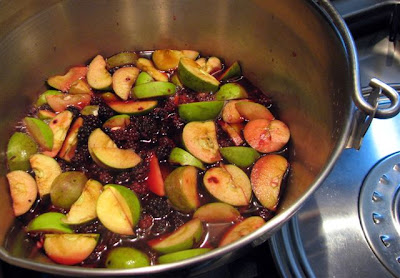
So, bramble jelly. I'm sure you all know how to make it, or else live in parts of the world where blackberries don't grow, but in my usual spirit of teaching my grandmother to suck eggs, I'll tell you how I did it. I picked somewhat under a kilo of berries, about two pounds, they don't have to be the most perfect specimens for jelly, then raided one of Victor's roadside cider wildings for a handful of the underripe apples, for the pectin, to make it set. I heaped them up in nonchalant still-life attitudes for the photo call, then soaked the blackberries for a few hours in cold water with some bicarbonate of soda. Not many bugs came out, and I rinsed them off.


Then I roughly chopped up the li'l green apples, and just covered the whole with water. and stewed and stewed them all up.


When it's all turned into a lovely dark purple mush, you get a big bowl and a jelly bag, and scoop the mush into the latter, and suspend it over the former. This is not a very photogenic part of the proceedings, because, at the risk of giving the more delicate among you an attack of the vapours, the distended jelly bag looks like nothing so much as a set of bull's testicles. I think I've lived in the country too long.


Anyway, it drips away happily, overnight if possible. Now this is my most important instruction: don't listen to any of those Women's Institute types who tell you not to squeeze the jelly bag. You must squeeze the jelly bag at the end, for several reasons: 1) You will obtain more juice that way, and more juice means more jam. 2) Who wants crystal clear jelly? It has much more flavour with a bit of pulp in it. 3) You will experience the delicious sensation of pectinous, purple, fragrant juice running all over your hands 4) You won't be able to help yourself. So, go on, squeeze that jelly bag, you know you want to, and furthermore, unless you work in a very specific sector of agricultural science, it's the nearest you'll get to squeezing a set of bull's testicles!
The next bit is where metric weights and meausures, about which I'm not normally at all Luddite, let you down, because there is no satisfactory metric rule of thumb corresponding to a pint to a pound. Measure your juice, and mix it in the preserving pan with sugar, a pint to a pound. I am continentally assimilated to the point where I only have metric scales, but I do still have a pint measuring jug. A foot in both camps.
Bring it all to a good roiling, or rolling, boil, then turn it down a bit and leave it for twenty minutes or so. You can skim the frothy stuff off if you like, which is good because then you get to eat it.
Setting. I still make mistakes and put jam in jars before it's reached setting point, even apparently idiot proof things chock-full of pectin like aple jelly and marmalade, and there's nothing worse than having to pour it all back in the pan and reboil it. (Actually, there's probably many things worse, but not in the area of jam-making. No, in fact, burning the whole lot to the bottom of the pan while you go back to bed of a Sunday morning, that's worse. I've done that too...)
The spoon test never seems quite reliable, I put a blob on a glass plate and put it in the freezer, then wander off while it goes on bubbling. In a few minutes it should be chilled and wrinkle when you push it across the plate. I reckon if it does, with the extra few minutes it's had while you've waited, it should be set. This method is also good because you get to lick the rest of the blob off the cold plate.
I never do any of the recommended waiting till it cools then putting it in sterilised jars. Cooled jam seems to me a recipe for mouldy jam in next to no time. I rinse the jars, lids on, with boiling water, then pour the hot jam straight in and screw the lids on. They go ping ping as they contract later. It generally seals well.
So now you have pretty purple jars of sweet stuff, to put on your toast and rice pudding, with no pips!


~~~~~

I'm writing this while I can, since the computer is complaining mightily, refusing to co-operate in unpredictable ways and throwing up blue-screen error messages. I've de-fragged it, done a hard disk check and fix, tried a system restore but it refuses to do that either, so I think I might call our friendly local anglophone computer whiz for advice, and perhaps visit the nice young Erwanns at Gigahertz. I don't like the idea of allowing Dell to come and take it away, but that might be necessary. It's no age to be breaking down like this really. I scribbled down all the impenetrable codes on the blue-screen message, and saved everything of value on DVD and USB key. Last night it wouldn't connect to the internet at all though the ballon was coming up telling me it had.

Another thing going wrong this summer, but a computer doesn't bleed or feel pain. If I have to do without it for a bit, I'll hold you all in my heart until we meet again, and dream of the day when we have advanced so as a species we can do all this telepathically without the need for cumbersome intermediary machines. See you soon.

Monday, June 16, 2008

Catching up, and elderflower cordial.

Well, there aren't too many standing out accusingly in bold on my feeds now, though there are of course those who've turned up recently who I haven't yet put on my feeds, and those on my feeds I haven't yet put on my blogroll... but I feel as if I'm something like up to speed again.

It's all over bar the splashing at qarrtsiluni, the editorial decision making is drawing to a close. The water-themed edition will continue to be published until well into July, and it's running at an unprecedented two posts a day, because, though we had to make many a heart-breaking decision and pass over much, we still accepted an enormous number, because they were all so delicious! If you haven't visited, or haven't been lately, please go and look. I feel inordinately proud of it, while being fully aware my overall part in it has been small. It's been a marvellous experience, if not always easy, and I still don't know what all its effects will be on me, but I think they'll be significant. It's been nothing but a privilege to work with the my brilliant and indefatigable, inspired and inspirational, co-editor and managing editors, and perhaps most of all with the writers, poets, artists and photographers who submitted work, I've gained glimpses into worlds I'd never dreamed of ...

Other projects and adventures and things to find out about await, ghazals and Mahima's travelling journal among them. More on these later, no doubt. And of course I really should be painting the back wall-plate and pointing the gable-end of the house this summer...

***
Gorgeous, Moon Walking Bee Drunken, with whom, as she is a Texan in the shires of South-East England, and hence a slightly culturally displaced person, I like to flatter myself I have something in common, often comes with me, virtually, on my walks with Mol. In fact, I would like to have more in common with her elegant, witty, informed, literary prose, she really ought to be writing a column somewhere, to say nothing of her knowledge of snickerdoodle and other baking matters. She enquired about elderflower cordial, and the making thereof, so, that process having just been completed, here is the recipe, with illustrations, before the blossoms go over. I love an opportunity to release my inner food photographer!


Ingredients:

1 kg sugar, I use white as it makes a pretty clear cordial and doesn't impinge on the delicate flavour, but I've seen browner sugars suggested, or some honey might be interesting.

850 ml (1 1/2 pints) boiling water

45g (1 1/2 oz, about four tablespoons ) citric acid, you really do need this, I tried doing without and using extra lemons the first time I made it, and it turned out horribly sweet and started to ferment almost immediately. Get it from the pharmacist.

15 to 20 elderflower heads. Don't pick them too green or in bud, they're difficult to separate from the stalks and will taste of cat's pee. The further blown they are the better, though obviously if they've got too many black bits that's not so nice.

2 sliced lemons.


How to make it:

Strip all the little flowers off the stems. This takes ages, c'est un travail de patience, but I am, relatively, time rich and cash poor. Some suggest doing it with a fork, others with scissors, but in my experience, you can't beat just pulling them off with your finger tips. The aim is to get as little stalk in with them as possible. Remember, white bits of elder = ambrosial perfume and flavour worthy to be drunken by angels, green bits of elder = cat pee.

I have to add this process is probably not recommended for any with a pollen allergy, I have a disgustingly robust constitution as regards anything like that but my nose still tickles and a blocked-up headache lurks at the edges of my awareness for a day or two after I've done it. Your fingers become a delightful dusty yellow.
Finally, you end up with a bowl of fairy confetti.


Put the sugar into a big bowl, and pour on the boiling water. It looks a colossal amount of sugar, which makes you realise how much sugar is contained in commercial drinks and sodas. Stir until it dissolves. Stir in the citric acid, elderflowers, and sliced lemons.


Cover the bowl, and leave to stand for about five days, stirring daily. The stirring is quite important as the lemons have a tendency to catch a bit of mould, so keep an eye out for that, fish'em out if they do. It will make the whole house smell heavenly, and is almost worth doing just for that.

Strain once through a sieve, and again through the sieve lined with muslin, or I use kitchen roll, with plenty of changes. Coffee filter's probably a bit too slow and would block.

This makes about a litre and a half, and although it's not so elegant, it's best to store it in the 'fridge in plastic bottles, a large mineral or tonic water water one is ideal. Elderflowers must contain huge amounts of natural yeasts, as all it really wants to do is ferment. The citric acid inhibits this to a point, as does the cool of the fridge, but it is a wild and mercurial brew, so drink it up quick. Shouldn't be too much of a problem. Dilute it to taste of course, perhaps one part to four or five. It's also very good on strawberries and lemon sorbet.