Sunday, March 27, 2011

Spring: pussy willow, shopping, spring cleaning, something new and something all too familiar.


Pussy willow (with bee).
~

Saturday morning shopping, it is spring and everyone is smiling, I didn't know I could enjoy the supermarket and its denizens so much.  A very small boy walking across the car park with his father, a large, luxuriant-leaved pineapple about half his height tucked under his arm.  In the shop, another lone small boy stands wide-eyed as a good-looking young man in costume flips crepes on an electric skillet.  The large lady with the short grey hair at the till in front of me, who now and then gives me an rather conspiratorial smile, is buying yogurty desserts and chocolates (grandchildren fodder, I imagine), some very sticky-looking choux buns, six tomato plants and a garden hoe of very traditional design, a large white cotton bra (sans lace or underwiring - nice to be comfy, nice to be nice...), a litre of whisky and a litre and a half of pastis.  She departs with a 'bon weekend!', looking as if she intends to have just that.

~

I sweep the front of the house and clean the windows.  I plant the blue room window boxes with light blue pansies, primrose yellow primroses, and white grape hyacinths.

~
I pass Tom his evening drink and find he is watching the Boat Race, and almost jiggling in his seat with excitement.  I remark on this and he says that he always does, he loves the Boat Race.  Well, well, eighteen years together and I never knew that.

~

Currently thumb-twiddling waiting for Tom's sister and brother-in-law to show up, having had a call from them yesterday saying they're on their way back from Spain in new luxury camper van and will look in 'just for a cup of tea'.  We aren't really on their way back at all so it's awfully sweet of them to come out of their route, but what with the loss of the hour and all we are feeling a bit pressured by this, and that our precious time is getting rather squeezed.  This in turn makes me feel guilty; why must I continually perceive and transform so many things which should be normal and pleasant into obligation and onus, so much that could be a source of satisfaction and ordinary human interaction into sources of anxiety, recalcitrance and even resentment?  Why do I so often recoil from the idea that anyone has any expectations of me? I need contact and the bonds that make us human, just like anyone, and if I didn't have them I'd quickly start fretting that I was excluded, isolated and unloved, but why do I just find it all so difficult?

Never mind, it'll be fine once they get here, or at least once they've been and gone!

~

Thursday, March 24, 2011

New blogroll gadget!

A couple of years ago I deleted almost all my IE feeds, feeling that they were extending a tyranny of guilt over my life that I was continually racing to keep up with them and never succeeding.  I simply kept my blogroll and tried to do its contents justice, occasionally adding to or taking away from it.  Then I started using chrome anyway so the IE feeds became an irrelevance.  I kept a very few blogs on Feed My Inbox, then later on Google reader, because either they posted very infrequently but I didn't want to miss them when they did, or else they were daily - and usually fairly succinct - posters and I liked to keep up with them regularly rather than fall behind.

However, I've finally been seduced by those rolling feed blogrolls some of you have got, and have transferred some 50 odd blogs to one of those, as you can see.  Owing to the very narrow sidebar here - HTML adjusted so that I can post egomaniacally large photographs - I was unable to have them appearing with a snippet of text, or even thumbnail photos, which is a shame but it just looked too crowded and awful, but the title and time of posting are pretty appetising anyway.  I also limited the display to the 25 most recently updated blogs, to be tidy.

Some of my old blogroll  I have kept as a straightforward links list below.  If this is where I've left you, rest assured it is no disrespect; either I already have you on the other two feed-reading arrangements mentioned above, or else perhaps I like to visit as and when and prefer to have the link in a fixed and handy place and not moving around with the feed.

I'll see how it goes, but I do like the dynamic thing of it, and also that the blogs appear in a separate window, which is handy, I reckon.

Sometime, now I've found out by happenstance how it is done, I might get around to making some fixed pages.  Or I might not.

Tuesday, March 22, 2011

St Pol de Léon, the cathedral, the dead and their heads.


St Pol de Léon (famous for artichokes, and cauliflowers too) is a place that might easily be overlooked by British ,or Irish, ferry passengers, disembarking at Roscoff (famous for onions) and heading straight on down to wherever they're going, bypassing it completely.  But we like it, including its 13th century cathedral, which is imposing, outside,


and inside.


It's quiet and twilighty, a bit dusty-feeling and melancholy as so many French churches seem to be,  but there are many interesting and lovely details.


St Pol, Paul Aurelian, was one of those Celtic saints that came bobbing over to Brittany in the dark ages at the time of the Franks and Merovingians, and got all mixed up with various pre-Christian ideas.  He had to see off or subdue a number of creatures who didn't want any saintly hermits setting up on their patch, such as this fine wild bull, who he sent off back into the forest,


a pesky dragon, which he led off, no sweat, occasionally belabouring it with his crook, to the water's edge whence it swam off,


and a grumpy wild sow and her young whom he persuaded to become tame and stay around (they''re running along the bottom of the picture in the window below).


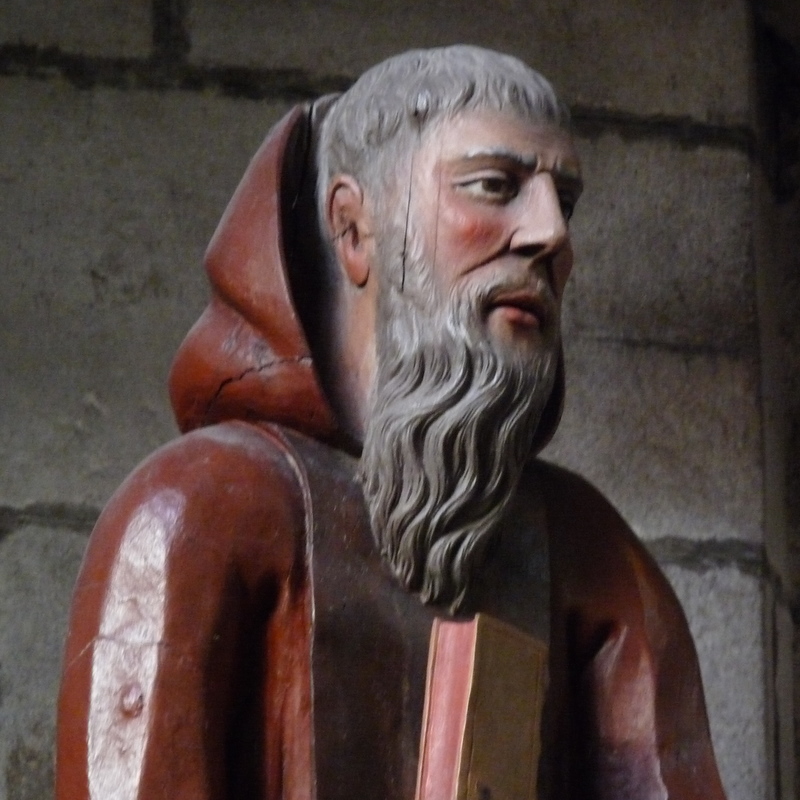
I have been known to deplore the heavily pig-oriented nature of the agrarian economy in this part of the world, but things porcine have clearly been a preoccupation for a long time.  Here is St Antony, in good old wood polychrome.  His face is soulful, wise and world-weary, expressive and well rendered,


but someone clearly had some fun with his emblem - a pig.


Many people have been buried here, this stone set into the flagstone floor looks very ancient,


and this 18th century bishop had his well-fed, country face, as well as his gorgeous robes and trimmings, very exquisitely sculpted in marble for his tomb,


but below him the reminder of what all these things would come to.


But oddest of all these rather lugubrious artefacts were these.


Reliquaries, containing the skulls  (le chef originally meant the physical head, still used in the informal expression remuer le chef, to nod the head) of people disinterred from under the church floor, and later from the cemetery.  They are called, it seems, les étagères de la nuit, which, directly transalted as 'the night shelves' doesn't make a lot of sense, but according to this Breton expert on Flickr, it implies the levelling ( an obsolete meaning of  étage is connected with rank) of all in death - nevertheless, the bishop's is the fanciest by far, the big gilded one in the top middle... 


Little boxes - in poplar wood apparently, the same as is still used to make the crates for the artichokes and cauliflowers - in the form of little chapels.   They are simply painted in monochrome, often with a cross on top and sometimes a bit of other decoration, an aperture in the front in the shape of a heart or a trefoil, and the name of the person whose skull it contains.


The wiggly forms painted on the one below, and on several others, puzzled me, looking as they do like tadpoles or, indeed, spermatozoa, so that perhaps the very beginnings of life and the very end of it seemed to be coming together!  They are though, it seems, a representation of teardrops.


These collections of chefs used to be, apparently, quite commonplace in many Breton churches, and were part of the furniture of the ossuaires, the charnel houses, which are a notable part of the famous enclos paroissiaux of the region.

This has strong echoes to the cults of the dead and the head of the pre-Christian Celtic past, but the relative intimacy with mortal remains is nevertheless unsettling, of course. Prosper Mérimée was horrified and repulsed by what he saw as the casual  and disrespectful attitude of the Bretons to their, often not-long-enough, dead.  In recent times, just back in the 1980s, one reliquary and its contents, and one skull were stolen from here.  There are local folk tales, however, of people, mostly the young and curious, daring or naughty, who pushed their luck too far getting over-familiar with skulls and bones.  Generally they died of fright.  And hang around in or near bone houses too long, they say, and you might hear more than you want to...


Tom put his hand through the bars and gently ran a finger along an exposed eye-socket.  I was quite surprised, but it was not done in a spirit of bravado or of wishing to shock.  


" Jacquette," he said, reading the skull's name "I'm sure she won't mind."


~~~

( A good site for information is to be found at Ossuaires et Reliquaires en Basse Bretagne.  In French and rather small font, but some fascinating stories, extracts and astonishing photos. As I have been known to lament before, as one brought up with English parish churches and the obligatory leaflets on their history, architecture and features that one picks up as one enters, it is rare to have any information on the individual French church buildings and what they contain, only standard issue Catholic pamphlets about the benefits of the Catechism and of making the pilgrimage to Lourdes.  So one has to do one's researches before and/or after visiting them.) 

Friday, March 18, 2011

Clarifying

I'm a bit worried about the matter of thews.

Thews is an old word for the sinewy muscly manly bits in arms and legs, which are very visible and exaggerated in some William Blake's paintings, and which the ripply patterns the water makes in the sand remind me of.  The ripply sand patterns aren't called thews!

Just thought I'd better clear that up, in case I misled anyone and any readers of this blog anywhere might find themselves perplexing their companions while walking on the beach  by pointing downwards and remarking 'Look at those thews!'

Now.  Fruit liqueurs.


Sloe gin  -  orange spice  -  quince


Thursday, March 17, 2011

Thews


The patterns made by rivulets of water over sand are some of my favourite things at the seaside.  Sometimes they look like trees, or cloud shapes, or even twisted bits of cloth, but often they remind me of anatomical drawings, or the limbs of the figures in some of William Blake's paintings.

Thews, I think they're called...


Tuesday, March 15, 2011

L'île Callot

The rain stopped, and tide went out, and we walked across the causeway to Callot.  


There is something liminal and tantalising about islands accessible at low tide, with their causeways which appear and disappear.  Short of staying here, at least for the twelve hours between tides, or perhaps using a small boat, you can't really have a sense of this as an island, but more as a straggle of sandy outcrop, rock and mussel beds extending from the peninsular of Carentec.


The chapel, it's said, has been a place of pilgrimage for more than a thousand years, the corsaires sailing out of Morlaix to do battle with the English would salute it as they passed with a cannonshot,


and clearly it's much frequented and gifted with votives and artworks still; one of the plaques on the wall above was for a fisherman lost at sea in 2004.


 I couldn't find out anything about the painting above however, one of a pair.

A lovely walk, and another corner of the bay to explore.

Monday, March 14, 2011

Witchy trees

A stand of twisted oaks, as much ivy as oak, looking out to sea just above the cliff path, on the first evening we were there.  The tide was high and the early evening light off the sea was good.


Sunday, March 13, 2011

Monday, March 07, 2011

Oops...

While messing about here trying to remember how one actually does things so as to be able to explain it to someone else, I inadvertently put up a post containing nothing but the words 'blah blah blah'.  I deleted it immediately but there is the irrevocable horror of feeds and feed readers that mean that once committed in that way, then, like a fatwa or flatulence, once a blog post is out there there is no calling it back.  

So, sorry about that feed reader readers!  Just to make up for it, here is a picture of Molly in the woods, not today but a week or so ago.    

Lovely walk with Rosie and Porridge, now I really must go pack a bag.  See you in a few days.


Saturday, March 05, 2011

Hobnobbings, changelings, spotted wings, siblings, and other things.

CG Jung, it was once told, was asked by a needy client (patient, analysand, whatever the recipient of Jungian analysis is called) if he could see him the next day.  No, Jung said, tomorrow I will be busy.  The next day the patient came across Jung on the banks of the river engaged in tossing stones, building dams, paddling his toes and such like, as the illustrious man liked to do.  But you told me you would be busy today! - protested the patient.  I am, replied Jung.


When I was approached by the very nice mother of a very nice girl who is approaching her school leaving exam with a view to some English coaching, I told myself the (probably apocryphal) Jung story again and said that for the duration of these holidays I was too busy.  She looked disappointed and queried it, but I stood by my resolve firmly, without any sense of obligation to explain what I would be busy doing.


I was so utterly fed up and tired of work by the time the the winter holidays came at the end of last week that I was quite prepared to hunker down in an introvert huddle, snarling and snapping at anyone who came near me, for the duration.  In fact though, I have been rather enjoying catching up with my friends, in my own time and theirs, without having to fit them around other commitments if I saw them at all, and ending up strained and ragged and unfit for human company.  So I have celebrated D's 88th birthday with champagne, done yoga at leisure with E, explored the outlying woods and orchards of various châteaux and drunk Darjeeling with B the German doctor, been read to delightfully and chatted about translation with H, had coffee with A and turned our faces to the early spring sun in the lee of her house wall, and there is still a walk in the woods with Rosie and Porridge to look forward to on Monday. The only problem has been it's led me to eat rather a lot of cake and biscuits.


In addition, Tom and I no longer have any Radio Times crosswords outstanding, we have watched several episodes of Inspector Morse on DVD, I have despatched the second half of Middlemarch, which I had wandered away from some time in January in the middle of a rather doldrummish patch of provincial politics, and Molly has had a good brushing and a trim round the head and ears (her hairdresser was on holiday so she was spared her thrice yearly shearing, which, in view of the chill wind there has been of late, has probably been a blessing for her).  I've even dallied with a little light housework, and Tom's been out on the garden a bit, though I haven't much.

~~~

The volume of Salley Vickers short stories, Aphrodite's Hat, was like a box of good chocolates, some sweet and light, some darker and more bitter, some hard centres and some soft, some with a surprising twist of chilli pepper in.  Very easy to keep dipping in and taking another and another, to see what the next would be.

Oh dear, so much for my resolve to try to write more intelligent and articulate reader's responses to the things I read.  Already it has degenerated into self-induced synaesthesia which whimsically insists on seeing books as food items. Never mind, the link will take you to a proper review from the Guardian, which also, and I didn't know this when I made the chocolate analogy, describes it as a box of delights.  

However, by coincidence after I'd mentioned the uncertain dimensions of the fairies in A Midsummer Night's Dream, it contains a story, The Indian Child, which takes a wryly different angle on the quarrel between Oberon and Titania which is one of the central elements of the drama.  It begins

"But what, beyond the world, does she want with a human child?" the visitor enquired.

then later, revisiting the 'ill met by moonlight...' scene, 

The king [Oberon] left alone and caught off-guard, drew himself up to his greatest height.  Quite what that was would be hard to quantify, but it had the effect of his seeming to tower above the queen when she swept into the glade followed by her extensive retinue.

Which pleased me, that someone else had thought of it and by serendipity I came across it.  Then a bit later there was this post at Christopher's, which doesn't have a lot to do with the matter of Shakespeare's fairies, but does contain  this picture, a bit of Victoriana fairy stuff, which also attempts to tackle the Dream's muddle of scale and perspective in visual terms.  I would correct Christopher on one thing though, and Salley Vickers makes the same point, the Indian child was not a changeling.  He was taken from the human realm because his mother was Titania's friend and died in childbirth, he was not duplicitously changed for a fairy child.

One Brothers Grimm tale, a short one, tells how to retrieve a human child thus swapped.  The trick is to make the changeling laugh, which will break the spell.  This is best done, it seems, by boiling water on the fire in the broken halves of an eggshell.  The changeling in that story, on seeing this spoke the words

Though I am as old as the oldest tree
Cooking in an eggshell never did I see!

and laughed, at which a group of elves rushed into the kitchen carrying the human child, replaced it, and took the changeling away.

(Mervyn Peake's illustration of the changeling )

This in turn led me to thinking of Yeats' poem The Stolen Child, and the matter of child abduction by outside forces.  These tales and songs of children taken off by the fairies, (up the airy mountain, down the rushy glen...), mostly strike us as quaint and picturesque, a bit of pretty folklore and legend, if a little eery and melancholy.  In Loreena Mckennitt's setting of the poem to music, the background sounds of dogs baying and people shouting suggest more forcefully the reality of a child disappeared, the panic and desperation of the human community which stalks our nightmares still. If there really was a folk belief that missing children were taken by beings from beyond the human dimension, to a place where time and life went on differently, was it a comfort, I wonder, compared with our far more concrete imaginings of what can happen to them, including the fear of outside hostile agencies which are all too human?   For the world's more full of weeping than you can understand...  

~~~


We go on feeding the birds, they sit in the amalanchier tree and chirrup at Tom when he goes out there in the morning.  Emy, our vet, says that once there's blossom on the trees they should be feeding themselves, but Tom quickly grows attached to anything he perceives to be depending on him.  I have said once this food is gone I won't buy any more.  Emy had two budgies, a green and a yellow, in a fine golden cage in her reception area when I called in for a natter and some dog food.  Someone had brought the yellow one in on a cold day, having found her at his window, asking to come in.  Emy said they put her in a hamster cage, faute de mieux, then grew rather fond of her, so they bought a proper cage and another budgie to go with her.    

A VIP visitor to the garden is this fellow,


greater spotted woodpecker, not uncommon hereabouts but the first time we've had one regularly coming to the garden.  I have the impression they're quite territorial.  When I was about ten, my friend and I (RR, I think it was...) found a dead one of these on our school playing field, a road casualty.  We buried it in somewhat makeshift fashion under some grass and leaves in the bank nearby.  A day or so later, our science teacher asked us to bring in some specimen of nature to display and discuss ( we were a bit big for show and tell...).  We hit on the bold move of digging up the dead woodpecker, which we put in a cereal box and took along to our science class, with half an idea we might be able to shock the teacher and our classmates.  The teacher, Mrs Q, a rather delicate-looking old lady not too far off retirement, was nothing like so easily discomforted, showed a lively interest, and spread out the dead bird's wings to show the remarkable patterning of spots which give the bird its name.  A shower of ants fell from the feathers, which she stamped on energetically.

~~~

The Canigou is Catalonia’s Holy Mountain. I suspect that this is at least partly because it has been seen as the gatherer of rain, distributing it to the valleys at its feet, supplying the orchards of apples, pears, cherries, peaches and nectarines, as well as the plots of vegetables. There are complicated systems of irrigation here with stone and concrete channels which collect the water from the streams and run for miles around the hillsides, feeding the fields and orchards through little sluice gates at intervals.

I have been here in May when the rivers are rushing with snow melt, and in September when the snow has gone but thunder rumbles deeply around the great ravines that run upwards for thousands of feet  towards a summit so often concealed by cloud. The Canigou is a benevolent giant generating water in what would otherwise be a dry landscape, and discharging alluvium into the valleys at its feet,


Number Two Brother, Chris, who lives in the Mayenne and who wrote the guest post 'Cats', which receives consistently more hits on Box Elder than any other post ever, is blogging at last.  I'm a little wary of plugging my family's blogs, as they tend to start and then find life gets in the way, and I don't want anyone to feel under a sense of obligation or expectation about anything.  (In fact Number Three Brother Phil has been blogging quite steadily if infrequently for ages, but it tends to be a specialist job about Doctor Who or other SF, or about the games he designs, which sound fearsomely clever but are somewhat of a mystery to me; though occasionally he writes a cracking good review of an exhibition or some such ).

I set the blog up for Chris getting on for a year ago, at his request, but then I think he lost the e-mail with the instructions, then winter set in and the office wherein dwells the computer became too cold to spend a lot of time in, but spring is around the corner and he seems to have overcome his keyboard aversion so we're on the way, I hope.  The blog title, Artisan or Wanderer, describes how he sees himself, and his wish to explore the tensions created by 

the need to be somewhere one knows and feels secure, and the need at times to be somewhere else; one organism, struggling to decide which direction to go in...

As well as cats (which may not in fact feature very frequently), he's good on art and architecture, particularly the Romanesque, the Camino pilgrimage, cycling and travel in general, building, being displaced, and a whole slew of other potentially fascinating subjects, so please keep an eye out for him.  I have warned him that old-fashioned blogging like this is an evolutionary blind-alley from which most people have retreated in favour of Facebook and Twitter, but I can't imagine that bothers him too much. It doesn't bother us, does it brothers and sisters?

~~~

Off to Kerbiriou again for a few days next week, it's early to be heading off, and it may well be chilly, but no matter, it's cosy there and we'll have books and pens and paper to keep ourselves busy, and we should find somewhere open to eat.

Still quite a few things to do, so I must draw this meandering to a close for now.  Might post again before I go, might not!