Showing posts with label mise en abyme. Show all posts

Monday, September 22, 2014

Finistère mises-en-abymes


Not sure about how the plural works for that. Anyway, we are returned from a truly marvellous, wonderful and lovely trip, with many many experiences to reflect on and photos to edit, but just for the moment here are three separate instances of mise-en-abyme I found on three separate days out.  In fact they are only really just mise-en-abyme, since it seems to me that to create the true sense of mirrors reflecting mirrors and fractals disappearing into themselves ad infinitum they need to be to the power of three at least (an image within an image within an image), whereas these only really repeat once, but they were, as it were, naturally occurring, and once I'd found one I was looking out for others, and was happy to find a trio, so the infinitely repeating and dwindling pattern must be left to the imagination.

  • On a door in a wall as we walked the perimeter of the Kernéléhen peninsula, straight from the door at Kerbiriou,


  • and finally, and perhaps my favourite, a mail box replica of the house it belonged to on the beautiful Île de Batz just off the port of Roscoff, though if it had been mine I would have had to make a replica of the replica out of a matchbox or something.


I must find away to bring more mise-en-abyme into my life...

More anon.

Sunday, August 17, 2014

A trip on the Sainte Jeanne # 1 (before we even get on the boat...)


Last weekend, we headed up to Erquy to take a special 20th anniversary trip on the Sainte Jeanne - it was the boat's anniversary, not ours. As we later learned, she was wrecked in the 1930s off Paimpol, by the actions of a skipper cutting corners by overloading her and relying on a recently added engine to get him out of trouble which then broke down. She was rebuilt and relaunched in 1994. Needless to say, I took a lot of photos, and Tom took some more with my camera, which it's taken me a week and more to sort and edit.

It was a day of a high tidal coefficient, something we've kind of known about in the abstract, but have lately become aware of and interested in, after inadvertently making an evening outing a little further down the bay a few weeks before and finding our usual walking beach non-existent, familiar rocky landmarks disappeared, and the sea beating at the cliff stairs at our feet.  It was curiously exciting and magical and made me think of the Franklin's Tale. (It seems the town of St Malo is even trying to make a tourist attraction of this phenomenon.)


So, although it was nothing like the lowest point of the tide that day, when we arrived in very good time so as to get a parking space, there was not much sea to be seen - all that we could see-see-see was the bottom of the deep blue sea-sea-sea, in fact. 

But we also saw plenty of people enjoying an old fashioned seaside experience,


some having less traditional fun,


And quite a few happy dogs sharing the day, the ice cream and the tidal mud.


all of which did our hearts good.

The Sainte Jeanne, which we'd been told would leave from the harbour wall, was not to be seen there. Le Grand Lejon was there, but clearly wasn't going anywhere just yet. 


Her crew didn't seem too bothered, they sat around nattering and lunching and making fairly merry.  After a while they made to hoist a sail or two.


the main one had a picture of the boat painted on it, thereby creating an always pleasing (to me anyway) mise-en-abyme effect.

Don't worry, though, we were told, the Ste Jeanne was in open water the other side of the fishing quay, and we would be conveyed to her by a smaller vessel. So we went to have a look.


On the way we saw the official tender, painted in matching livery, or whatever boats paintwork is called. It seemed a tiny cockleshell to carry many people, we thought.

Passing the fishing port, very much the business end of Erquy, there were lots of examples of the kind of counter, original, spare and strange stuff, lines and shapes and textures and colours, that I find hard to pass by, though I didn't linger too long.


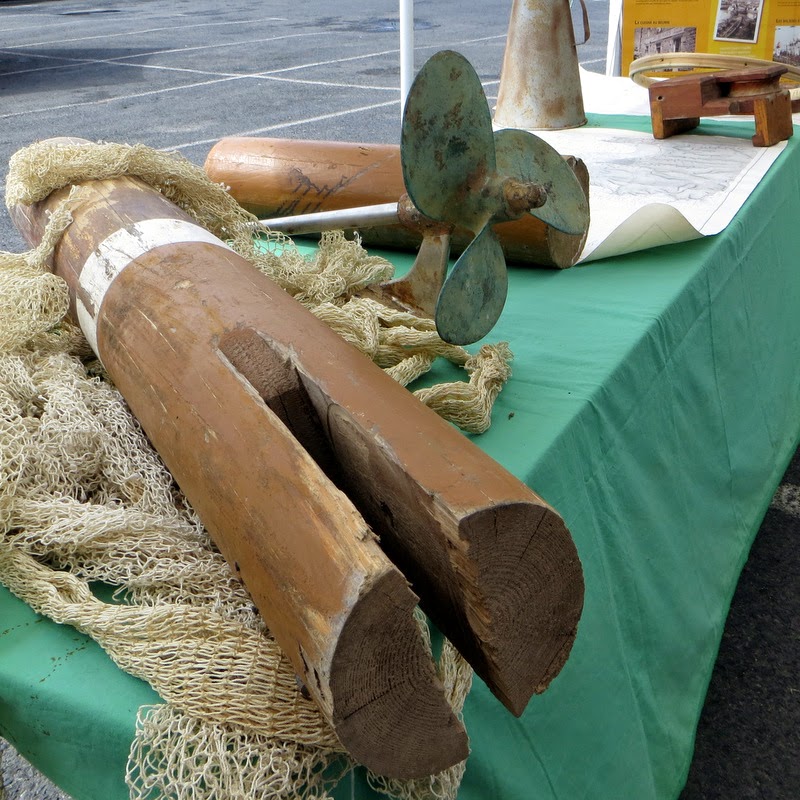
and  a more artfully arranged exhibition of older gear and tackle and trim, chandlery, books, maps and prints:


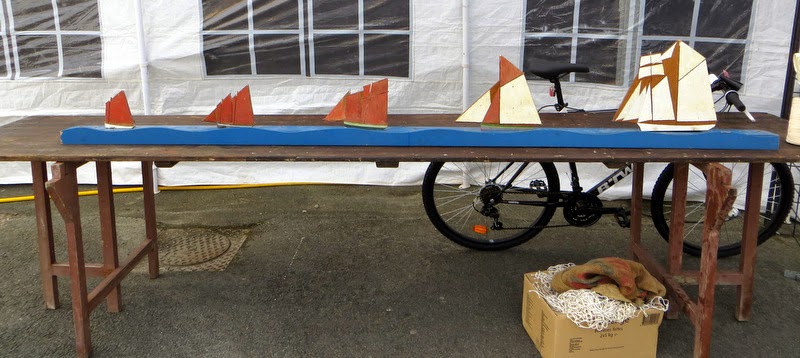
 as well as some models of different kinds of old working sailing boats.

Another very minute detail of something, which I reckon is worthy of a digression, was to be spotted down a drain. (And if, like some, myself included, bits of workaday and rugged cast iron street furniture float your boat, the drain cover in itself is worth looking at. No? OK.)


What I spied through the grill, just about visible here as three white stripes, I recognised as a netting needle. When I was about eleven, I had to endure school needlework and 'handwork' lessons.  Despite having stitched and worked a sewing machine and made all manner of things quite competently with my hands from almost before I could walk, I was a hopeless failure and bottom of the class in these areas of the curriculum. Mostly this worried me not one whit, except that those who shone were allowed as a special privilege to do netting.  This involved turning a chair upside down, tying a lot of lengths of string to it, and somehow weaving and knotting in and out of them with a netting needle, around which was wound another length of string. I didn't think this looked a particularly satisfying process, my interest was in the potential product: a hammock. I always wanted a hammock.  I'm not sure where I would have put one at the time, since there weren't really two suitable trees in our garden, but I dreamed of one anyway.  I do now have one, in fact, not made of netting but very handsome blue and green canvas, which can be hung between the timbers of our open barn thing in the summer, but I don't in fact use it much. However, seeing this tool in this context, I understood for the first time that the technique wasn't simply a bit of leftover Victorian effete hobbywork for nice young ladies and gels, but was and apparently still is really used by fishermen for real fishing nets. In these times when fishing seems a murderous, industrialised, globalised behemoth, and indeed, young ladies and gels occupy their fingers principally with checking their phones and Facebook accounts, I find that rather cheering.


Two other old-fashioned sailing boats and a more modern Bermuda sailed, fibre-glass hulled yacht flapped their sails idly in the fishing harbour while the people on them sat about nattering to one another from one craft to another.  We scrambled up the rocks along the harbour wall and saw the Ste Jeanne waiting on the other side.


Unfortunately, the wind direction was such that we couldn't get a nice sideways view of her, but later we were able to. We strolled back to the meeting point and were issued with life jackets, which were rather hot and bothersome and cumbrous,


and off we went.

(To be continued...)

Monday, November 12, 2012

Mise en abyme

Setu, who knows many languages and all kinds of amazing things, and also hails from sardine country himself, has filled another gap in my knowledge: the device whereby the lady on the sardine tin is holding a sardine tin with her own image on it, presumably, if one could see, holding a sardine tin with her image on it etc, is known as mise en abyme.  According to Wiki (the link given), it is used to describe 'the visual experience of standing between two mirrors, seeing an infinite reproduction of one's image' as in the painting Las Meninas by Velasquez, but it originally came from heraldry, when a coat of arms contained another coat of arms within it.  It's acquired currency in modern critical theory, and can be used to describe plays within plays, representations of buildings contained within the same buildings themselves - there's one of these in the stained glass in the church in Moncontour - films within films, dreams within dreams even.  It's long been used in packaging and marketing and children are particularly taken with it, and of course it's also related to the theory of fractals.

Setu's own first awareness of it was on the Vache-qui-Rit box, where said Laughing Cow is wearing ear-rings of boxes of cheese with the same image on. My favourite instance of it was in the model village at Bourton-on-the-Water in the English Cotswolds, which was a perfect replica of the actual village at the time, and contained a model of the model village, which in turn contained a model of the model of the model village... not sure if there was a recognisable one within that.

Considering the prevalence of the device and of the term for it, and the importance and interest in it in all manner of circles, I'm rather ashamed not to have known about it before, but I love learning new things (as long as they're nice ones, of course...), and will look out for it now.  It's also brought it yet further to the front of my consciousness that I want to read Borges, whose stories of rooms within rooms, libraries within libraries, reflections of reflections, Setu  said his early diet of La Vache qui Rit prepared him for well !  My sister sent me a copy of The Other Tiger a while back, and lately I've been fascinated by Zoe Blue's strange and beautiful paintings and reflections inspired in part by his work.

Anyway, I wondered how I might try to produce something in the mise en abyme line myself. I was pointing the camera around in the kitchen, particularly at different coloured circular objects with shiny surfaces, thinking I might just do a collage, and it occurred to me one could do a collage within a collage...

I took it to the power of six, so there are five collages contained within the final one. It becomes rather compelling, not least because Picasa will automatically shuffle the images each time, and one has to keep recreating the order, only substituting the last collage made each time in the final space.  I exported and posted it full size, so if you can embiggen it (there's an expression one doesn't hear so much now!) sufficiently, you can perhaps see what I mean.


~

Saturday, November 10, 2012

In a hurry? Why not a tin of sardines?


A very quick post here as we're off to eat curry with the Quiet American.

Tinned sardines, a part of the cultural landscape of Brittany.  The canning plants often long established, in quite remote places on the coast, even on islands, their names punning or picturesque: Connétable, la Belle Iloise, Phare d'Eckmühl... The tins themselves I think are often minor works of art, and delightfully old fashioned. This brand, la Douarneniste I've not come across before, but I scanned it because I thought the Breton lady was lovely, not least because she's holding a tin of sardines with her very own image on them, which presumably, if one could go small enough, would be holding another tin of sardines with her picture on, and so ad infinitum, an old device which has always intrigued.

And they taste rather good too.