Showing posts with label Monts d'Arrées. Show all posts

Friday, November 14, 2014

Friday night...

... and even less of a post tonight, but I've had the gardener bending my ear about how he used to work cash-in-hand for a Polish countess who was Mitterand's mistress and he wasn't allowed to prune the roses as that was Mitterand's job, then I spent the evening cooking moules farcies then Tom lost his eating reading glasses and we had to look for them before we could eat the moules farcies and they turned out to be in the barn next to the tile cutter where he'd left them after cutting his thumb on a bit of broken slate, and now I've rather run out of steam.

So here are three photos of Molly, with her companion humans, on our last holiday with her in May in the Troglogites in the back hills in Finistère:


having a roll around on the carpet,


enjoying her kennel on wheels (that isn't a pink sausage roll in her mouth, it's her tongue)


and on our way out.

Time for a glass of wine, see you on Saturday.

Sunday, June 01, 2014

Meditations on moorland


Wendy recently posted a fine meditation on the psychology of landscape and people's response to a moorland, which more often than not an uncomfortable one: 'its very openness mistrusted for a lack of delineation and directive patterns'.

I was expecting myself to struggle more with a sense of fear and hostility to the landscape of the Monts d'Arrée, but I was curious to find out.  Wendy points out that the kind of person to whom the emptiness of moorland does appeal is 'not necessarily the clichéd solitary spirit of romantic literature'. In fact the one of the people who encouraged me to go there was my knitting buddy Soize, with her busy small town life and all its networks, her lively family, funny dog and hobby 2CV, but whose eyes kindled when she told me how she loved the desert landscape of the Monts, as did those of her cherubic twins when they showed me the photo album they'd put together of the trip and told me with glee that it was 'the Gates of Hell!'

And when I came to walk in that landscape, it was like a return, and I remembered that in fact I had loved moorland as a child, from chasing ponies on Dartmoor and Exmoor, to marvelling at the slopes of the Yorkshire moors (hoping vainly to see a merlin), to falling in love with the uplands of the Long Mynde in Shropshire on what turned out to be a sad family holiday (which I wrote about here, a long time ago).

Childhood literature fostered this rather, many of the adventure and pony books I remember reading (I was not a precocious reader, when I was a child I read as a child, so the menace and melancholy of Wuthering Heights, Hardy's Heath, and even Jamaica Inn I didn't come to till I was older) featured moorland as exciting and full of adventurous possibility, and somewhere often to which the characters ascended at epiphanic or transitional points of the narrative. I remember a description in (I think) an Arthur Ransome story where the moor is described as like a ragged counterpane thrown over the skeleton of the earth, with the rocks as bones showing through in the threadbare places, and a passage in a pre-war pony book, Jerry the Story of an Exmoor Pony (a hand-me-down from who knows when which I held in such nostalgia that I recently sought out and bought an old copy on-line) where the eponymous equine and his young rider follow a stag hunt, to a high and desolate part of upland where 'the moor looked wild and, even at this time of year, rather stern.  Colourless too, for there was very little heather, only crisp wiry grass. The very sheep looked different...' Everyone the boy knows has been left behind, including his father who has tired earlier with an injury,  he is among strangers.  A sudden storm washes the landscape, the hunt is abandoned, then the stag appears, to the boy's eyes only, from a thicket, but he says nothing, allowing its escape.  Yes, yes, I don't like bloodsports either but that's kind of mythic, isn't it?

No stags where we were in the Monts, that I know of, or even many sheep, though the last wolf survived there until 1906, but it is good horse country; we saw more evidence of horse riding and pony trekking her than elsewhere we've been in France.


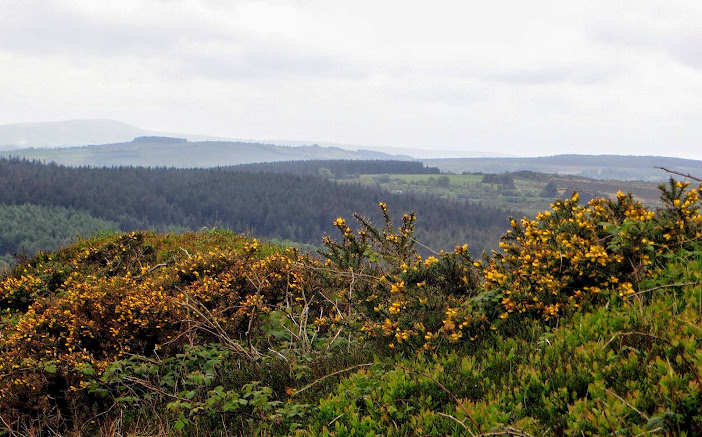
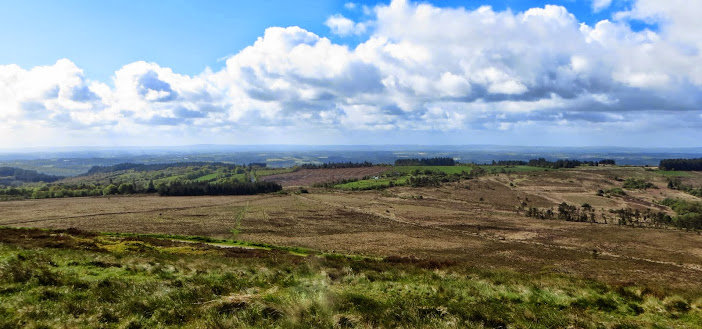
For me though, much of the appeal of moorland, I think, is the juxtaposition of vast to small, macro to micro, the wide horizons and long views,


set against the fine detail of the flora and fauna and stone, detail which would be lost in a mass in a lusher landscape,


the counterpane may be threadbare, but it is nevertheless finely bejewelled and embroidered.  Much of my delight in the heathlands I discovered as a child was in the rich texture of the heather and in finding the succulent tiny jewels of bilberries, though it was too early for those now, in fact moorland comes into its full beauty perhaps in late summer, when more fertile country is often overblown and past its best.

On such an open and austere canvas, marks and lines, whether natural or man-made


acquire drama and power, indeed, human constructions and objects become quickly weathered into abstracts and emblems:  


It's worth rediscovering the moor.

~

(I should have got this post done a while ago, I've some excuse to plead that I've just been knocked over by some unpleasant flu type thing and have only just been able to face screen and keyboard.  I have more photos of the trip to post, and will try to do so before they are completely out-of-date!)

Sunday, May 25, 2014

Wendy's Monts d'Arrée


A rather wonderful thing happened when we got to the Troglogîte.


Wendy Mewes is my go-to writer when I want to know anything about Brittany, especially Finistère, and something of an all-round hero.  She lives very close to where we stayed, but she does guided walks and researches and writes about the whole region,and keeps a blog about her activities here. She is a power-house of information and knowledge, of imaginative, accessible but rigorous writing and scholarship, plus she's an indefatigable walker and loves dogs. Her first book I discovered was her History of Brittany, and it made me appreciate what it is to be a proper, trained, disciplined historian, who can assimilate and retain huge amounts of knowledge, evaluate it and present it in a form that's concise, readable and appealing. In addition, of course she's working with sources in a second language, which clearly doesn't bother her much but must make things a bit harder going, though in fact her books on Brittany are often translated from English into French.

I already had Finistère, Things to see and do at the End of the World, which covers the whole department and was giving me plenty of ideas - it's set out in fourteen scenic driving tours each rounded off with a comment with particular recommendations, pieces of advice and remarks about anything that has personal resonance or affection for Wendy herself, which is a nice touch.  When I noted on her blog that she was also bringing out a short guide especially about the Monts d'Arrée, the area where we were staying, I asked whether and how I made be able to get it for the trip, and she instantly said, though it wasn't officially out yet (it is now), that she'd drop one round at the gîte when we got there, she passed the place every day.

So within an hour or so of our arrival she came looming out of the fog, for which she apologized, with a copy, wouldn't stop since she had an awful cold and a lecture to deliver miles away in Morbihan the next day, though she did look over our shoulders and ask where Molly was, since she reads here sometimes and is a dog person (Molly was reclining comfortably on the sofa, which was suitably covered in a clean blanket and towel, I hasten to add).  She wouldn't take anything for the book and was nice about my blogging, which I took as a great compliment.  The Troglogîte people, who she introduced herself to and showed the book to before coming to find us, asked later how we knew each other, and had we met before, with that rather puzzled air that people who don't do this blogging/on-line thing tend to have about the friendly, familiar, generous relationships and contacts which it engenders.

So here a a few more long shots of the places she has helped us to explore. Thanks Wendy!


Up to Menez Mikel, the Montagne St Michel again, from near the gîte,


and from climbing it: looking west, 


south,


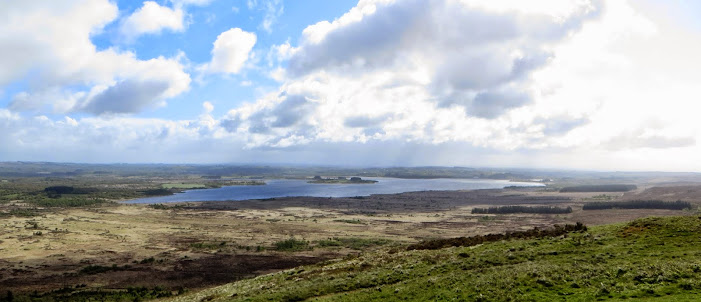
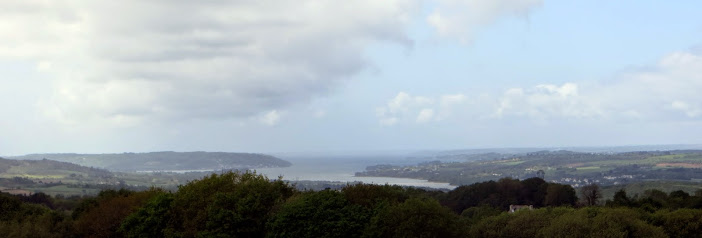
and east over the Lac St Michel.


And from a drive rather further west, across the Rade de Brest.

Wednesday, May 21, 2014

Inside the chapel, Montagne St Michel


The chapel door was indeed open (though not in fact this one but the side one). I had the impression it often was, which isn't always usual.


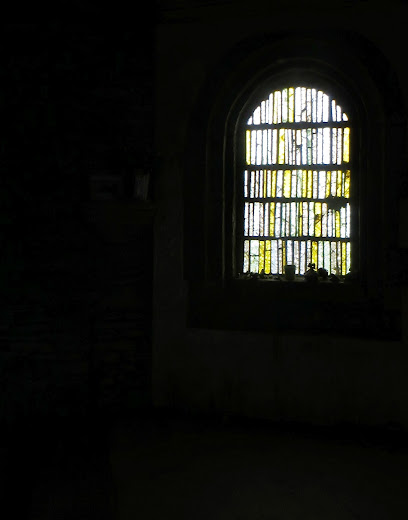
It took a little time for the eyes to get used to the dark,


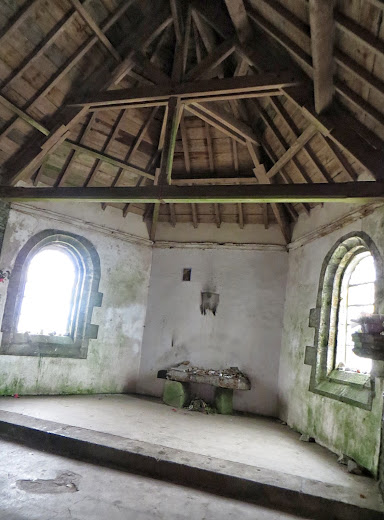
when they did, it was evident that though the chapel was not maintained, nor used for services, it was far from disused.


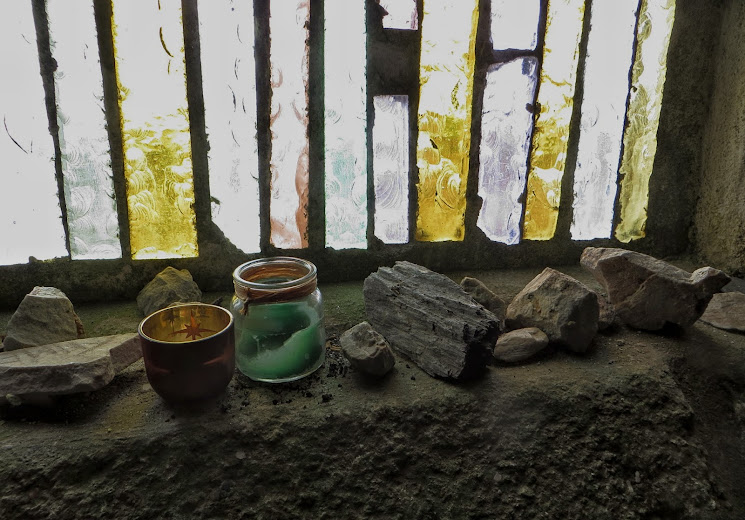
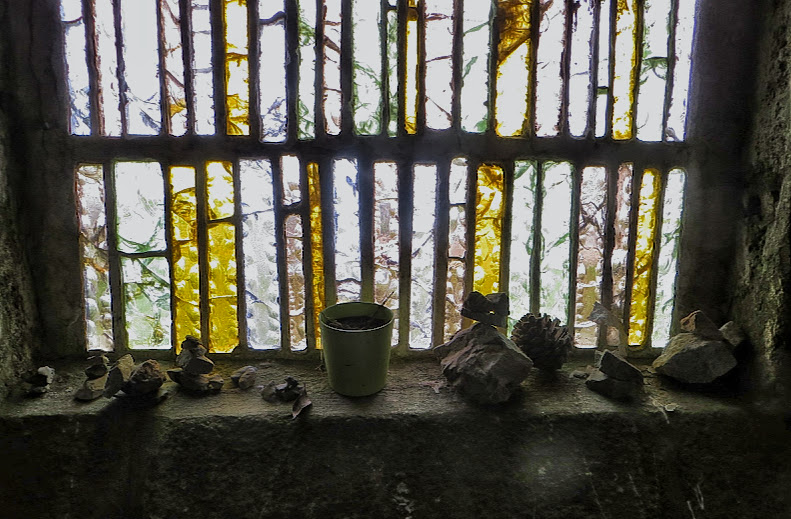
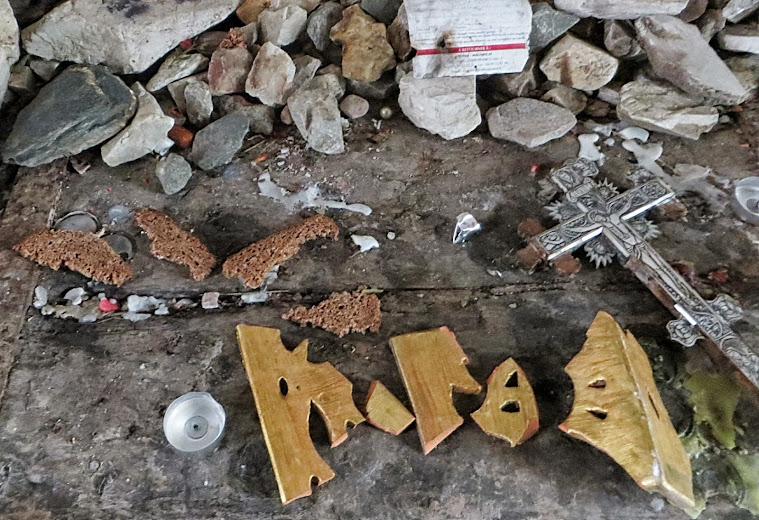
All the surfaces - windowsills, altar, wall shelves, were covered in informal, sometimes impromptu but not meaningless objects, votives of all kinds,


vegetable and most of all mineral, including many stones from the path up the hill,


conventionally religious and otherwise.  Some of the fragments on the altar above appeared to be morsels of some kind of cake or bread, possibly buckwheat based, the others indecipherable ceramic shards. The paper envelope may have been something to do with a medical prescription.


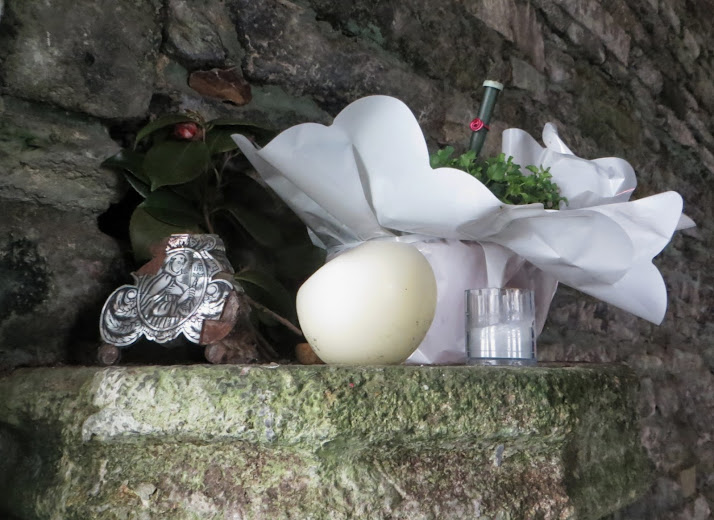
the small wall shelves seemed to have been appropriated for particular offerings, 


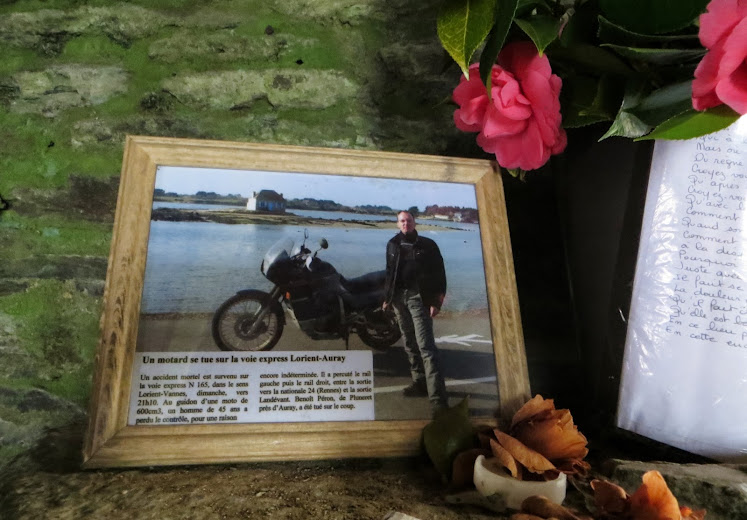
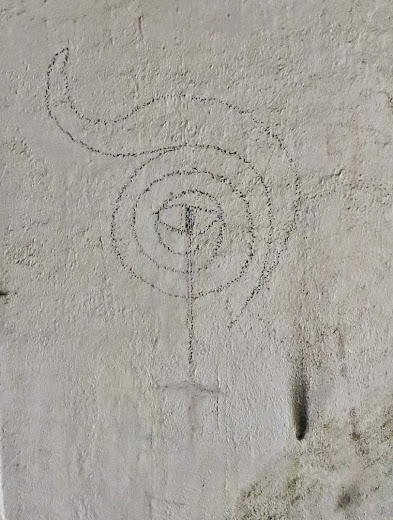
this one for a man killed in a motor cycle accident was more clearly explained, but many of the objects and marks left were elliptical in their purpose.  Yet there was a sense that everything there had meaning in the minds and intentions of the people who had placed it, it was not mere litter.  I grew up with a fear of de-consecrated space, possibly artificially created and fed by horror films and books, but it seems to me there was no sense of disrespect or malevolence here, its uses might be sometimes occluded but not occult. Although it was decaying and unmaintained it was clean and there was no vandalism, no smell of urine or graffiti tagging, and I can't think there are many agencies to police and regulate the place, although it is clearly much visited. The only mark made on the wall was this mysterious sign, which may, I suppose, be something sinister, but I don't somehow think so:


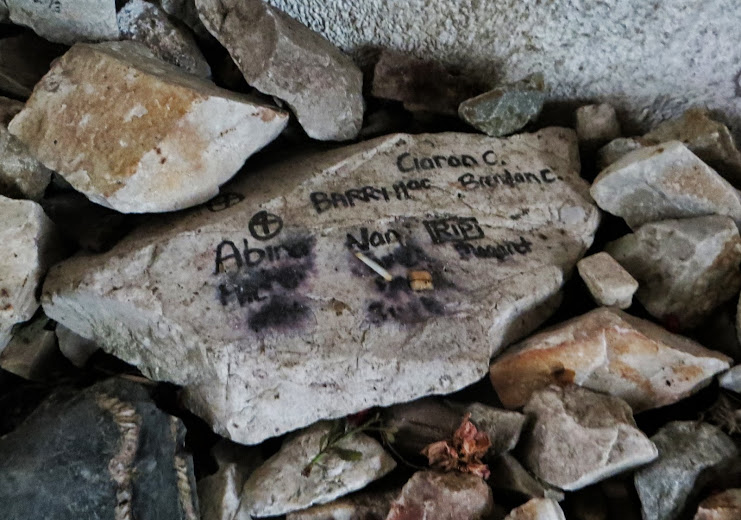
Possibly it was made by the same young people who left this rough, solemn little improvised tablet, a memorial to a lost friend, perhaps, and to their own passing presences.


The practice of folk belief is alive and well, it seems, in these back lands which have always been a home to it.


Sunday, May 18, 2014

Back from the back hills


We've been back from the back hills, les Monts d'Arree, a week already, and I'm afraid I'm just not getting around to editing the photos and doing anything very creative with them.  I seem to have been fairly occupied with other things, and there are quite a few other projects calling to me, which means I put off everything, and now it's beautiful weather and I'd really rather be outside, quite possibly taking more photos, than sitting indoors in front of the computer editing them! 

However, I've just sat down in the comfy seat, with the notebook computer, on which I can't normally carry many photos on or do much editing, and started fiddling about with the Google+ on-line editing tools on the automatically backed up photos - I think this must be the result of a box I must have ticked somewhere along the line with Picasa, not something I actively wanted to get involved with. As with any on-line photo editing it's comparatively slow and laborious, but perhaps that forces me to make more stringent choices.

So here is our Troglogîte, something like a hobbit hole:


and here is a rainbow over the one next door. 


They were interesting places to stay, very cosy and surprisingly light, and very nicely appointed; there was a lovely loaf of organic bread, a bottle of cider, crêpes and an array of pots of jam, wood for the fire, towels and soap all laid on and to hand, unusual for a gîte.  We needed the fire, and to keep a ventilator fan on for much of the time to keep the place well-aired, since the misty, windswept moorlands of central Finistère were, typically, rather misty and windswept for some of the time.

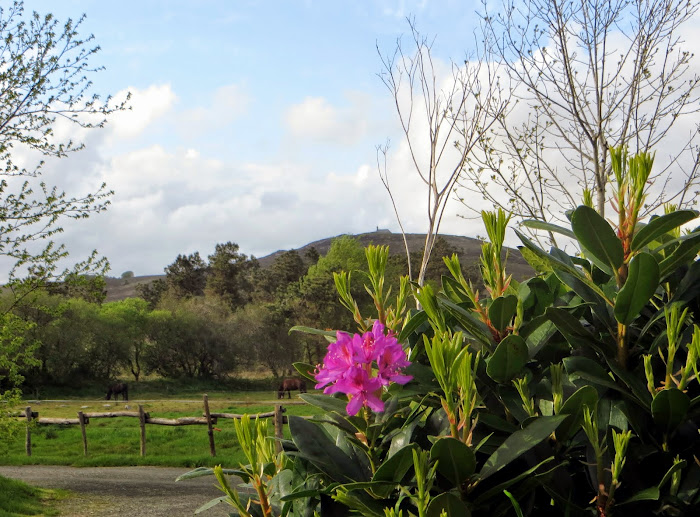
They were very lovely though, and a more varied landscape than I expected. Here is the view from our door: 


The horses lived there.

It was a couple of kilometres to the top of that hill, called the Montagne de St Michel. The old chapel, which served the needs of the isolated shepherds in former times, is now disused, but much visited.


for the views, of which this is just one,


and the bracing air.  


It really was very windy!


Those are old German military emplacements we're standing on.

I'll post more over the next few days.