Thursday, October 08, 2015

Maritime museum, instruments and and art

The museum is divided into three sections, the west, north and east wings leading off from the central courtyard. Once back inside we decided to explore the east wing, which is dedicated to objects. 

I think mostly what I want out of any museum is an aesthetic experience. Learning and reading and lots of words generally don't really grab me much, you can do that at home before or after. Audio-guides we don't bother with, though I'm sure they are often very good, and I prefer the silent company of people plugged into then than the intrusive voices of tour guides. The use of space and light and colour is important, though it doesn't have to be anything fancy; many years ago I was so smitten with the elegant simplicity of the Cycladic art museum in Athens I almost felt I could move in and live there (don't know what it's like now, it looks rather more extensive than I remember it). However, I do like to see objects, preferably close up; often a quaint and cosy small town local history museum can be just as enjoyable, but I've been to some exhibitions which seem to be very set on impressing with lots interactive hi-tech stuff - holographic figures talking to you, projected spatial stuff, lots of touch screens etc - yet I've found myself disappointed and thinking fine, but where's the stuff?

But this section at least of the Maritime museum (we didn't bother with the more pedagogic, interactive, 'explore-and-experience-the-life-of' bits) was brilliant, with creative use of space and light and sound and electronics, but with real solid stuff a-plenty too. We went first to the navigational instruments galleries. The room was darkened midnight blue, with illuminated star maps moving over the ceiling and a low, hypnotic background sound, suggestive of waves and bells and distant voices. An open book with empty pages greeted you in a pool of light as you entered, and this is what happened when you touched it and turn the pages:


(yes, I know he's turning them backwards, I don't think it made much difference)

Then there were the transparent cases of with the instruments, from late mediaeval astrolabes to modern equipment,


most of which I just enjoyed gazing at as objects of mystery and beauty, without taking much trouble to identify their names and purposes. The things below, however, were lead weights, for taking soundings, (and swinging when one was shirking, I suppose. Better look that one up):


while these are clearly compasses:


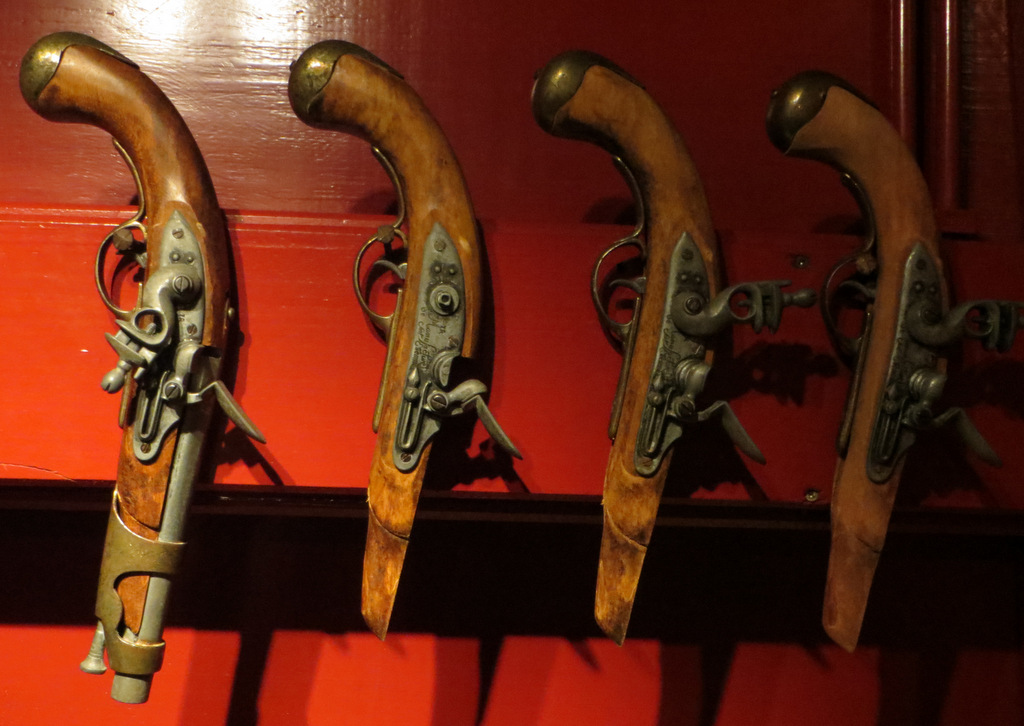
Then there were the decorations, not only figureheads, but stern and mast decorations, tiller heads and all manner of wild, graceful, fierce, funny and sometimes downright saucy creatures and characters, enough to people a sea-going saga on their own:





(a touch of mise-en-abyme there, a ship within a ship...)

Again the sound and light murmured and shifted and changed around and on the objects.

And after that there were the paintings, dating from the early 17th century, when there were still sea monsters,


with examples in the genre of pen-paintings, which I didn't know about, executed with eye-watering detail and precision with pen and india ink on an oil paint ground,


and moments of high and luminous drama,


~

We only really saw a small part of the whole collection, and this is only a small part of what we saw. It really is a splendid museum. 

Sunday, October 04, 2015

Maritime Museum - the East Indiaman Amsterdam (and a hornet update)


Steve's half-brother proved too elusive to rope him in for hornet eradication; in the end I contacted someone further off who had done a wasp job for us. He arrived the same day, with a ladder and toxic powder, and set to work. People sometimes grumble about the €100 plus flat rate it costs to get rid of these bestioles, but this time he earned his fee; he was here for nearly an hour in his sinister veiled clothing and used one canister after another of The Product while the drunk and furious insects whirled about his head. I ventured into the utility room below while it was going on, and it was filled with infernal noise: a deadly low drone punctuated by high angry buzzing. I invited the Agent of Eradication in to hear it, and he was somewhat surprised and concerned that there was only a thinnish layer of polystyrene insulation between our living space and the arthropod enemy. He advised us to shut the door and not go in there for the rest of the day and night, and call him in the morning if there were still any live hornets around. Luckily there weren't, I can only assume we have a large number of dead hornets, mummifying (I hope) between the insulation and the roof slates. He said it was a very large nest, which had probably been building since the spring, though we had been almost completely unaware of them. In fact they are mostly discreet and peaceable creatures, until the nest reaches critical size and then you can't miss them. I do have some qualms of conscience about initiating such mass murder, but live with them we cannot at this point, and I tell myself hopefully that at least they've had a whole summer of going to and fro quietly, building industriously, chewing up old wood and spitting it out again as nest wall, eating pests (and possibly honey bees), making and feeding baby hornets etc, before they would presumably all die off anyway except for the hibernating queens. I am almost an entomologist manquée, but not quite, the bugs creep me out too much.

~

Neither could I have been an 18th century sailor. Apart from living in the wrong time and being the wrong gender, even if I could have had the head for heights and the constitution, I've concluded I could never have mastered the geometry and other maths and the applied-in-extremis physics, or indeed the knots. I can however contemplate it in smitten wonder, thanks to Patrick O'Brian and places like the Amsterdam maritime museum. 

Oh dear, I took so many photos there, and it's taking me an unconscionable long time to get around to posting them. One of the reasons I find I'm now shying away from photography (and by consequence, blogging*) is the matter of selecting and editing the results afterwards. I can never quite decide between this angle or that, so I keep both, and I can very rarely just leave a photo alone; as well as needing to shrink, export and upload them to web albums I'm almost always sure it needs a trim or a fiddle with the contrast or a tweak of the white balance, maybe it does but it would likely do a blind man good to see it, as my mother used to say. Tom has been cheerfully producing egregiously sunny, extrovert, unexamined-life travel posts for the last week or so, uploading his perfectly good photos without any fiddling with or interference from me (huh, what do you mean you don't need me for tech support, do you want me to have an existential crisis or something?), but I did bags the maritime museum, and will probably need a couple of instalments for them. 

The museum is housed in the old Admiralty building, a grand, elegant, four-square place, on the wharf a little way from the main part of town, twenty minutes walk from the Central Station, or any other tram stop. Its once open courtyard has been glazed, rather like the British museum, with one of those marvellous, attenuated webs that create quiet, softened, outside-in spaces where one instantly stops, breathes and looks upward:


We had already seen the East Indiaman Amsterdam the evening before from the water, floodlit and looming, which impressed us with something of how such vessels might have appeared to the people of the time whose lives they were part of, so we knew we wanted to see more of the ship, and made our way out to the quay.


It is, as most grand sailing vessels you might see now, a replica. The original was built in the middle of the 18th century, but foundered in the Channel near to Hastings in Sussex only a year or two later. The wreck was, by degrees, covered in mud and sand. It was excavated some years ago, and the replica was built with the help of voluntary work and public subscription, a matter of justifiable pride. At very low tides you can still see the remains of the original off the coast at Hastings, they say.


the outside is a riot of colour and carving, from the fearsome-funny lion figurehead,


to the striped sides,


and the florid stern, peopled by rather pale and modest gods: Mercury


and Neptune (who amused me especially by his coy attitude and odd resemblance to our local Dutch vet),


and their attendant animal familiars


(I don't know why Mercury has a chicken either...)

Sailing ships are full of geometry, even before you start any stellar navigation,


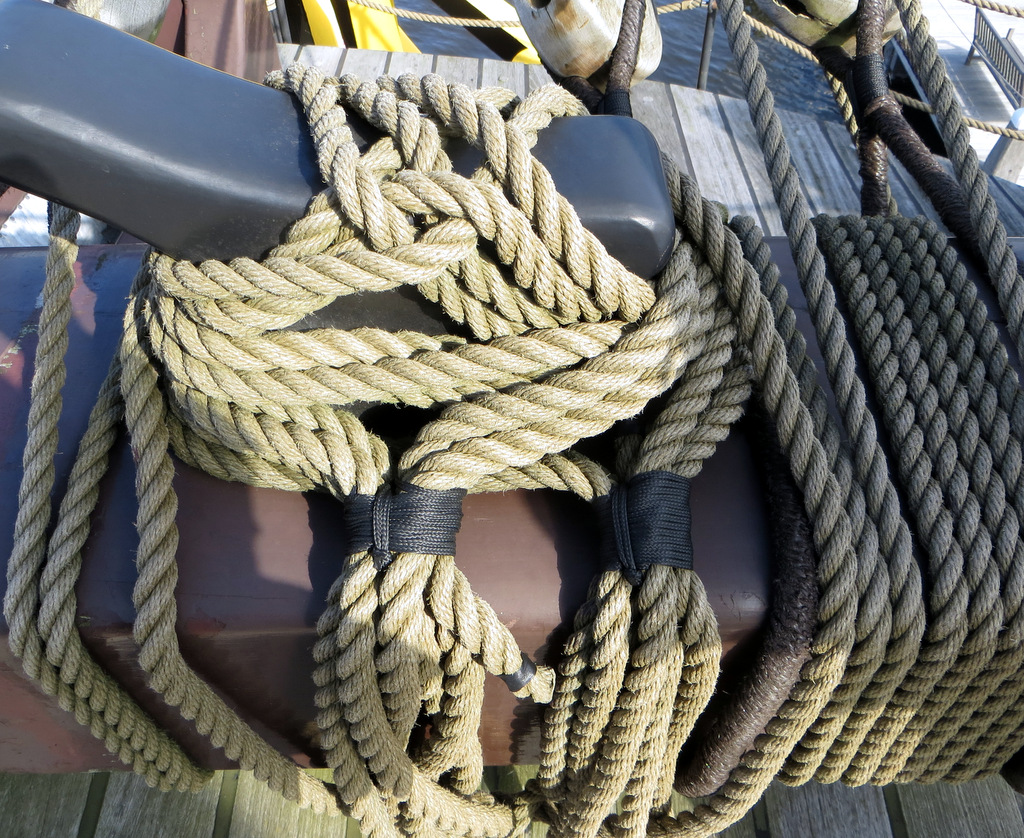
and knots and tangles and ropey things (as I say, I don't really do the technical stuff, I just admire it)


The spaces below deck were full of painterly compositions, interiors both grand and humble (the higher your rank the better your head room, on the whole):


and still lifes of objects, attractively and, I imagine, authentically rendered


I was interested in this crate of cargo in the hold, green coffee beans mixed with cinnamon sticks, and wondered how that worked, and if it was what they did, since you couldn't roast them together.


We had a good clamber and wander about, then went on to the next part of the museum, via the café. The Dutch, we found, do good museum cafés. More on what we saw inside next time.

There's more about the Amsterdam on the museum website here


* also because once I start writing I blather on too much and don't know when to stop. QED.