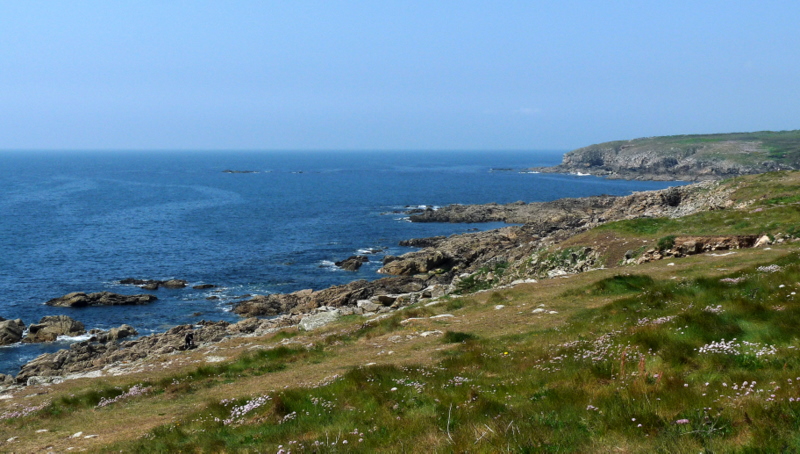
Sunday, May 22, 2011

Road of the Solar Wind, 6: Land art

Land art is something I generally like the idea of, but don't seem to have found the time to learn more about, though there was an exhibition about it at la Roche Jagu a few years ago, which piqued my curiosity.

When it comes to those pebble towers by the seashore, which have become as ubiquitous if not more so in greeting card imagery as that Zen gravel raked into circles and swirls, or baskets full of spices or coloured pigments on Indian markets (in fact I've still got rather a fondness for the latter...), I was quite charmed by them initially but by the end of the first decade of this century I could say I wouldn't have minded if I never saw another photograph of them.

However, a couple of things lately have made me review my jaded attitude.  Our friend Isobel recently went on a land art course down by the sea in Morbihan, and is quite in love with the whole subject.  She described the process of building them with such enthusiasm, about how you had to embrace the stones, and feel the centre of balance in them with your whole body (she is a dancer too), building up the stack slowly and with concentration, and how they then sat and waited for the sea to come and dismantle their work, and how surprisingly resistant to it the most apparently precarious of the structures were.  It sounded very beguiling, and had something of the same charm as the theatre of objects which she has also introduced me to: an ephemeral art form made from things which are already there, perishable things in the process of disappearing, or things which have always been there and will continue to be, but not necessarily in the fugitive form in which we have arranged them.

The other experience which has helped me learn to love pebble towers was something we saw at la Pointe de la Torche, at the southern end of the Route du Vent Solaire.  This is a magnificent spot with the disadvantage of being invaded by a very commercialised surfing scene on its wilder, north-facing side of which more perhaps later.  However, on its gentler southern aspect, we came across an entire city - or was it a forest? - of pebble edifices.


of all shapes and sizes.

There was something so balanced and still and patient about them, especially in contrast to the frenetic, gregarious intrusiveness of the surfers.  They made one smile and sigh.  Another lovely thing about them was they were in a continual process of making, people, mostly children, were free to move among them and add to them, and the thoughtfulness and focus they required was evident in their movements.

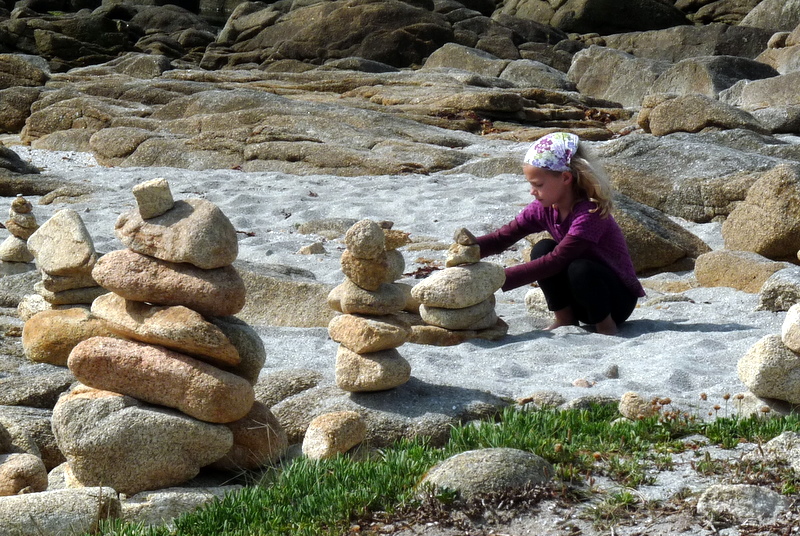


So, I am quite converted to pebble towers!

A smaller but also pleasing example was at the top of the bay, near to Audierne, these characters,


who also brought a smile.

I must find out more about land art...

Saturday, May 21, 2011

Road of the Solar Wind, 5: Poppies and wishing stones

St Vio's chapel was locked.  There are so many on this route, that this one doesn't even merit a mark on the Michelin map in bold blue,  But it has one of those astonishing heavy granite stairways on the roof up to the bell tower, which I can never quite credit the roof structure as really being strong enough to support.


However, just as good things were to be found beyond the chapel itself,


like this quaint round menhir, which looked as if it had been split and cemented back together again, in a field to one side ( the chapel roof is visible just to the left in the picture).  Closer examination revealed it to be oddly pitted, like the surface of the moon,


and that people had placed shiny coins, sometimes of quite high denominations, in the craters.  A kind of wishing stone, perhaps.  ( I'm rather hoping that the enigmatic and knowing Setu, my authority on the ground for all things Breton in general and Finisterian in particular, may stop by and tell me more about this, but he moves in mysterious ways, and hasn't been about for a bit...)

Best of all though was a field of clover and poppies, grasses and other flowers,


on the other side of the road, and stretching far and wide, with the sea in the distance.


~~~
(I'm trying to get all the photos in this series out before I go to England for a quick trip next week, as after that I think they really will be beyond their sell-by date, so please indulge me in over-frequent posting!)

Friday, May 20, 2011

Taking the Road of the Solar Wind, 4; the ruins of Languidou


What is it with a ruin? Perhaps it shows the beauty of the elements of the building in a way that the finished, knit-together structure cannot.  Spaces only partially enclosed require an act of vision to define them which engages the viewer more deeply.  Or perhaps it is the paradox: pillars to support a roof which isn't there, a rose window to pass the light through stained glass but which is open to the changing colours of the sky, arches which stop in air before the arc is achieved or barely even begun.

Or perhaps its the melancholy of them. (Melancholy, I think,  is a sort of default vagueness, a get-out clause, a smothering lack of focus says Edmund de Waal, in The Hare with Amber Eyes, everyone's book of the year, if not the decade, I know, and worthwhile for this line alone, and for the fact that he sticks to that position...)

The funny thing is, one deplores the forces that ruined the chapel of Languidou  - it was broken up for materials just after the Revolution, which is odd, since many other religious buildings in this region escaped this - but if it weren't a ruin it would be less remarkable, one of dozens of quaint old chapels which dot this part of the world.  And the ruin is a piece of artifice, reconstructed, perhaps inaccurately, in the early part of the last century, so far and no further, to create just the romantic impression I've fallen for.

However, though the French wiki link above goes into exhaustive detail about the architectural history of the place, and deciphering inscriptions which might give further clues to this - it has obviously been the subject of much study as well as many photos - I can't seem to find any reference to the beguiling little face under the capital, or indeed the geometric mandala type figure on another capital, or the worn cross in a circle on a threshold stone underfoot,.though they appear in other photos.  So they remain mysterious, to me anyway.  I'm rather glad about that.

Monday, May 16, 2011

Taking the Road of the Solar Wind, 3: the chapel at Penhors

Numerous chapels in various states dot the route, too many to take in at one time.  The one at Penhors has an imposing gateway onto its enclosure, and is looks out onto more wide expanses of sea and open, flat land, a few modern domestic buildings that do little to distract the eye, either to please or displease.


Outside it is well maintained and, aside from the archway, quite typical, I think. Inside there were things to please..


An elderly couple sat near the altar (you can just see the man's white head to the left of the photo). They seemed relaxed, chatting quietly rather than praying, but they had a bubble of calm privacy around them which  contributed to the benign, sunny quiet of the place, but which made us aware of not wanting to crowd them.

There was plenty of wood polychrome.  You get used to this hereabouts, at least if, like me, you spend a bit of time hanging around in old chapels. I've grown to like it; some of it is interesting, some grotesque, some quaint and amusing, some touching.  It seldom feels over-restored, the colours are often powdery, muted, the kind of thing people were in a frenzy to recreate on their walls and furniture a few years with the help of Country Living magazine-type books and articles on decorative paint effects.

In this place though, I felt there was something quite special about the faces, which can sometimes be monstrous or bizarre, or else mannered and saccherine.  These however, seemed gentle, with some depth in their sweetness.  Also in their gestures, clumsily rendered, but kind of intense.


There were also a number of rather unusual fruit motifs, which are something I've always liked in any decorative art, feeling they give a richness to it beyond that of flowers and foliage.


We also spotted another couple in residence, who didn't seem to mind ducking in and out over our heads to gain access to their home (not great photos, they were high in the beams and the light was low).


A place of charm and sweet airs, we found it overall.


Sunday, May 15, 2011

Sculpted rocks and seed mussels


as I mentioned there were.

Saturday, May 14, 2011

Taking the Road of the Solar Wind 2 - bugs and flowers


On the cliffs there were flowers.  There was thrift.


I like thrift.  The flower, that is.  I generally approve and practise the virtue too, I think.  But then I remember the bit in The Enchanted April:

 Mrs. Wilkins's clothes were what her husband, urging her to save, called modest and becoming, and her acquaintance to each other, when they spoke of her at all, which was seldom for she was very negligible, called a perfect sight.
Mr. Wilkins, a solicitor, encouraged thrift, except that branch of it which got into his food. He did not call that thrift, he called it bad housekeeping. But for the thrift which, like moth, penetrated into Mrs. Wilkins's clothes and spoilt them, he had much praise.

which makes me look a little askance at thrift.

 Not at the flower, however. I assume the flower was named after the virtue, not the other way around.

There was mallow,


the one above was hanging over the cliff edge, so it is in part the reflected light of the sea which passes through the petals,


and this picture I kept trying to throw out because the flower was out of focus and the leaves in, but something stayed my hand.  Who says it's the flower that matters?

The blue-mauve flower with the glaucous fuzzy leaves below was everywhere, including, I think, in some cultivated versions.


I don't know what it is, and haven't got around to finding out, or indeed what that lovable little fluffy grass is called either.  Identification of grasses and sedges is an an anorakism just waiting for me to acquire it, no doubt.

However, I did check out the blue butterflies, which seemed to be as tiny, holographic chips of the overwhelming blue of sea and sky.


They seemed extraordinarily blue, and consulting the book, which is illustrated only with paintings (very lovely ones, but never really so accurate), I badly wanted them to be Adonis Bllues, for the mythological hyperbole of the name, and their claim to be the bluest of all the blue butterflies in Europe.  But taxonomic discipline compelled me to go to the internet, where the ever-excellent Steven Cheshire's British Butterflies affirmed that they were mere Common Blues.  However I was consoled to see that as such, their Latin name is polyommatus icarus, while Adonis only gets to be a p.bellargus, which has less myth and magic.


There were Hottentot fig flowers,


this one had a visitor.  And there was a swallowtail butterfly.


But I couldn't capture it.  They are the most archetypal bright elusive butterflies, eye-catching and recognisable from a long way off by their shape and size and dipping, whimsical flight pattern, but tricksy and unpredictable, waiting until just before the camera finds its focus to take off sharpish.  Fortunately, this one chose to pose on a valerian flower further down the road.  In fact one of its swallowtails is broken, odd really, to have such a fragile, vulnerable, apparently useless appendage at all, but that's what makes them swallowtails, so it's just as well they do*.  One of the blue butterflies has a broken segment too, I notice.  Butterflies are very much like animate flowers. They blossom just for long enough to seed themselves then fade and crumble and fall away, sometimes quickly, sometimes they are quite enduring, but individuals seem to have no powers of self-renewal or repair.  Then, though, they might reappear later on in a second, remontant burst of flowering.  It's just an impression, though, a whimsical comparison, I'm no naturalist.

Some years we get quite a lot of swallowtails hereabouts, others hardly any.  This year they seem quite common, I even saw one in the supermarket car park the other day.  It was Ecomarché, too, not even Carrefour. 

More tomorrow, if we're spared (as my granny used to say), from data corruption and other anomalies in the space-time continuum ...


* Yes yes, I'm sure it's probably got some evolutionary function to do with attracting other swallowtails.

Friday, May 13, 2011

Taking the Road of the Solar Wind 1

We had travelled up and down this part of Cornuaille, the Breton Cornwall, the southern corner of the westernmost end of Brittany before, years ago, but had kept to the direct inland route to take us up to Audierne and beyond.  That must have been six or seven years ago at least, before I took photos much or had this blog, or even a computer, our pre-digital time.  I am struck by the difference that having the means to record things makes to my memory of them; it's not only that the words and photos are there as reference, I think that having made the record and presented it for others' consumption I do actually remember things more clearly.

I suppose looking on the road map at that time, the small winding coastal road down the Bay of Audierne, with its forks and dog-legs and staggered junctions, its branches and tributaries which led nowhere but to the sea or back on oneself into unknown villages, must have looked too complicated to navigate comfortably, but in fact, it is a well-maintained and waymarked road, with pretty signs with yellow lettering and a sun motif directing you at each otherwise uncertain turn and keeping you on La Route du Vent Solaire.

This name is a reference to a book by Pierre-Jakez Hélias, one of the region's luminaries, whom I must get round to reading some time.  The route is as beautiful as its name suggests, and lined with wonders and treasures and unexpected magic.  It begins a little to the south of Audierne, where we drove to one wet morning during our trip not really expecting too much from the day, since the weather was miserable and the inland towns and villages looked drab and uninviting.  But by the time we reached that rather pleasant harbour town the sun had come out, and everything seemed a little brighter.  We looked in an art gallery displaying oil paintings so garish, badly drawn and generally atrocious we couldn't understand how they managed to pay the rent on the strength of them, and I took some pictures of the huge grey mullet nonchalently loafing about in the shallows of the harbour.


We didn't stay long, but decided to head out to the point where the map said there was a lighthouse and a good view, and eat our picnic.  We didn't find the point, or the lighthouse, but we found a picnic spot behind some dunes which was nice enough, then set out to see what the sea was like the other side of them.  


The photos don't, of course do it justice.  I should know better really than to keep pointing the camera at sublime expanses of empty sky, sand and water and expect to capture anything much of what they are like, but I couldn't help it.  


Where we live, the sea can be wonderful, and more than wonderful, but it is still the Channel.  Growing up in the UK, we make much of being a Sceptred Isle, a sea-going folk, of having an incredibly long and varied coastline, and quite right too, but most of it is Channel, North Sea, Irish Sea, Bristol Channel, Firth of this or Sound of that.  It always sounds odd when I hear Americans routinely talking about the sea as the ocean.  Not until one gets out to the furthest west of Cornwall in Britian can you really consider yourself to be on the edge of the ocean.  I do remember on the west coast of Ireland people proudly saying that there was nothing else out there until you get to America.  Ocean is different.


Here at the coast by Audierne you can look north and west out toward la Pointe du Raz, finis terra, Brittany's Land's End, and the eerie, tragic Baie des Trépassés (literally, the ones who have passed over, that is, the dead, diverging from the same root as 'trespass'), where we didn't go this time,


or south round the sweep of the bay which ends eventually at the point of Penmarch, where our journey finally took us.


Molly and I scrambled up the rocks and onto the cliff path,


 where there were chunky lines of fragmentary dry stone walls, and clumps of thrift, and clear, delicious air, and we could have walked on and on, 


but the Road of the Solar Wind was calling, though we didn't know it at the time, and we turned back. 


(There were also sculpted rocks and rockpools, embroidered with veins of seed mussels, and flowers and butterflies galore, but they will have to wait...) 

Wednesday, May 11, 2011

Squaring the circle, three collages out of one.


The benign, enigmatic little face tucked above the capital in the ruins gave me a giddy lurch, of something like covetousness. Or was it nostalgia, or the inkling of creativity?  Whatever, I wanted it.

I remember wanting things this way when I was young. It was quite unimportant whether I bought a trinket, tried to make one out of something, or drew or painted it.  Acquisition or making, the having of something in the hand was what mattered.  Now that feeling, like so many others is questioned, doubted, compromised, held at a distance.

A lovely trip, stacks of photos, most of the duties and distractions, more and less pleasant, confronting me on my return hopefully ironed out, I need to shake off this mild reluctant paralysis.  I'll try to put something here every day for a bit.


Tuesday, May 10, 2011

Give that buoy a medal

(Trans: This buoy has saved lives.  

In fact we call it a life belt in English but that wouldn't really work as well) 

Sifting and sorting, other concerns niggling, back here before long.