Monday, March 28, 2016

Easter Sunday with Elfie


Watching Watership Down in the afternoon.

"Look, I've been a dog with a job, now I'm sitting watching cartoon rabbits..." 

This was after we had retrieved a drowned cat from out of our garden pond (the lairy neighbourhood tom, pushing his luck once too often in pursuit of our goldfish, I think/hope, rather than someone's beloved minou, it was hard to tell), and before we had retrieved a dead greenfinch out of Elfie's mouth (it was dead when she found it under the Mexican orange bush, I think/hope). We are now working on the command 'drop'.

Then I found that the burly free-range chicken I was looking forward to roasting for our Easter Sunday dinner was not in fact prêt à cuire, as they usually are but merely effilé. I have come across them with the giblets in a bag inside, and I have learned to cook a poule, rather than a poulet, which could give Paula Radcliffe a run for her money in the stringiness department, slowly so it turns into delectable shreds in a tasty broth, but effilé I have never had to deal with before. It means it has been drawn, so the intestines have been removed, but the remaining organs are all in place and attached. There is a depiction here. At least it didn't still have its head on.

Even so, I announced that after everything else that day there was no way I could cope with this, and I was going to go and face ridicule and give it to Victor. However, Tom said don't do that, he would deal with it and turn it into curry, but not now. I was surprised at this, but then remembered this is a man who owns a pair of poultry shears and isn't afraid to use them, so I put it in the freezer and we ate the potatoes roasted with the garlic cloves I was planning to stuff inside the chickens nicely empty cavity, with some hastily defrosted chipolatas.

The last episode brought back two memories. The first was of my mum buying a couple of chickens when I was a kid from an Asian stall on High Wycombe market, probably suspiciously cheap. They were completely undrawn, so still contained their intestines. I sat in the kitchen and read the instructions to her from the Readers' Digest Cookery Year, a book I still own. She bodged the first one and burst its gall bladder, the smell of which pervaded the house. The second was OK. I guess we must have eaten them, though I'm not sure either of us fancied them much by then.

The second was of lunch at a day out in the eighties of the El Salvador Solidarity Campaign in Islington. There was chicken stew as well as a vegetarian option, and the chicken tasted distinctly as if it had been badly drawn. Jeremy Corbyn was speaking (I imagine he got lucky and had the vegetarian option). He warned against the dangers of dilettantism, I recall. I probably should have listened to him.


Saturday, March 26, 2016

Elfie


Our new arrival, an épagneul breton, usually known in English as a Brittany spaniel, or simply a Brittany, which sounds nicer than Breton spaniel, we thought.

We weren't going to do this yet; we'd told ourselves we'd get a couple more trips out of the way then commit to another dog perhaps in the autumn. But we got back from a short trip to Mont St Michel where Tom had said he really didn't want to wait to get another dog but didn't want to impose this on me and deprive me of travelling etc, and I'd said I felt much the same, and then I saw Elfie on the website and the next day we drove out to the other side of Rennes to find her.


She was living in an SPA refuge, for about five or six weeks. Before that she had been in the pound (rather sinisterly called in French la fourrière). She's probably about six years old.

We took her on a 'test-drive', chatted a bit about her, then went to sign the papers for her. She went back in her pen, which she shared with another dog. When we went to get her again, she flew out and into my arms, then went looking for Tom. She spent the first quarter of an hour or so of the drive back rather anxiously watching the traffic going by on the N road, then withdrew to the back of the car (we had one back seat down as we used to with Mol) and hid under Tom's jacket.


We have the impression she has lived indoors before, she's clean and well behaved and very happy to be a house dog.  Clearly though, she is a strayed and unclaimed hunting dog. She has a number tattooed in her ear, which presumably was useless in tracing her owner, but no chip or other ID. She was sterilised from the refuge, you can see where the hair's growing back.


In the house she is the most polite, attentive, sweetest, kindest creature imaginable. She has winning ways galore, and does that listening-with-her-head-on-one-side thing to perfection. Furthermore, she is remarkably, weirdly voiceless, her lack of a bark was noted in the refuge's notes, and we haven't heard her bark, whine or much less growl there or since she arrived here. She seems completely without aggression, though we were warned she was a cat chaser, isn't destructive and picks things up quickly, especially since she's now learning a second language! Her 'sit', 'stay' and 'come' are already quite established, and 'leave', 'wait' and 'down' seem to be generally understood, as does 'up-up', but then again she doesn't need much encouragement with that.


She has the rescue dog's preoccupation with food, but isn't obsessed or too much of a thief so far, if she smells food on the counter she will investigate, but a firm 'no' is enough to make her desist, and the rubbish bin so far is unmolested, she takes food from our hands and eats quite delicately. I can't move towards the kitchen without having her on my heels, and she has certainly attached herself very firmly to me, but she likes and is friendly to Tom, and he's started giving her her dinner to strengthen the bond.


She likes sofas, and has slept, just two nights so far, which we have to keep reminding ourselves, in our bedroom but in her own bed. I hesitated about this, but Tom was decisive. It would help her to see us as pack, and also save us having to render everything in the kitchen and downstairs secure. The first night she jumped onto our bed three or four times, perhaps, and I lifted her down firmly and put her back onto her own, the final time I put the t-shirt I'd been wearing all day down for her to sleep with, and it seemed to work. Last night she played at jumping up but then settled without protest. Once in the small hours I felt a wet nose and a lick on my foot that was sticking out, but I led her back and she went back to sleep. Yet the moment we spoke to each other about getting up she was suddenly in between us and greeting us affectionately. 'How did she get here?' Tom asked 'I didn't feel her jumping up'.

For indeed, this is the sole real problem with her: she is Elfie the Flying Dog, or in another sense, Elfie la Fugueuse. The first morning, at about 7 am, after having pottered round the garden together the afternoon before, watching her closely but without a lead on, and assuming it was safe, I let her out the back door. I followed but wasn't quick enough to stop her suddenly flying effortlessly over the picket fence at the side and haring off down the road. In pyjamas, dressing gown and wellingtons I pursued her through every corner of the village, finally catching her up in one of the scuzzier backyards. Having been totally deaf to my calls she looked at me without a trace of sheepishness or contrition, as if to say, 'Oh, are you here?' I lifted her up (she had no collar or lead on at the time) to which indignity she submitted equably, and carried her home, gasping with my heart thumping. I certainly need to get fitter.

This is a worry. I've been reading up about the breed, which resemble small setters as much as spaniels, and it seems it's rather the nature of the beast to take off like this when something catches their nose, it's called 'throwing a deafy', apparently, or simply 'buggering off'. However fit I am I'll never catch her, and the chances of her making her own way back safely are not good. Presumably this is how she ended up in the fourrière. At six years old, however sweet and trainable she is in other ways, I rather doubt she can be cured of the behaviour. It may well be that she will never really be able to be off the lead outside of the house. This isn't so terrible, though. She is lovely to walk on the extending lead, sensitive and responsive and not just a tedious puller, rather like having a butterfly on a string. But her mind is elsewhere, she isn't interested in treats and food and fuss while there are the smells and sounds of nature around her.

I feel at times overwhelmed, worried, oppressed by sudden new responsibility, and fearful of regret. Suddenly our planned freedoms have been curtailed, our life is going another way, and there is another creature's life to be taken into account and worked round. I feel she is forcing me to come back to life in certain ways and part of me is reluctant to do that.  Since Elfie arrived, I've cried more about Molly than any time since we lost her I think. It's not only comparing them, or that I'm going to places and doing things I've not done since Mol was with us, in her younger and fitter days, it's because I find I'm feeling and facing things I thought I'd let go of and give up on. But she's also forcing me to wrap up and get outside, to walk hard and not to fear the weather, to come back cheerful and with a good appetite, to carry a plastic tub of dog treats in my pocket and think about how best to train her and build her confidence and our relationship. I think she may be what I need.

Elfie isn't Molly, of course, we never expected her to be. But though she is wilder and stranger and in some ways more problematical, she also has her strengths. She seems to be a sturdier, more robust, healthier, less needy and more adaptable little person, rather more of a doggy dog. Her beautiful strawberry blond coat is feathery and soft to the touch but only needs a basic brush now and then, won't need cutting and dries quickly; her paws are neat little tools, and she has a canny way of getting right in between the closely set pads with her teeth and tongue to get out any prickles or other foreign bodies, her ears are perky little clean pink shells which I can touch and look at without objection. She is herself, and we will grow to know and love each other accordingly. And I think she'd probably cope much better with going to stay in good kennels with other dogs now and then, as long as there are plenty of walks, good grub and high fences.

And we've already had some very good moments I really wouldn't have expected so soon. She's not completely relaxed in the car, though she gets in happily, we may try her with a travelling crate. But yesterday morning we made a trip to the arboretum, stopped at the supermarket where she stayed in the car, a bit hot and bothered and fed up but without any real problem, then we went visiting.

Our friend J was very pleased to welcome her, despite it being evident there was a cat somewhere, she lay down like a lamb while we drank coffee and chatted,  Knowing she'll settle down quietly at other people's houses, and maybe restaurants or cafés too, is really a plus, and when she met J again today Elfie greeted her familiarly.  J took this picture of us with her i-pad.


Wednesday, March 23, 2016

BIS records, and the importance of copyright


You may remember that at New Year I posted a video slide show I’d made and posted on Youtube, from snapshots and short video clips of Iceland, accompanied by the music of Jón Leifs’ Requiem which I’d lately heard for the first time on the radio.

Then a few weeks ago I revisited the video, and found the music had been withdrawn from it for copyright reasons, though the visuals were still there. I was disgruntled; what killjoy had been so mean as to spoil my pretty little artistic and sensitive creation? For the first time I looked up the details from my purchase of the music, and with possibly even less thought than when I used and published it, I wrote to protest, and ask to be made an exception of, to the recording company, BIS records in Sweden.

Oops.

Ouch.

I will gloss over the rather painful details of the e-earbashing I received, in person, from their CEO, Robert von Bahr, or indeed of my rather puny and petulant initial reaction to it. However the gist of his response and what I learned from it is important.

It turns out the withdrawal of the music is an automatic procedure based on ‘fingerprints’ on the recordings, and it’s done for a good reason. With all the free stuff that’s available on the internet on tap, and with recorded music everywhere, it’s too easy to take it for granted and even assume an entitlement to it, and to do what we want with it, without giving a thought to how it gets there and how much it costs to produce it. The recording companies, especially of classical and other rarer and more specialist kinds of music, pay a lot for the privilege of recording, it’s a labour of love and patience. They make little enough from legal downloads, nothing from illegal ones of course and unauthorised distribution is a huge problem for them, and people taking the line that they are doing them a favour by doing so must be exasperating to say the least.

Not always but sometimes, however, one’s more bruising experiences can end up being the more rewarding ones. Mr von Bahr, like many other stratospheric, passionate, fierce and direct people who don’t suffer fools gladly, turned out finally, and indeed quite quickly, to be quite as good, nay better, at being generous, warm, helpful, charming and funny as he was at being cross. The exchange of emails continued, since, happily in this instance, both he and I are the kind of people who cannot bear not to have the last word, and gradually they became more friendly. He went on to extend a gracious and unlooked-for apology for his gruffness, while still explaining, with patience, eloquence and integrity, how very important copyright matters are and how unacceptable it is to go around thinking you can ignore and abuse them.

If copyright holders themselves choose to release material freely, for advertising or simply out of generosity, that’s their prerogative, it’s not mine just to take it. The fact that I’ve paid for a recording doesn’t give me the right to distribute it; MP3s can be stripped from videos on Youtube, (something I wasn’t aware of) and anyway, taking something for your own uses without consent, just because you can and lots of people do it, is simply wrong, and ignorance is no defence. There is plenty of legitimate free stuff on-line, and there is music which it’s permitted to use as long as you don’t monetise what you make with it, but it’s the copyright holder’s right to decide whether and how they make their property available.

Youtube are going some way to addressing this problem, there is a page of FAQs on the subject of copyright, an audio library of freely available music and a music policy directory to find out the status of a piece of music, but the last is by no means exhaustive and it’s not the simplest matter to get information from them on the subject, as I’ve subsequently found out when I tried to contact them to find out how to go about doing things properly, it wasn’t easy to get an informed and satisfactory answer; they don’t really seem all that interested in creating a better, clearer relationship between their users and copyright holders. Essentially, if you wish to use music and are unsure about its copyright status, it’s better to try to obtain the right permissions than just use it anyway. Recording companies or other copyright holders are usually not difficult to find and contact if the recording’s in your possession, if you ask politely and are honest, as Mr von Bahr said, it’s quite likely you’ll be allowed. A copyright holder can release the music when the video is uploaded and they have the URL, even though it has been automatically blocked.

And you never know, you might make some interesting connections. The experience and the path it led me down was enriching, not only in raising my consciousness in a salutary way. As I said, I’d not paid much attention to who had recorded the music, but BIS and their catalogue are a wonderland. Though they began in a very small and personal way in 1973, they have become one of the most important names in classical recording recording, while maintaining a very individual touch; they are the oldest recording company still run but its original founder and unusual in keeping all their previous recordings available.

Their digital arm, eClassical has an even larger on-line catalogue, since they now distribute material from other labels as well as BIS, and they are nice and easy to browse since you can do so by many criteria: period, genre, orchestra etc as well as artist or composer.

And BIS are certainly not mean with their musical property. Their own catalogue contains an abundance of free listening if you take the time to browse, not the parsimonious 30 second snippets to be found elsewhere, but whole, quality tracks, not downloadable but listenable on-line unlimited. EClassical’s downloads, not only MP3s but also 16 and 24-bit FLAC flies, lossless (love that word!) and very high quality, are probably the best value you’ll find anywhere; they also do a very good ‘daily deal’ - an album download, often something rather unusual, at half price; their latest release e-mail newsletters are a delight, with interesting, personal and informative blurbs, and maybe even a free video about one of the albums or musicians featured.

In fact they have their own channel of professionally made videos on Youtube. Amongst these is a one not to be missed of Carolina Eyck talking about and playing the theremine, the strange ‘invisible’ instrument invented a surprisingly long time ago, once used for spooky effects on old sci-fi movies but now with its own, growing repertoire. From their channel I was also led to an interview with RvB himself.  The man is frankly something of a star, and moreover (as he slipped in with a touch of very understandable uxorious pride) he is Mr Sharon Bezaly. She is the best flautist in the world and, with her shock of hair and smouldering eyes and her gold flute made by an anonymous Japanese master, looks and sounds like something out of a fairy tale. And that’s before you’ve even heard her play...

Another video released under their auspices is this beauty, food for any lover of Tallis: New York Polyphony in a little church in Sweden, performing ‘If ye love me’, with a sound of incomparable depth and richness,
If ye love me,
keep my commandments,
and I will pray the Father,
and he shall give you another comforter,
that he may 'bide with you forever,
e'en the spirit of truth.

Play by the rules and truthfully to keep what you love, perhaps?


And in a short time, Mr von Bahr stretched out his hand at a word when I had reposted the Jon Leifs/Iceland video, properly amended with credits and acknowledgements, to lift the block so it is now visible again with the music, in all its ethereal wonder, and I have embedded it once again in the New Year post. For which much thanks.

Saturday, March 12, 2016

Ken Hyam


A couple of days ago, on the second anniversary of Joe's death, a card came in the post. The sender's name on the back was J.Hyam, which gave me a start, but when I looked again it was a London address. It was in fact from Joyce, the wife of Joe's brother Ken, with the very sad news that Ken had died, suddenly, of a heart attack, almost two weeks previously. She had written almost straight away, though the card had taken a time to get here, which was strikingly thoughtful of her, since she and I didn't know each other personally.

Ken was the youngest, and last surviving, of the three Hyam brothers by some way, not yet seventy, I think. I met him just the once at Joe's funeral, and instantly felt I was with a trusted friend, not only because of our blogging contact and connection through Joe, but because he was clearly a gentle, kind and listening soul, a quiet man. He was a teacher, specifically of youngsters with learning difficulties, and he must have been a lovely one; the comments he often left here were always positive but also thoughtful and showing a very careful and attentive reading, and at times of loss and sadness most sensitive and comforting. We corresponded from time to time in the last couple of years, and a little while after his brother died he sent me Joe's copy of Eliot's Four Quartets, which had come into his possession, well-preserved with an inscription from when he left school in the fifties, a preternaturally perceptive choice which meant more to me than I can say.

He blogged as Lucas, mostly poems, sometime photos, less so of recent times, but he also ran a collaborative magazine blog with some excellent content called Small Party, for the last couple of years.* He was a fine and original poet, his work an intriguing mixture of naivety, subtlety and surprise which seemed to bespeak his character. He posted last in January of this year, about an old vinyl copy of Brahms Lieder he had found in a charity shop, copied onto CD, then spent some time researching the lyrics of and rendering into his own translations, the kind of pleasure in finding treasure and unexpected beauty in the detail which was typical of the man. I'm taking the liberty of reposting the translation he made of one of these, a poem by Dieter Rihm. It seems to me to take one to a place of clear, bright, joyful serenity, a good note to leave on, even if you are leaving too soon.


There was a town of noble heritage,
A church, shops, thatched roofs with spiral chimneys,
A hill that sloped down to a landing stage.
I see white blossoms drifting on the breeze,
The pleasant boredom of the boats in Summer,
How Autumn’s setting sun and fiery leaves
Influence the lake with bronze, how it grows calmer.
I see the stillness deep Winter conceives

When in the lake an image of the town
Appears: sloping roofs, smoke in blue air,
The shops closed-up, the church’s gentle spire,
This holiday, pointing both up and down
Into the water, which holds as in a mirror
Good will for everyone, both here and there.

Dieter Rihm, translated by Ken Hyam.

~

*Both these are now left as they were; I imagine he must have been the comment moderator on Small Party, so even a comment about his passing can't be made to appear. This brings it home again that, morbid as it may seem, we should think about what might happen to our blogs if the worst happens to us, and if possible sort out someone to be able to access and post on them, or at least do a bit of housekeeping. Ghost blogs of the departed, left hanging in the ether, getting cluttered with spam comments, are a very melancholy thing, I think, whereas on Ellena's and Paula's, for example, their dear ones have access and have posted since their deaths, which seems better, and even a potential comfort to all concerned. For many of us, our on-line lives are an important and very solid dimension of our whole lives, and need to be tended to and marked when these end, I think.


Thursday, March 03, 2016

Cutmores


Needing something to get me back into blogging mode again, I thought I'd try doing a throwback Thursday, one of those alliterative tags people sometimes use as prompts, based on some article from bygone times. So I rummaged in the box of old photos and other sentimentalia and came up with this one, which I've always found quite interesting, and I'll set myself an hour after dinner to write something about it.


These are my maternal grandparents, Ellen and David Cutmore, with Dorren the dog. Unusually the photo has a date on it, 1950, perhaps in my mother's hand. Granny was the only grandparent I knew and can remember. Granddad died when I was a baby, I think, but we never met because my mother and her mother were in a period of estrangement at the time, sometimes known in the family as the Nine Years War. I've a vague idea what it was about, but it's not important. My father and my eldest brother, who were among the Blessed Peacemakers but not pushy about it, kept lines of communication open, so my birth and Granddad's death did not go unreported. Mostly the place of this episode in my awareness is as part of a body of evidence of the Cutmores' aptitude to fall out and have long feuds, silences and estrangements. This fact is a sad one of course, but it also reassures me somewhat, in a carrion comfort sort of way, that my own shortcomings as a daughter were perhaps neither peculiar to me nor entirely one-sided.

Something that strikes me is how old Granny looks here; she would have been only just over sixty, less than ten years older than I am now, much younger than many of my friends and family with whom I feel no difference of style or outlook. She died twenty years later at just over eighty, but here she looks exactly as I remember her at the end of her life.  Her look was always archetypal Old Lady, as you see her here - Lyle stockings, little hard shoes with buttons on, high-neck blouses, felted wool coats and jackets, hats of the kind I used to love to try on in British Home Stores. But I suppose it was a kind of echo of the style of her youth, before and around the First World War. I wonder if, in the eyes of children and young people, I am heading towards, or even trapped in, some similar atrophied recreation of how I dressed and styled myself when I was young? Probably. Yet one still occasionally sees old ladies who dress like Granny did, so they must adopt it as their age advances. 

 Yet Grandad is in a timeless, casual open-neck shirt; it looks quite a warm day, a picnic perhaps. 

They both came originally from East Anglia, from Norwich. Granddad's parents were bakers, they were well regarded small business folk, fair haired, solid. He was a racing cyclist, a very popular figure. Granny said, with a mixture of pride and jealousy, I think, that there were times when the whole stand of spectators around the race track resounded with the chant of 'Davey, Davey, Davey!'; there were cabinets full of silverware and other treasures he had won, some of which we still have. He earned the local fame of being the first cyclist to cycle up Gasworks Hill in Norwich without stopping, still no mean feat. Later he sold bicycles. He was a gregarious man, a man's man, clubbable: cycling clubs, angling clubs, the Freemasons, often a source of worry, bitterness, jealousy for Gran. My mum was, frankly, quite hard in her judgements, yet she rarely spoke harshly about her father, though she didn't idolise him either, and had her reasons to feel bitter and short changed too. On rare occasions when, as an adult, she was able to spend relaxed time alone with him, he was, she said, good company. For a man of his time and class, there was much of the bon vivant about him; outgoing, fond of company, enjoying the finding, catching, preparing and eating of fish and seafood: salmon fishing in Scotland, deep sea fishing off Brighton, prospecting for cockles in bare feet, my eldest sister a toddler on his shoulders, on some sandy stretch off the east coast. In a compliment to my fondness for unusual food and foraging, my mum once said he and I would have got on well. Though when I rather sentimentally expressed a wish to have known him, my sister looked a bit doubtful; he was, she said, rather grumpy and not very friendly towards his grandchildren, accusing them of peeing in inappropriate places when it was really the dog. In the photo he does look somewhat dour, with a set of the mouth that bespeaks perennial impatience, disappointment even, but then you can't always tell from photos.

Granny's background was perhaps rather less happy. She was born out of wedlock, though her parents married shortly after. Mum said she remembered her weeping when the law was changed, some time in the 1920s, to legitimise children whose parents married after their birth. Her father often resented her as being responsible for trapping him into a marriage he didn't wish for. Cruel, that. At these times her called her Rachel as an insult, because she looked quite Jewish. But when he lied about his age and enlisted to fight - and die - in the War, he visited her before he left. My mum was a baby, and he emptied his pocket of change and put it in her hand, which with a baby's reflex, curled round it. 'She'll be all right,' he said.

Ellen was quite a beautiful woman in her youth and liked to dress up; she looked not unlike my sister Alison. Somewhere I may have a photo of her in her heyday, if so I'll post it another time. 

The Jewish strain came from Dutch immigrants to East Anglia some time in the 19th century, no one was quite sure when. It was clear to see in my uncle Jack, the youngest of my mother's generation, who was presumably the one taking the photo.  He was able to procure good meals from Kosher eateries in times of rationing with no questions asked. I was watching Danny Finkelstein on telly today and thinking how much like Jack he is. The Viking traders and Saxon yeomen of my father's and grandfather's genes had altogether subsumed it, however, by the time of my generation. 

Dorren (I assume it was spelled that way, it rhymed with sporren) was a cairn terrier of lively temper but quite good repute. He starred in a photograph taken by uncle Jack which won a prize, called 'A Game of Patience', in which Granddad was playing the card game (solitaire, I think in American English) and Dorren is waiting at the end of the table with his lead in his mouth.

These stories are as I remember hearing them. They may not be the true ones.

Wednesday, February 17, 2016

Ellena


When I started this blogging thing, I didn't know it would bring me such friends, or such sorrow at their passing, as it has.

About five people known through this medium now, I think, have died since I began; a couple of them have quite broken my heart. Ellena is one. She was always a quiet, discreet, self-effacing presence, but a rare and special one. Her writing on her own blog, too infrequent, was remarkable, giving as it did glimpses, flashes of the light and shade across her hinterland, and her own unparalleled courage and sweetness. Visiting here, she always, without fail, shed her own, surprising, light, observed the detail, remembered the anniversaries, made the connections. I shall miss her.

I come back here, and shall continue to do so, for the friends I've found here.


Monday, February 08, 2016

Weather,wood and wool


Having risen early to try to record again the first seven minutes of the seventh chapter of the second book of The Well at the World's End, (alas and alack, I fear I am verily fed up unto the back teeth with it, forsooth), I find that, while I have worked out that it is probably the laptop fan which is causing the interfering whine on the soundtrack, even if I position the mic and myself differently to avoid this, the escalating winds of storm Imogen are really making far too much racket round the house for a quiet recording environment, or at least one in which I can concentrate enough to read aloud. So as I'm up already I'll start a post, since, touch wood, we still have internet connection, power etc.

I dislike high winds. Some of my earliest blog posts, I recall, were expressing anxiety about this meteorological fact of life, it must have been another windy winter nearly ten years ago. Especially I worried about what would happen if Victor's trees blew down on our house, in particular his largest chestnut tree. Changing bedrooms, so I heard the wind less and we were not directly under the predicted downward trajectory of said tree, and accepting the futility of trying to communicate this concern in any effective way to Victor have to some extent alleviated the fears, but the source of them has continued to grow, as trees will.

A week or so ago I encountered his remaining sister in the village, old Hélène, who is 96 and almost totally blind, outside the house, and she entered into her usual tirade against her brother and his trees and how inconsiderate and irresponsible he was to let them grow so near our house. This was one reason I had stopped trying to talk to Victor about them, I knew he had his sisters on his back pleading our case, and he didn't listen to them so why would he listen to me? Or maybe staying on friendly terms with him so he might just be concerned with our welfare might be more effective. One of the reasons Hélène, and their other sister, Marcelle who's in the retraite and Marie-Thérèse who used to live next door, gave for the undesirability of the trees was the amount of leaf litter and the way they blocked the light from the house. The leaves are a minor nuisance to clear up it's true, and make the road untidy, but in fact the effect on the light, which really is more from the screening effect of the coppiced shoots than the big tree, is something I love. The dancing, ever-changing filtered glow and dappled shade that plays through our windows and onto our walls as the sun moves round the house through the year, green in spring and gold in winter, making it into a great seasonal sundial, is a joy to me.

So I agreed with old Hélène but tended to shrug and laugh it off anyway, but then a day or so later, just before these spells of stormy winds moved in on us, two burly blokes with a couple of mighty chain saws and a piece of robust wheeled agricultural plant with a massive extending arm thing arrived. They held the tree in place with the arm and made short work of downing it onto Victor's patch and cutting the thickest part of the trunk into a couple of pieces. This was done in the darkling dusk (hence I didn't photograph the operation), with no ear protection or any other safety gear. Victor watched from a few paces off, and we watched from the window, while I formulated in my head the French for 'the monsieur has been crushed by a tree/cut his hand/arm/leg off/himself in two with a chainsaw', figuring I'd probably be able to get to the phone more quickly than Victor.

The latter, all ninety-four years and four foot eleven of him, has been having a whale of a time with his own chainsaw, axes, wedges etc, chopping the old tree up, as well as clambering about on a flimsy ladder trimming the remaining smaller ones. His daughters try to keep tabs on him but they don't live there, and he's a stubborn old git and will do what he wants anyway. When I told him on my way out to be careful up there he chuckled like a wicked gnome and carried on hanging off the ladder with one arm while sawing at a branch with the other. Tom had just given him a bottle of wine as a thank you for dispatching the tree, I don't know if he'd been drinking it. It was Chilean red not cider or calva so maybe he wasn't really interested, but his daughter looked appreciative anyway.

I clambered up the bank and took a photo of the section of the tree, then enlarged it and tweaked the contrast to count the rings. I've a feeling it wasn't the full bole at the base, so may have been only a coppiced shoot of an even older tree, but even so I make it about thirty-eight rings. It first saw the light when I was doing my O levels, was a mere sapling when I left school, at which time Victor was probably contemplating his retirement, and I've marked some other points:


Interesting to note it must have withstood the 1987 hurricane which flattened swathes of woodland here and took the roofs off most of the houses in the village, and laid low many fine old beeches in the park opposite my parents' house in Brighton, which I remember looking out at for long sad hours the February after when my father died. But then it was still quite a young tree then, and must have bowed but not broken, like the reed in the fable.

~

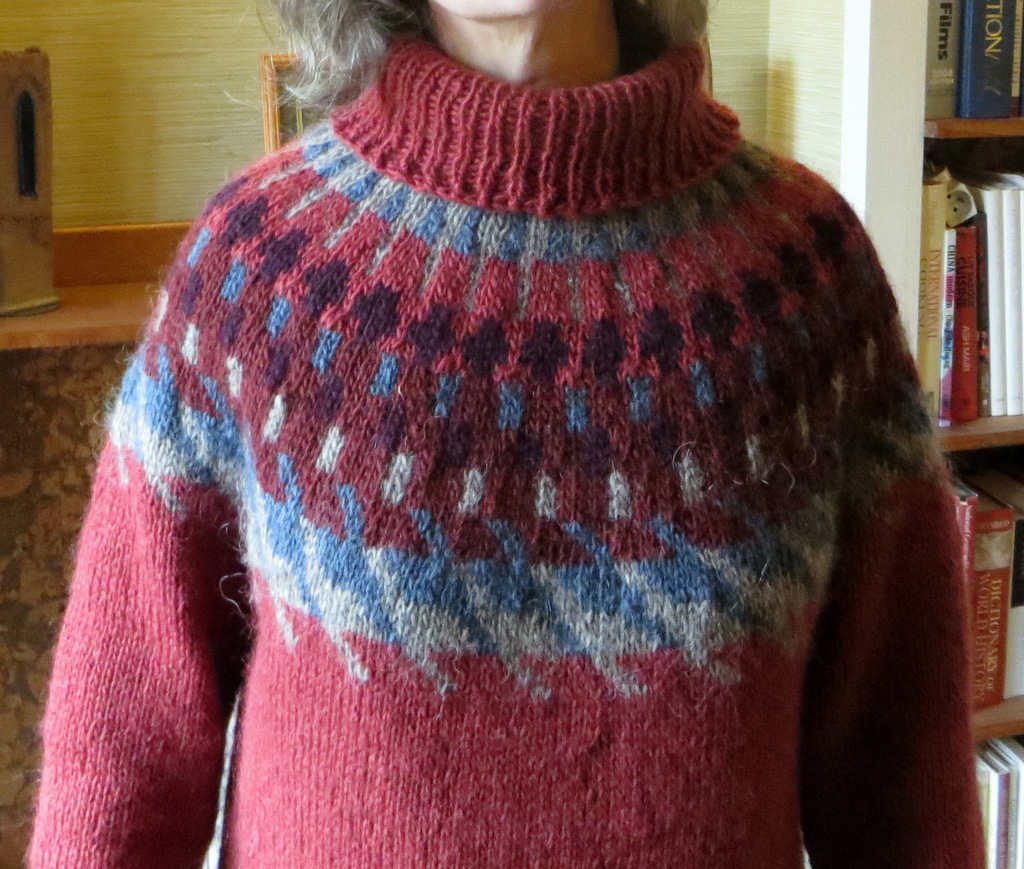
Changing the subject, my first lopapeysa! The design, called Antipodal, came from a recent book and is quite modern and atypical in some ways (including the rolled turtle neck), though the construction is traditional. You knit a big tube for the body up to the underarms, two small tubes for the arms, then join them all together into one yoke which you decrease in size, changing colours and making the patterned bit, up to the neck. So there's very little making up or sewing to do and all the fun stuff, patterning and shaping, comes near the end, so you have it to look forward to and don't lose interest. They're also fairly inexpensive and quick to make, as the wool is quite bulky, though this is made from the thinner Lopi-lite version.


In fact the yoke is really too deep, so the sleeves join too low and if I wear a jacket over it that pushes it up under the arms a fold appears under the neck. I can now see how this might be avoided, and half-considered unravelling some way back and reshaping it, but decided I'd rather just wear it as it is and go on and make another one, which I have already set about doing, though from other wool than Icelandic, which is something of a come-down since lopi wool is extraordinarily gorgeous: tough, seemingly harsh but luminous, unique and surprisingly warm and comfortable once you're inside, just like Iceland in fact. However, I can't really justify sending away for more of it while I've stacks of stashed stuff already, but then there'll be satisfying possibilities of arithmetical adjustments to allow for the different yarn. The study and perfecting of this form of knitting is much appreciated and has a large and enthusiastic following; I can vouch for how compulsive it is.


Reading up on the history of Icelandic knitting, I've learned that while wool and knitted garments have long been an important part of their culture and economy, the patterned yoke pullover is not so very old, dating from the mid-twentieth century, and they were originally called Greenlandic sweaters, not because they came from Greenland but because the patterned yoke resembled the decorative neck elements of some traditional Greenland folk costumes. 

So there you go.

Tuesday, January 26, 2016

January ticking over


I don't seem to have checked in here for a bit. An agreeable number of small, fairly constructive projects and events have been occupying me, here are one or two.

My first week or so of recording for Librivox. I've used them a lot over the last couple of years, and very much admire the aims and ethos of the project, an appreciation which has grown since actually becoming involved, it really is a work of patience and integrity. It struck to me as a worthwhile and useful outside activity to which I could commit some time and effort without in fact having to leave the house. It does demand, however, an early start - for quiet, solitude, concentration, lack of self-consciousness and free time on the big computer -  respecting external deadlines, learning some new technical stuff with the software which I find not intuitive and fairly challenging - they don't turn anyone away because of their reading skills or lack of them, but do insist on the recording quality being as good as possible and a level of self-editing with it. I also find that it's helping with the lack of focus I mentioned before; reading with a view to reading aloud demands an attention to detail and meaning, like making yourself chew small mouthfuls. I'm getting over my intense, if fairly normal, dislike of my own recorded voice, and possibly improving it a bit, trying, with care but not too much artifice, to smooth out the staccato crackle I always thought made me sound like a petulant six year old, and the occasional sliding into sloppy Estuary vowels (Hertfordshire isn't quite on the Thames estuary, it's true, but it's heading that way.).

All of which is doing me great good, and it's also rather fun.

Early morning recording session

As may be seen, my recording arrangements are rather makeshift. I very quickly realised that the flimsy cheap desktop microphone is unsatisfactory, or rather unsatisfying, since with a bit of fiddling with the software an adequate sound track can be achieved, but I find myself hankering for something better, more solid, more directed, which doesn't require balancing on a pile of books and total physical immobility other than moving one's lips, and, I admit it, which looks rather more the business. Another volunteer compared it to taking up tennis, at first you make do with your cousin's old cast-off racket, then when you start really enjoying the game you start wanting a good one of your own. So I've got a rather nice looking Samson on a little stand on order; it's cheaper than a tennis racket, honestly.

While with many of the more obscure texts one might be inclined to wonder why bother to record them and who will ever listen, I can see that that's not entirely the point, it's really more like archiving or even archaeology, a question of faithful and patient excavation and recording, in the broader sense of the word. Yet despite all the work that Librivox have put in over the last ten years (and they don't object to duplication anyway), there are plenty of interesting and delightful books still unrecorded.  So far, and it's been fairly slow going to get the hang of what I'm doing, I've recorded half a dozen Alice Meynell poems, one of a collection of Irish folk and fairly tales, collected by Yeats and Lady Wilde and others, about a smartarse atheist priest who gets his comeuppance, and I'm working on two chapters of the second book of William Morris's The Well at the World's End, of which I'm also listening to the first book. Odd to be immersing so in Victoriana, much of it so heavy, ornate, ponderous and melancholy, like some of the furniture I grew up with. Yet beyond the distracting noise of the language, Meynell's 'thees' and 'thous' and aura of religiosity, and Morris's sometimes quite impenetrable emblazoned mediaeval pastiche, sometimes some true and fresh psychological awareness or sweet originality of observation shines through. Good to be renewing my fondness for Morris too, apart from anything else, I think, despite the historical image he has sadly inherited of Rosetti's put-upon cuckold, consoling himself with beardy, romantic Utopianism and pretty curtains, he honestly liked and wanted to understand women in a spirit of real generosity, friendship and admiration.

~

Still knitting plenty, of course, amongst which my first foray into Icelandic wool, which was in fact three balls of the standard (ie pretty heavy) weight Lopi which I bought not in Iceland but Amsterdam back in September. I felted a sample of it, and went on to make a felt hat. Long ago I had a Nepalese round hat, a kind of pill box shape with a gold-yellow crown and a coloured patterned band around it, which fitted perfectly and always made me feel good. Don't know what happened to it, but I've often thought I'd like to re-create something like it. On this occasion I did not succeed.


The combination of the felting and the depth of the crown looked kind of nice off but wearing it feels like my head is being squeezed inward and upward (can't bring myself to enlarge this photo).  I made the design myself, tulips from Amsterdam, I'm fond of yellow tulips and like ochre shades but can't wear any great expanse of them. However, I have found another use for it as a receptacle for other knitting.

meta-knitting

Trouble is the tulips are upside down, I should have stuck with an abstract pattern. It would work quite well as a busker's hat for collecting money in.

I've been on a mitten-making binge too, here are a couple of mitten still lifes.


I find homes for them or keep them.

Even more totally frivolous playing about with colour, I discovered this site, where you can make those kind of colour palettes I see all the time on Pinterest and elsewhere. You simply upload a photo URL, or use one they randomy generate, to pick out colours and make a palette selection, either by clicking directly on an area of the photo or using the grid of shades which the software automatically extracts for you. Here's one from a photo I took of the lake in Reykjavik in the twilight:


and another of a Reykjavik street view, I loved having mountains at the end of the street


and another of darling Molly in the garden on a summer day, not long before she left us


People use them supposedly for decorating schemes, or quilts, or their next season's wardrobe, or whatever, but while I like to imagine knitting handsome Icelandic wool pullovers from the colours of the townscapes, I probably won't get around to it, really it's just a way of pleasantly idling a few minutes when I doubtless ought to be doing something more useful.

Like pulling the school bus out of the ditch just up the road, where it finished up on a morning of scarcely visible black ice which took everyone by surprise:


Not having access to the heavy plant required for this task, I couldn't have done this, though I did go up and offer the lady driver shelter and a cup of coffee, and to commiserate with her on her vehicle's de-roaded state, sharing with her the memory of the time when a full cement mixer truck had done the same thing and had to be left there overnight, no longer turning so presumably the concrete within must have solidified and had to be extracted by heaven knows what process. She declined the coffee as she was waiting for her boss to come and sort things out, the children having been already transferred to another bus. Indeed, a surprising number of people appeared as from nowhere, offering their help and company and curiosity, including Victor of course, next to whose patch the event occurred:


Then Ludovic from next door-but-one who works for the municipality  in some capacity with gear and tackle and some other blokes with a van and the shiny blue commune tractor arrived and the consequent confab lasted a good hour or so, by which time I, like Victor, had retired back to the house, taking photos from the upstairs window. Finally the bus was removed from the ditch and driven off, and life in the village resumed its habitual January quiet.

Which quiet I am greatly enjoying, with some worthwhile projects and agreeable home-based activities, a few other plans still untroublingly small on the horizon. The ice on the road was exceptional, the winter is generally mild and manageable. I walk often, dance sometimes, scarcely visit the garden, mull but don't mope. Sic transit January. Time to go make postcards of my sister's quilts.


Thursday, January 14, 2016

Speakers, 'phones, swifts and winders: in praise of stuff


In Jan Krul's Werel-Hatende Nootsaackelijke (On the Necessity of Other Worldliness) the poet wrote that "an overflow of treasures afflicts the heart and buries the soul in the deepest travail"... The playwright Vondel, no Calvinist, warned in similar terms that Amsterdam was "smothered and softened from such an overflow of goods [stof]"

The Embarrassment of Riches, Simon Schama.

I've been thinking about stuff. Interesting that almost the same word was used the Dutch at that time (early 17th century) with much the same sense as it is now: things you didn't need, worldly clutter, unnecessary material overload. And people had the same ambivalent relationship with it, seeking to acquire it and feeling guilty about it, or claiming to. Sometimes the guilt is about it being to one's spiritual detriment, sometimes that it will get in the way of our human relationships, or that it will soften up our collective moral fibre. It was ever thus, as the above quotes, and many more, way back to scripture and the Roman Empire at least, show; dualism may have been condemned as heresy but there has always been a tension for human beings between matter and spirit, it seems to me, with a fear that the former is the enemy of the latter.

I tend to think I'm someone who neither has, needs or wants too much stuff, but then don't we all? Yet I'm always somewhat wary when I hear tirades about the rampant materialism and consumerism the world is apparently sinking under, partly because I can't quite believe it, though I dare say it's true, that people are really so obsessively greedy and materialist and wastefully acquisitive, spending (like all the Athenians and strangers which were there) their time in nothing else, but either to tell, or to hear - or to acquire - some new thing. Also though, I often feel such tirades to be a rather knee-jerk, glib unsatisfactory reaction to our relationship with stuff. 

One of the most frequent truisms, and good money has been spent, I've heard, on studies to establish it, is that happiness is not to be found in the acquisition of goods, of the latest toy or piece of technology, but in joyful interaction with our fellow humans, and in enjoyable experiences. I'm a bit sceptical about the two things being necessarily related, but that aside, what's most of the stuff people acquire for, in fact? Communication, contact, furthering their relations with their friends and relations - indeed the problem often seems to be not that people are becoming remote and alienated from each other that they have too much unremitting connection and availability demanded of them. Otherwise, though, the stuff we acquire serves to help us enjoy the experience of music, film, reading etc, or to research and get closer to all the obscure and wonderful and fascinating things the world contains. Surely these things can be food for the soul? I know there are people who love and hoard useless trinklements, but I think mostly, as we get older anyway, that what we want is to pursue, experience and hold in the mind or the hand for a moment, our idea of beauty, whatever form that takes. I know this is the ideal, and that technology can also be used to further hatred and abuse and all things toxic and ugly, but either way, matter is no more or less than the means to the spirit. 

So I'm quite in favour of stuff I think, within reason. Among that which I personally acquired this Christmas (I order it then give the parcels to Tom to give to me at the appropriate time), was a small Bluetooth speaker - (it's only taken me about fifteen years to know what Bluetooth means)

(black object on the left)

This was in order to listen to podcasts, music and other audio from the small computer anywhere, usually while sitting on my backside making more stuff to fill the world, as can be seen. It's rather bothersome, and I'm a little embarrassed to admit it, but I find now that simply reading alone is becoming quite difficult; I grow restless and find it hard to concentrate, I need something in my hands, knitting of course, but it's not really so easy to do both. I don't know why this is, I fear too much knitting is quite literally scattering my wits (if wits can be literal, being an abstract concept...); I've grown too used to sitting and allowing my thoughts to wander. On the other hand, knitting alone, long tracts of time with just wool and my meandering, often repetitive and inconsequential, sometimes troubling, thoughts, can become heavy or just boring; improving listening is the answer, mind and hands being put to work at once.

The speaker was OK, good to be without the wires so I didn't end up tangled up in yarn and cable like a woolly-minded suicide bomber, or a knitting version of those telepathic people the Shadows put in their space ships in Babylon 5, or something, though the range isn't great. However, part of the point was for Tom and I to be able to retire to our own little bubbles of conciousness sometimes without disturbing each other, and having the speaker chuntering away didn't really serve this end. I found I could stick the cabled headphones into it, but that rather defeated the purpose, and anyway, doing so caused the speaker itself to pack up altogether, so I sent it all back and replaced it with a set of wireless headphones, which are so far so good, and a very cheap, supposedly waterproof, speaker for the odd occasion when it might be useful.

Our on-line retail haul of electronic-related stuff
In fact it seems to me that technology, rather than increasing it, is tending towards reducing the physical stuff, simplifying and minimising the volume of the hardware, aiming towards smaller and smaller units performing more and more functions, and more of these taking place directly on-line. I don't go in for very much of this myself; my 'phone is a 'phone, with an extra mobile one to be mobile, my camera is a camera, with a card which I stick in the big computer to download and edit the photos there, my e-reader is pale grey with buttons. This is because I don't care to replace things till I have to, am rather lazy about learning new operating skills till I have to, and while all these things are getting cheaper all the time too, I think I can still save more money by making do and mending and bolting on extra bits if I have to, which was how I saw the Bluetooth stuff. After all the excitement with that, as a gesture of frugality, I thought it would be a good idea to prolong the life of our fourteen year old dumbphones, which were needing to be kept almost continually on charge, so that I frequently forgot to take mine out with me, by getting them new batteries. Unfortunately, while the batteries were apparently unused, with their stickers still in place, I imagine they may be nearly as old as the mobiles, and don't seem to hold the charge much better than the old ones. Never mind, they cost little, and it puts off decisions about replacement a little longer. 

In fact I am wilfully reluctant about phones, or about vocal telephonic interaction anyway, as I may have said before, though I know a smartphone would allow me to avoid it by being able to text and e-mail anywhere, as well as other benefits. It turns out the main use of the wireless speaker is to use it in conjunction with one's 'phone, so one needn't can't under any pretext curtail a 'phone conversation. Awful idea, a kind of telephonic Sartrian huit clos, IMO. 

Or else people use them for Skype. 

'Skype's marvellous!', asserts my 80+ year old friend J, 'I can be on it with so-and-so for an hour, it's free, and you can see the person!'.

'I'm sure,' I reply 'but I don't want anything to do with it'. 

I've been dragged into Skype conversations with her family, I feel horribly trapped, self-conscious, intruding and intruded on, and everyone looks weird. I'm sure it's just me, and I'd probably get used to it if I had to. Most of the people I know who really love it are grandmothers. Pace Skype users, I know you're the normal sensible ones and I'm not.

~

Stuff, of course also has the old sense of fabric, cloth, which I suppose has always been one of the ways in which conspicuous consumption could manifest itself. I like stuff like that, too; though I really don't trouble with or spend much on clothes per se, I certainly accumulate more than I can ever use of the stuff that makes stuff. Some of this comes in skeins (or hanks, maybe there's a Brit/US divergence there), which are lovely and solid and feel like something very ancient in their design. Problem is you can't knit from wool in the skein, so it needs to be wound. Tom has always been very good about taking on the traditional tamed man's role of holding and moving the skein for me to wind, but he's not always available, and also, hand wound balls are round, the wool being pulled from the outside, so they bounce around and get dirty, and are a nuisance, even if you don't have a kitten around to do the archetypal kitten thing.

So, I treated myself to a swift and a winder.


The swift is the thing you stretch the wool onto, which takes the place of Tom. This one is an Amish design, very simple with just a stand, arms and moveable pegs, but remarkably smooth and fast in its action, and I do believe a thing of beauty.


The winder, well it winds. But it does it in such a way that instead of a bouncy round ball you have a delightful little cylindrical cake of wool, which remains stable while you draw the thread from the centre. This is formed in such a way that the wool is layered in a kind of honeycomb construction:


Boxing Day afternoon was spent in a blissful whirl, swift and winder spinning in hypnotic wise, winter sun through the window, colour and feel of yarn through my fingers. It took me back to childhood Christmases, when one had toys and things to make things with to set up and play with and put to work; till one put away childish things and only had books and records and such like, things where the interaction was, if not more passive, more within the mind. I had forgotten the pleasure. 


Sadly, I very quickly wound up most of the yarn I have in skeins, even resorting to turning the tapestry wool into tiny cakes, and have no more to play with. It's tempting to go out and buy more, or go internet shopping for it, just for the fun of winding it, but I'll have to knit some up to make room for it first. 

Enough's enough when it comes to stuff.


Turn it off and KNIT something!:
'Turn it off and KNIT something!'

~