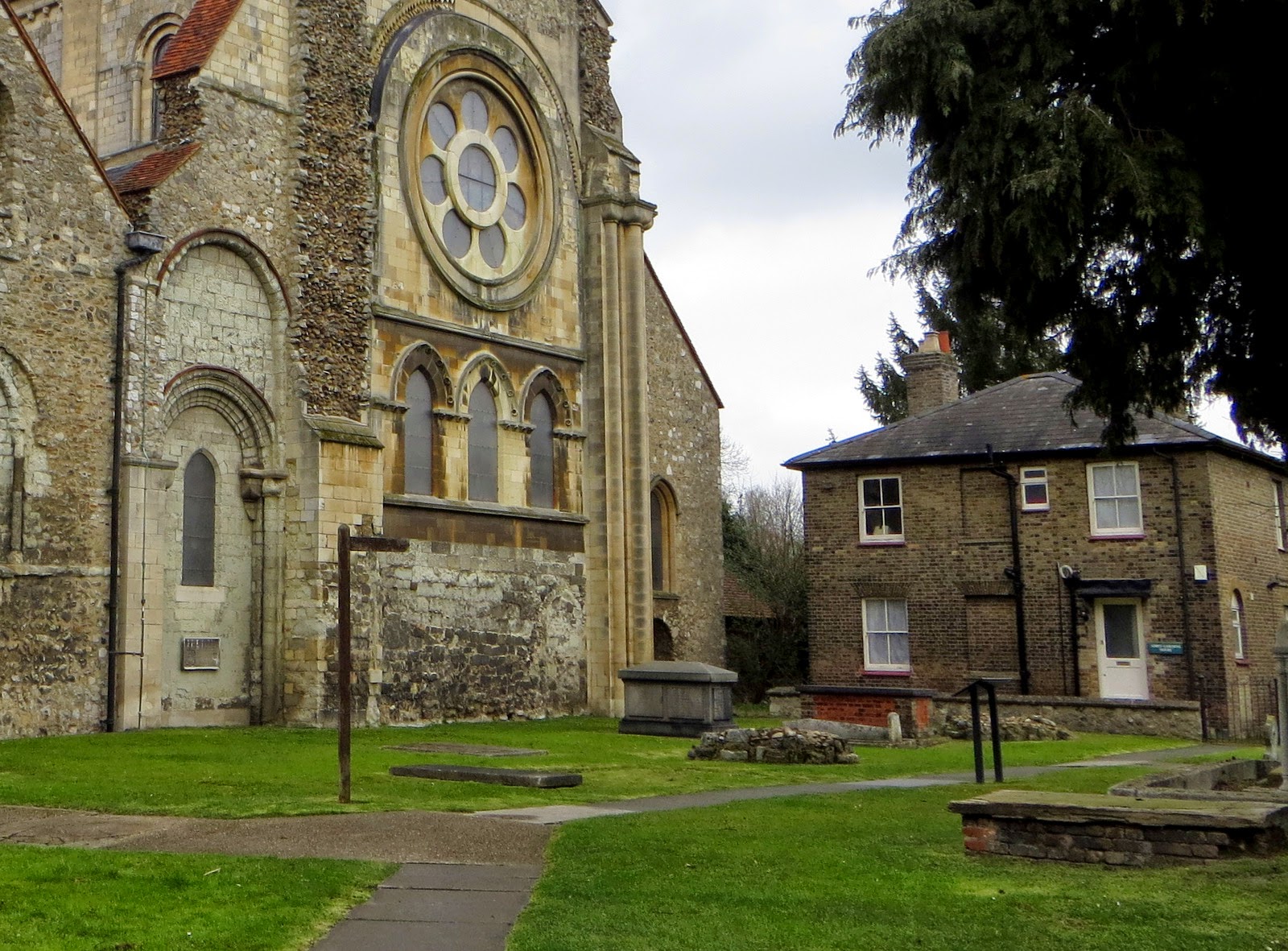
Waltham Abbey is the name of the town, its church is
Waltham Abbey church. The town isn't on a main railway, we had to get a train to nearby Waltham Cross, which reputedly has an
Eleanor Cross (and looks quite a pleasant place in the Wiki photo), but we didn't see it, only the rather unlovely bit of 60s town planning round the train and bus station. The latter was closed for works, so we had to walk rather further in the rain and with Tom's still bad foot than we would have liked, but when the bus came the kindly driver made a special stop for us, unasked, right in front of the church (wonders are worked when one carries a proper orthopaedic walking stick), and when we arrived in Waltham Abbey proper, despite its being Good Friday and a public holiday, and rather rainy, we found it a lively, interesting and welcoming place.
A cheery little ecumenical procession carrying a big wooden cross, featuring various card-carrying and badge-wearing Christian denominations but also a number of friendly dogs, arrived in the church grounds at the same time, we said hello to the dogs and hastened away inside. A service was due to start in an hour, we were told, but we were welcome to look around in the meantime. The board outside the church said, in effect, that whatever brings you here, whether faith and worship or just curiosity and an interest in history, the place belongs to everyone and everyone is welcome.
The church is known for its music, Thomas Tallis was the music master here at the time of the Dissolution of the Monasteries. The choir was practising various pieces, which made a good background, but there were plenty of people like us poking about, taking photos, chatting quietly in corners.

Indeed, there is more history in this pleasant but work-a-day Essex town and its church than you can shake a stick at, way back to early Saxon times. There are traces of burials and other things from the 6th century, then Offa (the one with the Dyke) built the first stone buildings over an older wooden one, then one of King Canute's (the one who didn't hold back the waves) thanes held sway over the area and further built up the church to enshrine a socking great miraculous cross he'd found in Somerset, and which his oxen insisted needed to be installed here. King Harold (the one with the arrow in his eye who lost at Hastings) was given it by Edward the confessor, and is fairly conclusively considered to be buried there, though the Waltham Abbeyites seem to have missed a trick; no digging up of bones, grand funereal traipsing round the town, all-day television coverage, primates of the church and minor royalty and descendants shipped in from Australia etc for poor old Harold as yet, though he has got this rather nice statue in an apse outside:

Henry II (the one who was married to Katherine Hepburn Eleanor of Aquitaine) built it up yet again while still flagellating himself for having Thomas Becket done in. It was huge, the present building and grounds are just a little stump of what it was
at the time when Henry VIII came along and dissolved it as an abbey foundation, and knocked a lot of it down again, so Thomas Tallis and many others had to seek new employment - they were mostly pensioned off quite reasonably, Tallis went to Canterbury - and the miraculous cross miraculously disappeared. The stones were used to build a grand big house for some of H8's friends, which is no more now than some ruined walls.
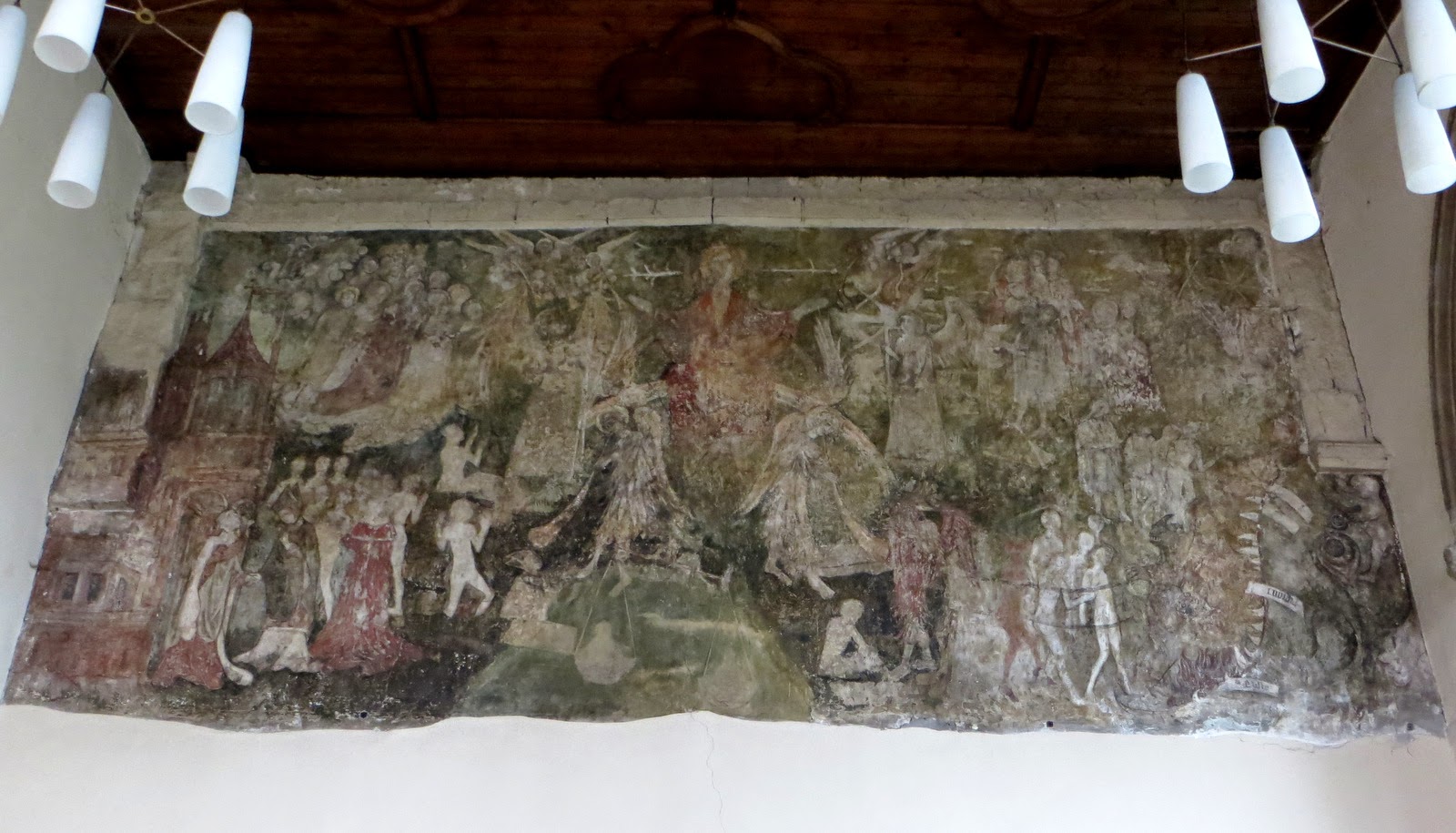
But it's still substantial, and full of fine things. There is 15th century
doom painting in the light and airy lady chapel,
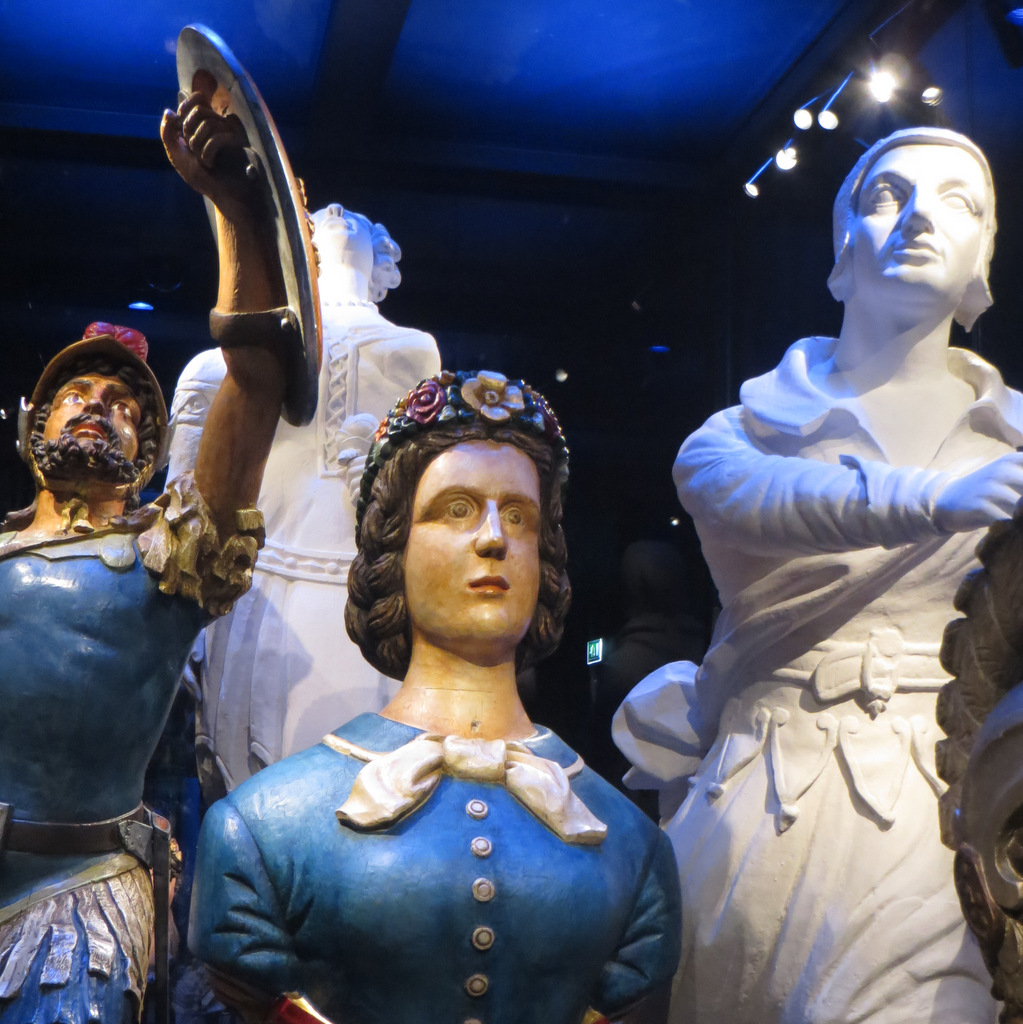
two creatures (perhaps called the Waltham imps, I thought, though I can no longer find a record of this) leer down at you from somewhere in the Middle Ages
and grand old Tudor families lounge around on grand old tombs,
A 17th century merchant is buried here, too, with these rather beautifully rendered alabaster graven images of the stuff of his trade:
and in the 19th century, the Arts and Crafts mediaevalists, specifically
William Burges, were given a free rein and went to town, with angels,
Burne-Jones stained glass
and a long painted ceiling featuring the signs of the zodiac:
I picked out Sagittarius for me,
Virgo for Tom (she looks a bit dour)
and Leo just because he's such a whimsical, story-book Victorian lion:
Pevsner, with typical mid-20th century snootiness, turns his nose up at Burges in general and his work here in particular, as 'robust ugliness'. But having spent much of my younger adulthood in South Wales, with visits to Castell Coch and Cardiff castle, and one or two of his domestic projects often pointed out on familiar routes, I've always retained an affection for his liveliness and colour and observant, typological, love of the natural world. And whether one cares to scoff or embrace, it did rather please me to see imagery not specifically Christian cheerfully embellishing a church.
Outside there are extensive grounds, with memorial plaques for people of the town with names that sound to hail from all corners of the world, as well as Mrs So-and-so, landlady of the Compasses, and water gardens, and the ruins of the house.
(The finger post in the above photo points to Harold's grave, but there wasn't much to see).
All the knocking down and building up again has led to a motley and patchwork effect of different stonework and materials, in the walls of the church itself, and more recently the landscaping of the water gardens,
and all kinds of faces look out at you:
We crossed the into the town proper, where plenty of places were open, public holiday notwithstanding, including a colourful, fragrant and diversely stocked Wiccan shop directly opposite the church, run by a lovely friendly couple, he hirsute, she with heavily kohl-darkened eyes, who chatted animatedly about their love of bee-keeping, archery and blacksmithing, and where we bought incense and a door-sign for my sister with a picture of a dragon and the words 'Please do not disturb, I am living happily ever after' (we passed on the black candles in the shape of naked people).
There were plenty of old-fashioned pubs, I do miss pub-signs, I realise:
and there was a the celebrated
Tony's Pie and Mash Shop, where I was brave enough to try stewed eels, which were kind-of OK but I wouldn't really recommend them on the same plate as the meat pie, however traditional it is, and a nice coffee and cake shop with coffee-and-walnut cake and more friendly people.
A good day out in a surprisingly rich and diverse place.
~
And now I must go and pack for another jaunt, a couple of days in Paris for our wedding anniversary. It may seem, it does to me, that our life consists of flitting from one pleasure trip to another, but it seems important to do these things now while we can, for who knows what the future holds?