Thursday, August 09, 2007

" Not the yellow Provençal August...

... of the English imagination." ( Iris Murdoch, again, from 'The Sea, the Sea'.)


I never much cared for August. A rank, flyblown time of year, the stale fag-end of summer grudgingly conceded to us by British school holidays, while over the Channel and the Atlantic, we knew, they played and basked all through July as well. The roads crowded, the service tired and jaded, ice cream sticky in the sand. High summer, in the sense that things are high when they start to smell. Sticky and dusty, by turns hot and dry and thunderous and torrential, and sometimes miserably, disappointingly cold, the sea shiverous. Never comfortable.


Yellow like ragwort, that sneaky plant that lures unfortunate animals with its persistent juiciness when other greenstuff dries out, then mercilessly poisons their livers.

I believe there is a kind of fractal pattern in the year and the day. Just as there is an Hour of the Wolf, that time of wakefulness in the stretches after midnight and before dawn when all one's fears and demons seem to have been lying in wait ready to prey and torment and pursue and do their worst, and one longs for light and morning for relief, so, a half-turn around the twenty-four hours, there is a corresponding Dog Hour, that mid-afternoon low point, not dark and menacing like the Wolfish time, but sluggish, apathetic, dull of sense, filled with a mood of pointlessness, and, for me, though it can be shaken and evaded by action and detachment, only really turned at that time of the evening when the working day is officially put away, the dog is fed, the wine is poured, the kitchen comes to life and all is wrapped in animated cosiness.

Similarly, there is that lean and Lenten time early in the year, in February or March, when the days lengthen but the cold and harshness seem to bite just that bit harder, when, even in these well-fed, centrally heated ( for some of you!) times, one feels the fear that one's reserves, the spiritual woodpile, may just not last, that the Wolf, who is hungry too, may really, at some deep ancestral level, be at the door. And, of course, the 180 degree point around the circle from then is now, the Dog Days, la canicule, caniculares dies. The time when summer is tired and grouchy, the nights perceptibly draw in, things lose their sharpness and savour, and I think of fires and the scent of chrysanthemums.

August used to make me long for autumn.

Now, though, I'm coming round to August, its baked-goldenness, and brightly peppered weedy wayside flowers. It helped when I discovered it was autumn. That is to say, Celtic autumn, the harvest and gathering season. Not Fall, not the colourful, smokey, nut-filled, first-frosts time, but Lughnasadh, Lammastide.

The Celtic seasons have an offset rhythm with regard to the traditional ones, and can seem rather unsettlingly previous in their expectations. Early February, Imbolc, Candlemas, (Groundhog Day even...), is surely too early to call spring, yet there is that sense of shift, of turning, of hesitant awakening. And it never seemed quite right that Midsummer Day, solstice, the longest day, was also the first day of summer, when from then on the days would shorten. But if one thinks of summer not as the full, hot, lazy time, but the time of growing light and full blooming, it makes far more sense to begin it at Beltane, May Day.

The descent into winter and darkness takes place from Samhain, Halloween, when the veil between the worlds is thin.


This year too, I appreciate especially the last heats of August however patchy and moody, which, after the non-summer in this part of the world, are less of a last gasp and more of a gracious bonus. And I always enjoy September, now it no longer means returning to school, at least personally - my current teaching resumes in October. It is Tom's birthday month, and we usually get away somewhere; most things are still open but the holiday places are usually more relaxed, more empty, heaving a sigh of collective relief, and the weather is often delightful, but with just a tang of sharpness, one's perceptions stirring with the earth's changes.

We have had the camera for about a year now, I realise, as the first pictures I took were of fields of wheat and barley, round bales of straw and gatekeeper butterflies on knapweed. It seemed frustratingly difficult at first, but some of them weren't too bad. I felt a little sad thinking that now I had covered all the seasons, as I had looked forward to new things to photograph with the changing year. But of course there will always be new things... and always the same ones.


Monday, August 06, 2007

Saturday, August 04, 2007

La Roche Jagu

A longer trip was to drive up the peninsular on the other, western, side of St Brieuc, to visit the marvellous chateau de la Roche Jagu. Being somewhat averse to taking long view shots of picturesque locations and historic buildings, thinking that better are to be found on postcards and in guides, and fearing to expose my photographic shortcomings, I didn't actually take any pictures of the chateau itself, but some very good views of it may be found on the above link.

It's justifiably held up as a jewel in the sight-seeing crown of Côtes-d'Armor; the building is imposing, the exhibitions held inside, a different one every year, from archaeology to lighthouses to contemporary costarmorican artists (this year's) are of high quality and often fascinating, and best of all are the gardens and grounds, which are entirely free to enter. There are miles of excellent waymarked walks of all kinds; we follow the rough blue ceramic globes which take you on the water walk.


The chateau stands high on the steep banks of the Trieux estuary, and overlooks a tributary valley. The water that runs abundantly through its landscape has been captured and channelled and shaped and played with and adorned.

We drop down to the bottom of the stream valley, to where it joins the estuary at a small landing beach, and admire the metal sculptures which surround it.

We are being watched. Where the spring emerges from the mossy, green moist wall, it has been appropriated; a pale, melancholy blue-clad madonna looks, solitary, from her cage. Why the bars? Could she be seen as vulnerable, a target for thieves or iconoclasts in this relatively religiously traditional, counter-revolutionary region? She doesn't look so old. Or is it, in truth, to contain and confine her, in case she transmutes, shakes off her assumed identity, morphs back into the nature spirit that was the original guardian of the spring?

In newer, less fearful times, we have put real and frightening nature to flight. We court and desire nature spirits and their wildness, or think we do. Romantic and creative souls can play with and represent them freely. On the opposite, more shaded bank of the stream valley, as we make our way up, we become aware of these old, shamanic faces, fountaining or dribbling or weeping water from their mouths and eyes,

their chins and noses damp and mossy,

their jowls sprouting weeds and ivy growth,

and occasionally, a small offering, like the winkleshell above, placed a crevice of their features. Endearing and wistful, synthetic and emasculated, this modern paganism, in an age of cars and digital cameras, supermarkets and subsidies and nitrates in the water.

We move up the course of the stream, round the wall with its rivulets of water running down it, into the Crusaders' Garden, made from the site of an old quarry, sheltered and sunny, its planting inspired by the species that would have been encountered and perhaps brought back by returning crusaders from the chateau's earliest days. Despite this rather belligerent theme, it is one of the most cheerful, peaceful spots I know, and I always look forward to reaching it with a sense of gentle joy, and usually pull off shoes, and socks if I'm wearing them, and dip my feet in its pools and runnels.

We continue our progress upstream, it runs over a metal convex cascade like a tyreless wheel rim,


into a series of small paved circular pools. The impulse to throw coins into such clear pools is perhaps, I feel, a more genuine and uncontrived survival of a pagan custom, something atavistic and unconscious.


Further on and further up, to the wooded head of the valley. A satiny sheen of duckweed spied through a living trellis of willow fence.


Duckweed abounds here; one of the first times Molly came she got very excited about everything and tried to walk on its apparently solid surface on a small pool, and became temporarily a green dog. Happily, it was a warm day. and the stuff seemed to miraculously all rub off her on the grass after a few good rollings around. She's a little calmer these days.

Suddenly, it appears to rain gently and inexplicably onto a small area of one of these pools; we search for the source of this phenomenon. It is a sprinkler in a high branch of a chestnut tree, the hose feeding it and the pump driving it almost completely concealed. There are several of these odd features in the grounds, timed in some way to go off irregularly, their existence not immediately evident until one is surprised by them.


We double back on ourselves, and emerge back along the drive approaching the chateau. A year or two ago, a fine avenue of beech trees had to be felled because of disease, and a young sculptor (sculptress? is this acceptable still?) was commisioned to make something of the sections of hollow trunk. These ring-shaped forms are simple but beautiful, and much of their attraction is in their positioning, so that one can look through them at different vignettes of the chateau and grounds, or play peek-a-boo through the openings,

or admire the delicacy of the galled and blackened interiors, the scars of previous lopping or falling of branches,
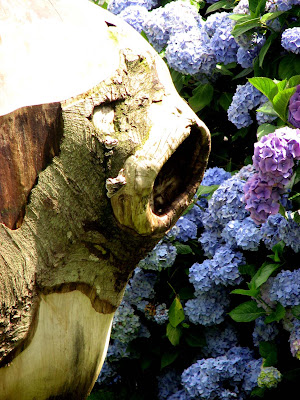
or the strata exposed as the artist's chainsaw scooped through the layers of wood and bark.
At the end of our walk, the weather began to deteriorate, which was well-timed. We stopped for an ice-cream at the bar-restaurant's canopied terrace, a welcome rarity. Places of refreshment at heritage and other sites are surprisingly unusual here, and ice cream vans at beauty spots haven't really been invented. Like all such things, this is a two-sided issue; missing such little pleasures being offset against a rather pleasing lack of interest in consumption, competition and commercialism. By then it was cool enough for Mol to settle down in the car, and we went into the chateau.
The exhibition particularly concentrated on local artists working on natural themes. It was good; the austere, high ceilinged rooms lend themselves well as exhibition space. One of the most beguiling artists was a sculptor/sculptress, Corinne Cuenot ( I think... can't find much about her), whose two displayed works were comprised of what must have been miles and miles of fine metal wire, intricately twisted into what looked like leafy patterned lace. They were immediately pleasing, but better still on closer study, when they began to reveal faces, figures, animals and birds, a whole crowd of beings concealing themselves in a wire forest.
Another delightful element, which there never seems to be time to fully enjoy, is a good sized turret room with comfortable furniture, sofas, chairs, textile hangings, all richly coloured, and tables and shelves laden with beautiful books about the theme of the exhibition, local interest etc, where you are quite free to cosy down and spend as much time as you wish. I found some fascinating books on Nils Udo, and other land art, which I could happily have browsed in for hours.
But even without the exhibition, it's worth paying the 4 euros entrance just to climb the spiral stircases to the top of the building, exploring the galleries and smaller chambers on the way, all dramatically lit,
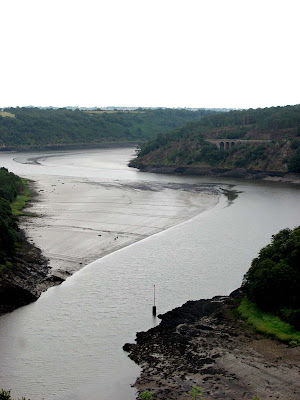
and to look down the preciptous walls and banks to the mudflats of the widening Trieux river, across to the viaduct where the steam train makes its way up the peninsular between Pontrieux and Paimpol.

And finally, to gape with wonder at the roof space, all completely renovated and new within the last 20 years, but all completely authentic, from the great adzed timber principles, purlins and rafters, to the thick, uneven tawny coloured slates. We love roofs!


( Thanks to Tom, aficionado of roof timbers, who grabbed the camera off me when we drew near to the top floor, for the last picture. Unfortunately, the dramatic lighting didn't make for very successful photographs, and horrible flash destroys all the form!)

Wednesday, August 01, 2007

Compasses 21 to 25

The sonnets nos. 21 to 25 from Joe Hyam's 'Handbook for Explorers' cycle are now posted over at Compasses, with photographs.

A stubborn bit of line spacing in no. 24 refuses to come right, please forgive this presentational flaw! Many thanks to Joe and readers, as ever.

Thursday, July 26, 2007

A painted church for summer


After our walk on the beach at Jospinet we stopped off at the little church at Morieux - opposite which is a bar with an outside terrace where in the season you can also eat moules frites, with cream added to the poaching liquor and really good frites made from real potoatoes with the skin left on, though this time it was late and we didn't stop to eat.

I wondered whether to post about this church in another post, alongside my other favourite little painted church which is inland at Langast, because they seem to me to be to be filled with summer and winter respectively. Instead I shall post about the Langast one another time, in it's own season, and show you Morieux now.

The church and its frescos date from the 12th century up to the 17th. I don't know exactly which are the oldest of the paintings, though in some the draperies and features depicted are more elaborate and realistic, and the linework is finer, clearly later work. These photographed less well than the bolder, simpler pictures with their blocks of colour. They were almost all whitewashed over from about 18th century, which of course preserved them, and restored during the last century.


It looks at its best in the light from these main, west-facing doors, which opens out towards the sea and the green fields between, on a summer afternoon. Today they are closed, perhaps because the frescos are fragile and sensitive to light ( flash photography is forbidden ) and we enter by a smaller side door.

It is a smiling, sunny place, the earth pigments on the walls retain strong russet and gold hues, and between the storytelling pictures and in the window recesses are dolly mixture florals, lazy daisies and polka dots,


and bold geometrics that look like Turkish kelims.

The barrel vaulted ceiling is limed wood, elegant and graphic,


and the thick, roughly sculpted walls and the ochres and limewash and the light falling on it give a much more southerly, Mediterranean feeling to the place.


The paintings themselves, while illustrating the standard mediaeval Christian staples of death in general and martyrdom in particular, also elicit smiles, and feature many smiling faces.
See how the virgin saint ( who? I don't know, Saint Foy perhaps, this could have been on a remote capillary of the Camino... I'll find out sometime), seraphically undergoes her very gruesome end,


while these characters (below) have perhaps better reason to be jolly. This fresco shows the celebrated resurrection from the dead by St Nicholas of the poor little Pickled, or Salty, Boys. This episode in the saint's life is one reason why he became the patron saint of children ( the other being that he saved three young girls without dowries from being sold into prostitution by their father... a far cry from the sanitised version of dear old Santa Claus as we now know him, and indeed of childhood generally,) and forms part of Benjamin Britten's 'St Nicholas' (the link is to Amazon where you can listen to a bit of it):
'See! Three boys spring back to life
Who, slaughtered by the butcher's knife
lay salted down!
And, entering hand in hand they stand and sing
"Alleluia" to their king!'
My sister was especially pleased with this one, as she has a friend who is fond of that particular work by Britten, and it has become a refrain between them on Christmas cards to ask 'Got any pickled boys in this year?'

The dead seen below rising from their graves on the Day of Judgement are as merry as jack-in-the-boxes or singing telegrams, as indeed perhaps they should be.

This angel's long bumble-bee striped nightgown ( again, the exact story being illustrated eludes me)

and the cartoonish toes of this Grim Reaper - or Ankou, as he is known hereabouts -

cannot fail to raise a smile. But perhaps the prize for the most rumbustiously gleeful depiction of something frightful must go to that of the Mouth of Hell, yawning wide to yield up the previously damned souls in the triumph of The Harrowing, the Devil small, puny and weaponless in the wings.

It is perhaps glib and facetious to laugh at these works, when one cannot really comprehend, at this distance, the workings of the minds that executed or beheld them. But it does not seem fanciful to perceive in them a strong current of robust joy, an energy and vitality and humour which is not lost in translation from then to now. They seem to me 'a beakerful of the warm south' in these wet, windy northwesterly fringes, and a glowing treasure still to be relished.

Monday, July 23, 2007

Being almost totally shellfish


My dear first sister has been ceremoniously handed over to my brother and sister-in-law, who live in Mayenne. While she is here, she causes me to talk out my substance and to get out more, neither of which are any bad thing, and when she's gone there's plenty of unprocessed stuff on the camera to be sifted and sorted. She always goes away with a pleasant collection of goodies, or 'preciouses', as she refers to them in a Gollum voice: this time they included a rather enviable compact digital camera (her first), a pair of Kickers sandals in green with pretty appliqué leather detail (shoe shop sale in St Brieuc), a piece of striped silk from Emmaus's Big Bastille Day Special Sale (patchwork for the making of), a woven grass shopping basket with leather handles in shades of green and purple from Lamballe market, and a large pack of good quality white card from Noz (probably the best discount shop-cum-rummage sale in the world, on a good day, serendipity rules...). Plus a chunk of our DVD and book collection which she always exchanges with a similar sized chunk from her own.
So I shall try to post a few items on the places we went.


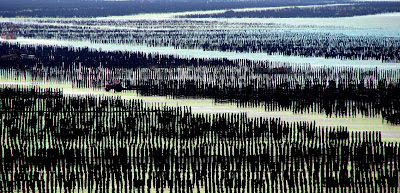
The mussels consumed every year on this coast must be numbered in millions, and most of them are very local. At La Moulerie de la Baie at Jospinet, they are brought in from just a few hundred metres away, from the great serried ranks of bouchots on which they are cultivated.


The posts with their spiralling ropes encrusted with the delicious blue-black bivalves are harvested every low tide by special tractors and amphibious vehicles.


They stand out from the lapping waters like strange, patient beings waiting in line for something, or perhaps in mourning...

... or a little like those mysterious, ancient and inexplicable wood-henges that have been discovered on other shorelines.


As the tide recedes, people, with dogs or horses, or armed with rakes and forks and spades and buckets, quickly chase the retreating waters, to forage, or just to play. It seems irresistible.


We forage with cameras only, on the rocks and in the rockpools,


where the oysters, which I have no desire to bash off the rocks with a big hammer, have taken up residence in abundance.

Shells on shells, worlds within worlds...


... preciouses galore.